
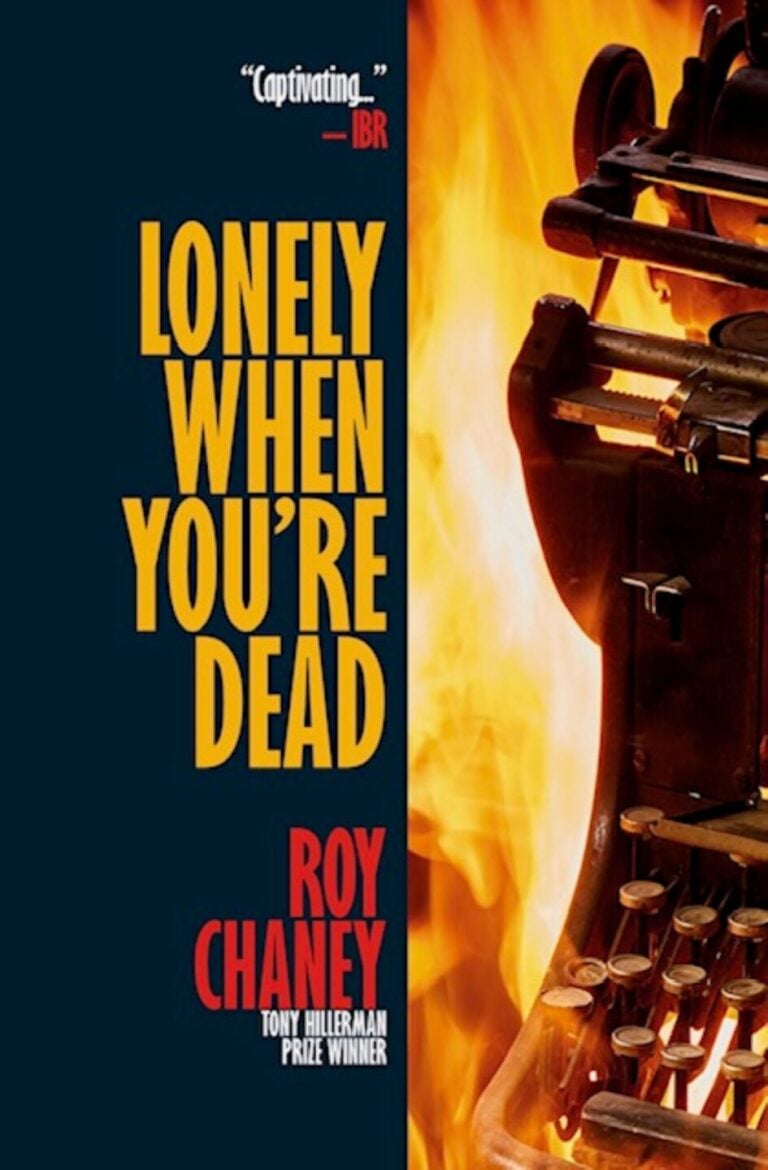
 LONELY WHEN YOU’RE DEAD received a 4+ star review, making it an IndieReader Approved title.
Following find an interview with author Roy Chaney:
What is the name of the book and when was it published?
Lonely When You’re Dead is the title of the new book. It was published in June 2026.
What’s the book’s first line?
“Jesus wept.”
What’s the book about? Give us the “pitch”.
Claude Murphy was lucky. He’d broken into the freelance writing market with a splash. But his luck is changing. Covering a poetry festival in Quebec, Canada in 1996, he discovers a dark trail of intrigue and murder. Murphy finds himself walking a tightrope between unsavory poets, motorcycle gangs, Quebecois separatists fighting for an independent French Canada, and a vast assemblage of Canadian police and military forces who are called into action as the threat of an insurrection rocks Quebec City. By the time Murphy arrives at the dark heart of the poetry festival, he isn’t sure he’ll get the story written. Murphy’s not even sure he can save his skin.
What inspired you to write the book? A particular person? An event?
Being in Quebec Province, Canada on several occasions in 1995 and 1996, when the Quebecois were actively considering the possibility of a sovereign Quebec, was certainly a central stimulus. It was a heady time, for both sides of the question.
What’s the main reason someone should really read this book?
Because it’s a good read. But don’t take my word for it. For starters, Lonely When You’re Dead has been described thusly: “A darkly lyrical crime thriller with a riveting plot that constantly challenges reader expectations”—Kirkus Reviews. “A deeply original tale… (Chaney) produces a ripping plot-line pitting poets, drug dealers, and rival motorcycle clubs into a solid and enjoyable thriller”—Independent Book Review. “Weird, sharp, and surprisingly thoughtful.”—Literary Titan. “Intoxicatingly refreshing”—IndieReader. “A compelling narrative.”—Readers’ Favorite.
What’s the most distinctive thing about the main character? Who—real or fictional—would you say the character reminds you of?
The most distinctive thing about the main character, an aspiring freelance writer, might be his determination to get the story he sees in front of him and report on it, even as the circumstances become increasingly dangerous to him. He has pluck.
When did you first decide to become an author?
I don’t recall deciding that I wanted to become an author. Things evolved. I started out as a journalist for the US Army many years ago. It was an interesting job. I went to college and earned a couple of degrees in English. I started tinkering with fiction writing, as an offshoot of my academic studies. Now, years later, here I am. Still tinkering.
Is this the first book you’ve written?
No, it isn’t. My first novel, The Ragged End of Nowhere, received the 2008 Tony Hillerman Prize. It was published by St. Martin’s/Minotaur in 2009. I’m also the author of Seven Times Dead (2016), and Flip Your Wig (2022).
What do you do for work when you’re not writing?
I’m retired, which is quite pleasant. During my years of employment I worked as a journalist in the US Army, as an investigator for the federal government, and as a federal auditor. Among other benefits, these jobs gave me insights into the kinds of mischief some people are happy to get into, when they think no one is looking.
How much time do you generally spend on your writing?
When I’m writing, I usually put in three or four hours a day, in the afternoon. I don’t write every day though. Sometimes I don’t write every week.
What’s a great piece of advice that you can share with fellow indie authors?
The usual advice: Don’t quit your day job. I’ve always found that I write better when the bills are paid and there’s food in the refrigerator. But that’s me.
Is there something in particular that motivates you (fame? fortune?)
I think at this point in my life writing is just a natural activity. Some people keep journals, some people blog, and some of us write fiction, or non-fiction. I suppose these are all ways to keep the world in proper order by writing about it.
Which writer, living or dead, do you most admire?
There are a great many writers that I admire, for a variety of reasons, but I don’t think there is one that stands above the others. I get jazzed easily, so maybe the author that I most admire is whoever wrote the last book I thoroughly enjoyed (Charles McCain’s An Honorable German, as it happens). I try to learn what I can from any good writer, and any bad writer.
Which book do you wish you could have written?
The one that got away.