
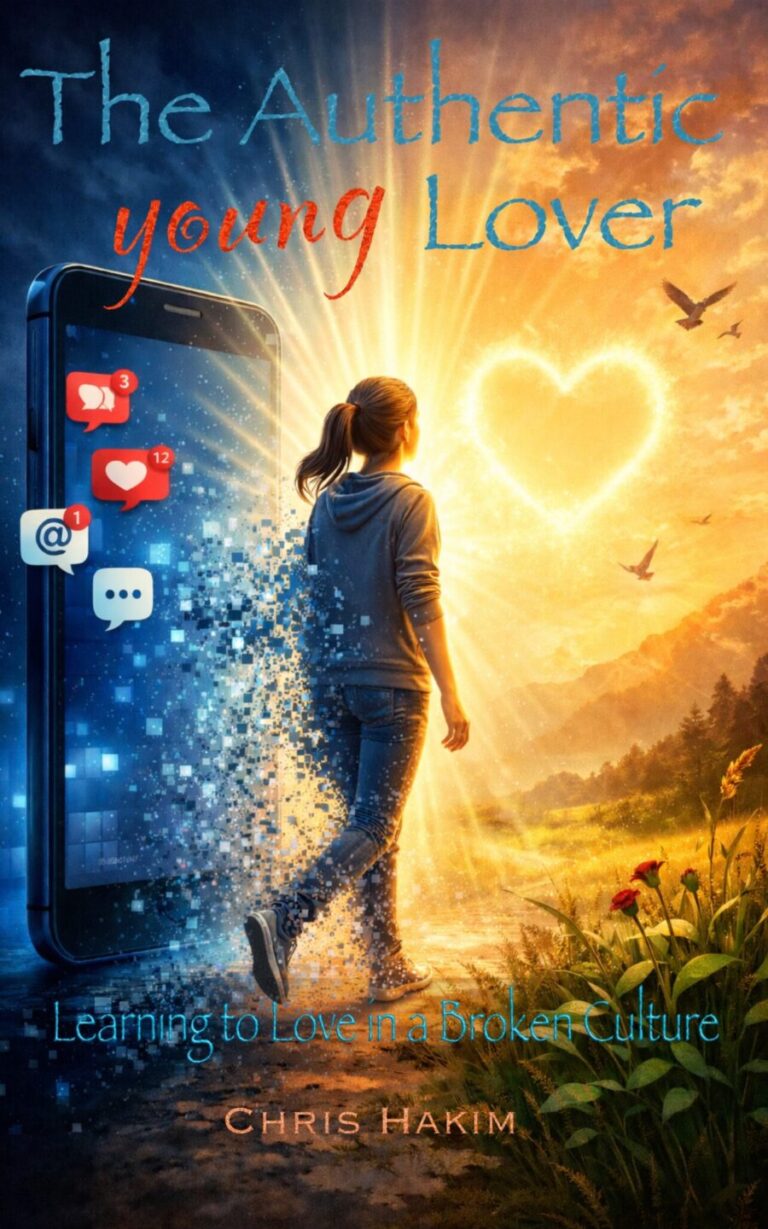
THE AUTHENTIC YOUNG LOVER: Learning to Love in a Broken Culture
Winner of the 2026 IndieReader Discovery Awards in Sexuality/Relationships, Nonfiction
What’s the book’s first line?
“‘As for sex, each generation thinks it invented sex; each generation is totally mistaken.’ — Robert Heinlein
The idea behind the quote is that it is inefficient to try and navigate sex without serious guidance, such as culture or the accumulated wisdom of generations past.”
What’s the book about? Give us the “pitch”.
This is an adaptation for young people (18-24) of a more complex work, The Authentic Lover. The original work has dense philosophical implications, whereas nowadays people want quick answers. Very few quick answers also are genuinely helpful in our lives. So it is a kind of compromise, and if people want more depth they are welcome to read the original as well. The Authentic Young Lover is a gateway to harder stuff.
What inspired you to write the book? A particular person? An event?
The original inspiration was to write the first book (The Authentic Lover), the result of a lifelong pursuit of authenticity. Now my son is in college and I hear many stories of hookups etc. It is all very sad and pointless. Clearly young people need guidance far beyond the mainstay sex ed, which doesn’t really speak to their experience. The Authentic Young Lover attempts to fill that gap.
What’s the main reason someone should really read this book?
If you’re a youngster and find the dating scene confusing and unfulfilling, you should read it. It is as simple as that. But if you’re the kind who asks a lot of questions and is prepared to read a long, sustained argument, maybe you should move to the grown-up book right away.
When did you first decide to become an author?
I didn’t! Each book I wrote because I felt compelled to write it, starting with a book on traditional Chinese medicine ages ago. I had met an exceptional Chinese doctor in Shanghai and felt her voice should be heard. It went on from there, one book every ten years.
Is this the first book that you’ve written?
No, although this project has been brewing for a long time, clocking four decades now. I took my time.
What do you do for work when you’re not writing?
I used to work as an electronics engineer, but no longer. Now I meditate and help my local meditation center, a lively good community.
How much time do you generally spend on your writing?
Very little. The important part is not the writing, it is having something to say. Most of the time I read, research, think, and live.
What’s the best and the hardest part of being an indie?
Publishers nowadays expect authors to market their own books. What lazy bums! Writing and marketing are completely different activities. Introverts don’t do very well as indie authors, and for the same reason don’t get in the door of conventional publishers. This has the perverse effect of distorting the book marketplace where the most bombastic are seen. I can think of a good many great past authors who today would be completely ignored.
If you ask what the best part is, going indie is neither good nor bad. Traditional publishers have abdicated their traditional role as guarantors of quality, so whether they exist or not is immaterial. Book typesetting made by large publishers isn’t even that great. I do my own, thank you very much.
What’s a great piece of advice that you can share with fellow indie authors?
It is less hassle if you have a publisher, but looking for a publisher in itself probably isn’t worth the hassle. You may try and find some niche independent press that really cares about quality and is interested in what you have to say. Those are rare, but they exist. At any rate, hoping to make money from writing books seems rather a gamble. Meanwhile, polish your typesetting and metadata!
Would you go traditional if a publisher came calling? If so, why?
With or without a publisher, the problem is the same: who will buy your stuff and why? It turns out I found a hybrid publisher for a second edition of The Authentic Lover. I am happy about this because they seem genuinely interested in the material and aren’t big on “author platform.” They are well respected and actually have their own marketing channels, as it should be. Maybe high-quality hybrid publishers are the future of writing, and ideally a concern for quality over sales would become prevalent again.
Is there something in particular that motivates you (fame? fortune?)
Spreading good ideas, making the world better
Which writer, living or dead, do you most admire?
I really don’t have one. One day I realized that writing talent is not scarce at all. I suspect that for every revered writer of the past there may be tens or hundreds that were just as good but remained undiscovered.
Which book do you wish you could have written?
I write what I have to say, nothing more and nothing less. I have no regrets.