
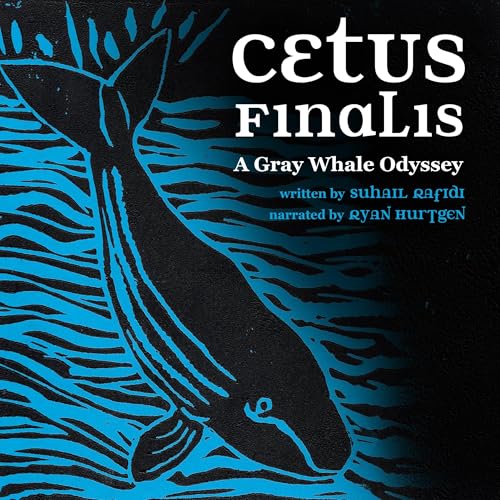
CETUS FINALIS: A Gray Whale Odyssey (Immersive Audiobook) | Narrated by Ryan Hurtgen
Winner of the 2026 IndieReader Discovery Awards in Audiobook, Fiction
What’s the book’s first line?
“The pod always savored the anticipation of their rendezvous, changing the tempos of their songs, eagerly awaiting the sight of each other after so many moons apart.”
What’s the book about? Give us the “pitch”.
One winter, a female pod of Atlantic gray whales find themselves alone at the equatorial mating grounds. Searching for their absent bulls, they quest through a submarine world ringing with the ancient calls of mysterious leviathans.
What inspired you to write the book? A particular person? An event?
I took a great interest in whales for various reasons: their intelligence, grace, and evolutionary development. The idea came during my personal whale deep dive after I learned that whales were the first petroleum industry. We did not drill oil out of the ground until 1851. Before that, the entire Industrial Revolution was powered by whale oil, rendered from whale carcasses. Every lamp in Europe burned whale oil. Machines were lubricated with whale oil; from turbines to train engines to watches, all those precise and sometimes delicate machine parts were lubricated with whale oil. Walking canes, umbrellas, and corset stays were made from whale baleen. Candles, cosmetics, and pet food were made with whale by-products. The list goes on.
I chose gray whales because most people are familiar with gray whales in the Pacific Ocean. Heavily hunted in the 19th century, they became a protected species in the 20th and have since bounced back to an estimated population of 30,000 or so. In 1994, the Pacific gray whale was finally removed from the endangered species list.
Fewer people know that the Pacific gray once had an Atlantic counterpart, a distinct population of whales which kept to the Atlantic Ocean. Atlantic gray whales are the only population of whales to ever become extinct. According to whaler’s documentation and archaeological records of some of their remains, we think they were wiped out in the late 1700s or early 1800s. They are the only population of whale to ever be wiped out. (Although, in 2010, a gray whale was sighted in the Mediterranean Sea. Subsequent scattered sightings off the coast of Africa, near Namibia, and far flung parts of the Pacific indicate that gray whales are migrating farther than ever before, and could possibly be reentering the Atlantic ocean after hundreds of years. This recent unexpected and unprecedented evidence of whale migrations may also be related to global ecological and climate changes.)
To put it simply, the ascendancy of Western civilization would have been impossible without decimating the whale population. In a deep way, human and whale fates are intertwined. I had to tell a story about it. I chose a story about the last pod of Atlantic gray whales.
What’s the main reason someone should really read this book?
It is a poetic rebellion against environmental decline.
What’s the most distinctive thing about the main character? Who-real or fictional-would you say the character reminds you of?
The most distinctive thing about the protagonist, Sylph, is that she’s the precocious, daring daughter of the pod’s matriarch. Her adventurous spirit is in tension with her mother’s restrictive sense of responsibility. (But her mother has a passionate past that she is reluctant to reveal…) As far as who she reminds me of, I’d have to pass that question on to the reader.
When did you first decide to become an author?
I first decided to become an author in 2006. After excelling at and passing through many unsatisfying ventures, I reached a crossroads of artistic identity. I said to myself, “If you want to be a writer, dear Suhail, be a writer. Don’t be a tutor or mechanic or salesman or waiter or restaurant manger – be a writer.” After I gave myself that blessing, I began writing professionally and never looked back.
Is this the first book that you’ve written?
No, it is my second novel. My first book was a science fiction about an artificial intelligence who used to be a human being. It’s called TJ & Tosc: A Field Guide For Life After Western Culture. It was adapted into a Prog rock concept album called Perfect Beings. I’m currently working on the sequel.
What do you do for work when you’re not writing?
I work as a Creative Writing and Language Arts Teacher in the private school sector. (It’s worth mentioning that I was recruited for my first private school job based on my indie publishing record.)
How much time do you generally spend on your writing?
10 – 20 hours per week.
What’s the best and the hardest part of being an indie?
The best part is the creative freedom. It doesn’t mean I can just publish anything I spit out, but it does mean I can travel deep into my fascinations and write about whatever I wish to explore and communicate to others. The hardest part is coming to terms with the likelihood of obscurity (which is why this Indie Reader recognition is so GREAT!). If you’re doing it for fame or wealth or attention: reconsider. Indie’s don’t tend to get rich and famous, but there is a market for our art all the same (but it’s a lot more legwork for the artist), and the readers care. When you find them, they care.
What’s a great piece of advice that you can share with fellow indie authors?
Persevere!
Would you go traditional if a publisher came calling? If so, why?
That used to be a quick, “Yes, please!!!”
Today, I’d have to carefully consider the publisher and their offer. And saying “No, thank you,” is realistically an option.
Why?
I’ve been to enough writer’s conferences to develop a decent sense of what traditional publishers expect from an artist in the indie era. Indie publishing has grown considerably and traditional publishers have adapted to the self-publishing explosion by becoming very risk-averse. Today’s traditional publishers expect artists to bring their own audience and marketing platform to a deal – things it used to be the publisher’s job to cultivate. In the age of Kurt Vonnegut or even later in the age of Octavia Butler, publishers looked for artists with talent they could take a chance on, build a relationship with, and develop over time. They still want to do that, but only if you’re already sufficiently successful. Now, they need to feel quite sure you’re going to sell. In fact, they prefer if you’ve already sold well. The double edge of indie publishing is that it has given traditional publishers a run for their money and they’ve adapted by leaving it to indies to develop themselves. And we asked for it. By publishing independently we told the traditional publishers: We don’t need you. Their response, in many cases, has been: Fine, be that way. If you’re big, they can make you bigger. If you’re unknown…well, good luck. If you get big enough in the indie sector, a traditional publisher may be willing inject money and marketing into your career. The question is: will you even want it by then? They’ll certainly put you to work, and the margins are narrower than they used to be. You might have to keep your day job anyway. If you’ve gotten big enough to attract a traditional publisher, why not just keep growing on your own? It’s a question each person has to answer for themselves.
Is there something in particular that motivates you (fame? fortune?)
Creativity. The actual act of writing and revising is a deep pleasure for me, syncing my mental capacity to my creative vision, living within it, and bringing it to life for others to see, that is my motivation.
Which writer, living or dead, do you most admire?
Ursula K. Le Guin
Which book do you wish you could have written?
A business tome called, Meetings: Time-Honored Bullshit