
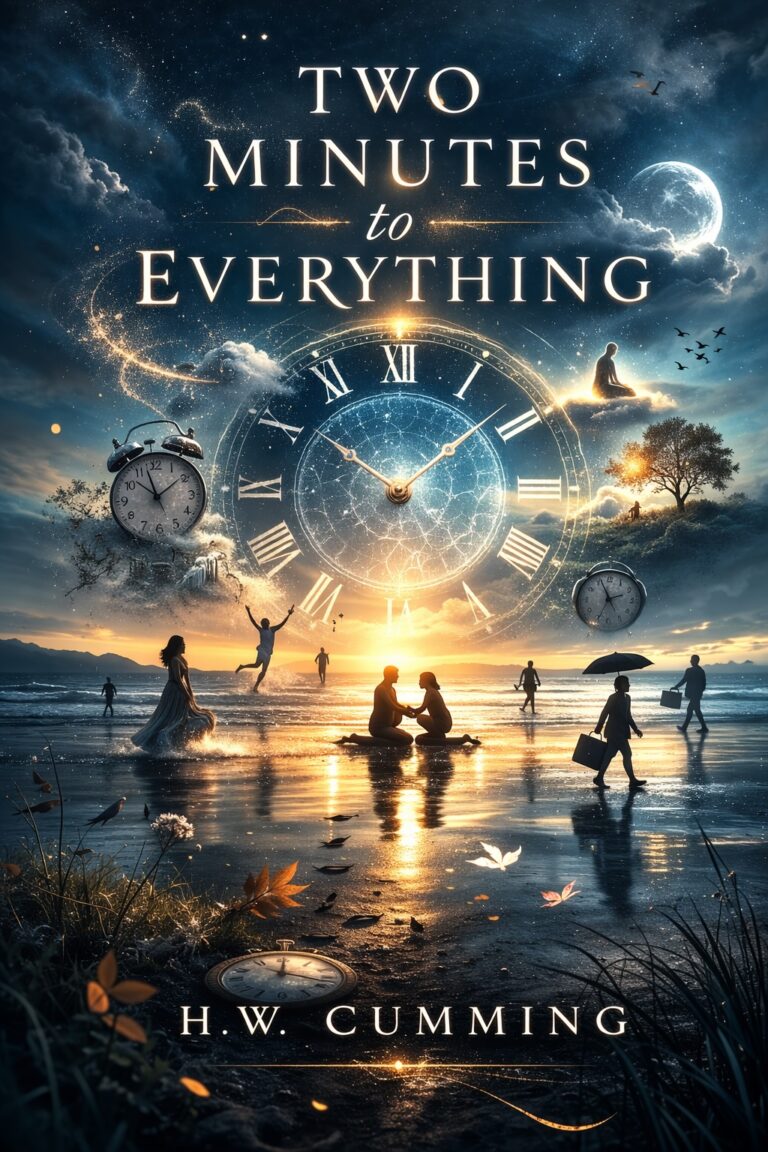
 TWO MINUTES TO EVERYTHING received a 4+ star review, making it an IndieReader Approved title.
Following find an interview with author H.W. Cumming:
What is the name of the book and when was it published?
Two Minutes to Everything was published in May 2026.
What’s the book’s first line?
“It was late.”
What’s the book about? Give us the “pitch”.
Late one night under a streetlight on Queen West, Daniel experiences something unexpected: two minutes of complete presence.
The moment sends him back through the life that brought him there — a childhood spent in a hockey crease, a near miss at becoming a musician, companies built from nothing, marriages he struggled to hold together, and the people he loved along the way.
As he retraces the moments that shaped him, Daniel begins to confront a question he has spent decades avoiding: was he building a life, or was he simply chasing being impressive at the expense of being present?
Two Minutes to Everything is a literary novel about love, ambition, regret, fatherhood, and the brief moments that quietly determine the direction of a life.
What inspired you to write the book? A particular person? An event?
It started around 2018 with a single scene in a Starbucks.
I was watching an older couple — clearly still in love after decades together — while going through a difficult period in my second marriage. I found myself imagining their first meeting and realizing it probably looked no different from my first meetings: two people, two minutes, and either something starts or it doesn’t.
Decades later, you’re either the couple still holding hands in a café, or you’re standing under a streetlight on Queen West wondering how you got there.
That idea became the spine of the book: a series of moments where everything changes. It started as a memoir. Over time I began fictionalizing it — keeping the emotional truth, but reshaping it into a novel.
What’s the main reason someone should really read this book?
Because almost everyone has a moment they still think about.
A conversation that changed everything. A person who arrived at exactly the right time — or the wrong time. A decision they would make differently. A relationship they wonder about years later.
Two Minutes to Everything is about those moments. The ones that seemed ordinary when they happened and only revealed their importance much later.
If you’ve ever looked back and wondered how you became the person you are, this book is for you.
What’s the most distinctive thing about the main character? Who—real or fictional—would you say the character reminds you of?
Daniel’s defining trait is that his life reads, on the surface, as a string of achievement-oriented choices — always moving, always building toward something.
But underneath that is a man who treats relationships the way a clockmaker treats a clock: endlessly focused on whether it’s ticking, on knowing what time it is, on the mechanism running correctly. People become gears — components that fit, that have a function, that keep the whole thing moving forward on schedule.
And the slow realization that people don’t work that way, and the people in his life never quite fit the way gears do. It takes him a long time, and a lot of broken clocks, to see it.
When did you first decide to become an author?
I’ve always written.
As a child it was stories. As an engineer it was software. As a technology executive it became articles, presentations, and strategies and as a young father it was bedtime tales. Writing has always been how I make sense of the world.
The decision to become an author wasn’t a single moment. It was the gradual realization that some stories wouldn’t leave me alone until I wrote them.
Is this the first book you’ve written?
No. My first books were the middle-grade fantasy series The Adventures of Horace, George and Ingle.
Those stories began as bedtime stories for my children and eventually became books.
Two Minutes to Everything is my fourth book and a very different kind of project — more personal, more reflective, and closer to the questions I’ve found myself asking as I’ve gotten older.
What do you do for work when you’re not writing?
I’m the Chief Technology Officer of a financial planning and analysis software company.
I spend my days helping organizations make better decisions through technology, data, and artificial intelligence. I also write regularly on technology leadership, AI transformation, and innovation.
How much time do you generally spend on your writing?
Less than people imagine and more than it appears. Sometimes it’s just a thought I want to come back to, and sometimes more.
The writing happens whenever I have the right moment of being alone, but much of the work happens while walking, traveling, sitting in airports and airplanes, or replaying a memory from twenty years ago trying to understand why it still matters.
The writing itself is often the final step.
What’s the best and the hardest part of being an indie?
The best part is complete creative freedom.
Every decision — from the title to the cover to the final sentence — belongs to the author.
The hardest part is exactly the same thing.
You don’t just write the book. You become the publisher, marketer, publicist, and advocate for the work.
What’s a great piece of advice that you can share with fellow indie authors?
Write the book you would read. About the characters you’d understand.
Not the book you think the market wants. Not the book you think will sell.
The one you would have been excited to find on a shelf.
Readers can tell the difference.
Would you go traditional if a publisher came calling? If so, why?
Absolutely.
Traditional publishing brings expertise, reach, and resources that are difficult to replicate independently.
At the same time, publishing independently has taught me a tremendous amount about readers, storytelling, and the business of books. I wouldn’t trade that experience.
Is there something in particular that motivates you (fame? fortune?)
Curiosity.
Most of my writing begins with a question rather than an answer.
Why do certain memories stay with us? Why do some moments become defining while others disappear? Why do people continue making the same mistakes long after they understand them?
Writing is how I explore those questions.
Which writer, living or dead, do you most admire?
Kurt Vonnegut.
His structural sense of disorientation that eventually resolves, his ability to undercut devastating subject matter with dry humour, and his refusal to over-explain all left a mark on how I think about writing. Few writers manage to be that playful with form while still landing real emotional weight.
Which book do you wish you could have written?
Galapagos.
It takes a sweeping, almost absurd premise and uses it to ask a quiet, devastating question about what we actually are as a species — stripped of all the things we think define us. The voice is wry and detached, but the emotional core underneath is real.
More than anything, it reminds me that the most important stories are often about ordinary moments, observed closely.