
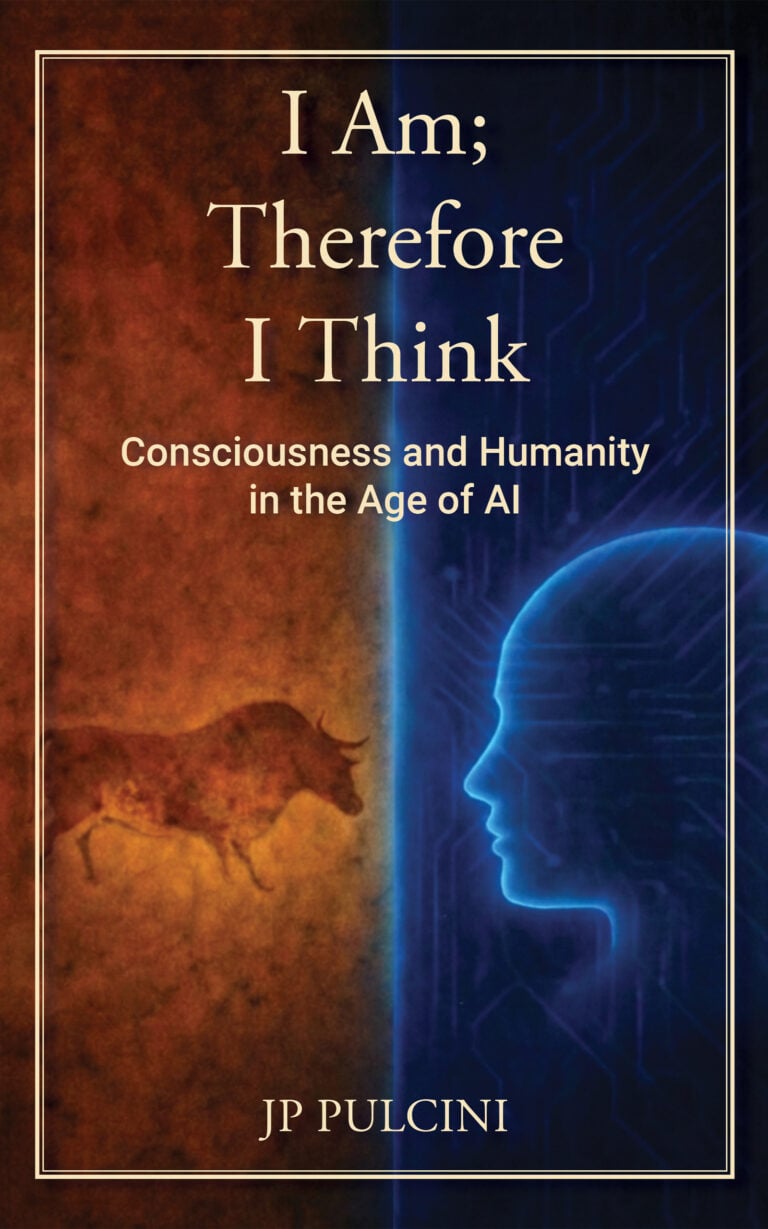
 I AM; THEREFORE I THINK: Consciousness and Humanity in the Age of AI received a 4+ star review, making it an IndieReader Approved title.
Following find an interview with author JP Pulcini:
What is the name of the book and when was it published?
I Am; Therefore I Think: Consciousness and Humanity in the Age of AI, published March 2026.
What’s the book’s first line?
“The light is bright, and there is a sensation of warmth.”
What’s the book about? Give us the “pitch”.
Descartes said “I think, therefore I am.” I want to push back on that. Thinking is something machines now do extraordinarily well, but that hasn’t made them conscious, self-aware, or human. I Am; Therefore I Think argues that consciousness comes first. It is the ground from which thought rises, not the other way around. The book explores what makes human consciousness distinct: memory, emotion, wonder, identity, the capacity to care, and why those qualities remain beyond the reach of even the most advanced AI. It is part philosophy, part cultural commentary, and part mirror held up to a species that is only now beginning to understand itself by watching what it has built.
What inspired you to write the book? A particular person? An event?
Thirty years in enterprise technology will do it. I have spent most of my career watching organizations adopt new tools and convince themselves the tool was doing something it wasn’t. With AI the stakes are different, because now the tool is doing something that looks, from the outside, remarkably like thinking. And the people building and deploying it are increasingly comfortable describing it in human terms. That bothered me. Not because AI isn’t impressive, it is, but because I think we are conflating two very different things: intelligence and consciousness. One can be engineered. The other, I argue, cannot. The book is my attempt to draw that line clearly and to ask what it means for us if we refuse to.
What’s the main reason someone should really read this book?
Because the question of what makes us human is no longer theoretical. AI is forcing us to answer it in real time, in boardrooms and classrooms and living rooms, and most of us are doing so without any framework for thinking it through. This book gives you that framework, without the jargon, without the hype, and without the either/or of AI utopia versus AI apocalypse. It sits in the uncomfortable middle, where the real questions live.
When did you first decide to become an author?
Honestly, the book decided before I did. I had been thinking about these ideas for years, turning them over in the back of my mind while working through the practical realities of a long technology career. At some point the thinking accumulated enough weight that writing it down stopped feeling optional. The decision to become an author was really just the decision to stop postponing the thing I was already doing in my head.
Is this the first book you’ve written?
First published. Not the first started. Like most first-time authors I have a graveyard of half-finished manuscripts that taught me what I actually wanted to say. This is the one that made it out alive.
What do you do for work when you’re not writing?
I have spent thirty years in enterprise technology, with the last twenty focused on utilities and critical infrastructure. I recently completed an MBA in AI from Ducere Global Business School, which gave me the academic scaffolding to say more precisely what I had been thinking about intuitively for years. Currently I am exploring how my background in technology, AI strategy, and authorship intersect, which turns out to be a more interesting Venn diagram than I expected.
How much time do you generally spend on your writing?
More than I planned and less than I wanted. The Mirror, my weekly philosophical reflection series published across Substack, my author site, LinkedIn, and Instagram, keeps the thinking sharp between longer projects. Writing consistently in public is the best discipline I have found. It forces you to finish thoughts you might otherwise leave comfortable and vague.
What’s the best and the hardest part of being an indie?
The best part is owning the work completely. The ideas, the voice, the decisions about what stays and what goes. No one told me to soften the argument or broaden the appeal. The hardest part is that no one is telling anyone else about it either. Discovery is entirely your problem. You write the book and then you become a marketer, a publicist, a social media strategist, and a distribution specialist, all while trying to remain the kind of person who has something worth saying.
What’s a great piece of advice that you can share with fellow indie authors?
Write the book you need to write, not the book you think will sell. Readers are better than we give them credit for. They can tell the difference between a writer with genuine conviction and one performing the idea of having something to say. Conviction is the only marketing advantage an indie author actually has over a traditional house. Don’t dilute it.
Would you go traditional if a publisher came calling? If so, why?
It would depend entirely on what they were offering beyond distribution. If a traditional publisher brings genuine editorial partnership, meaningful reach, and the kind of institutional credibility that opens doors a self-published author can’t easily open, yes. If they want to sand down the edges and put it on a slower conveyor belt to the same outcome I can achieve independently, probably not. The conversation would be interesting either way.
Is there something in particular that motivates you (fame? fortune?)
Neither, honestly. What motivates me is the suspicion that we are making decisions about AI, individually and collectively, without asking the right questions first. If this book puts better questions into circulation, that is enough. The Literary Titan Gold Book Award and the first reader reviews suggest the ideas are landing. That matters more to me than either fame or fortune, which is fortunate, because indie publishing is an unlikely path to either.
Which writer, living or dead, do you most admire?
Camus. Not because I share all of his conclusions but because of the clarity of his refusal to look away. He sat inside the most uncomfortable questions about human existence, absurdity, mortality, the absence of inherent meaning, and wrote about them with a precision and honesty that never tipped into despair or false resolution. That is the standard I hold myself to, even when I fall well short of it.
Which book do you wish you could have written?
Godel, Escher, Bach (An Eternal Golden Braid) by Douglas Hofstadter. It is the most ambitious attempt I know of to take the question of consciousness seriously as an intellectual project, weaving mathematics, music, art, and philosophy into something that shouldn’t work and somehow does. It is also the book that most clearly demonstrates what I believe: that the deepest questions about mind and meaning cannot be answered from inside a single discipline. You have to be willing to range widely and follow the idea wherever it goes.