
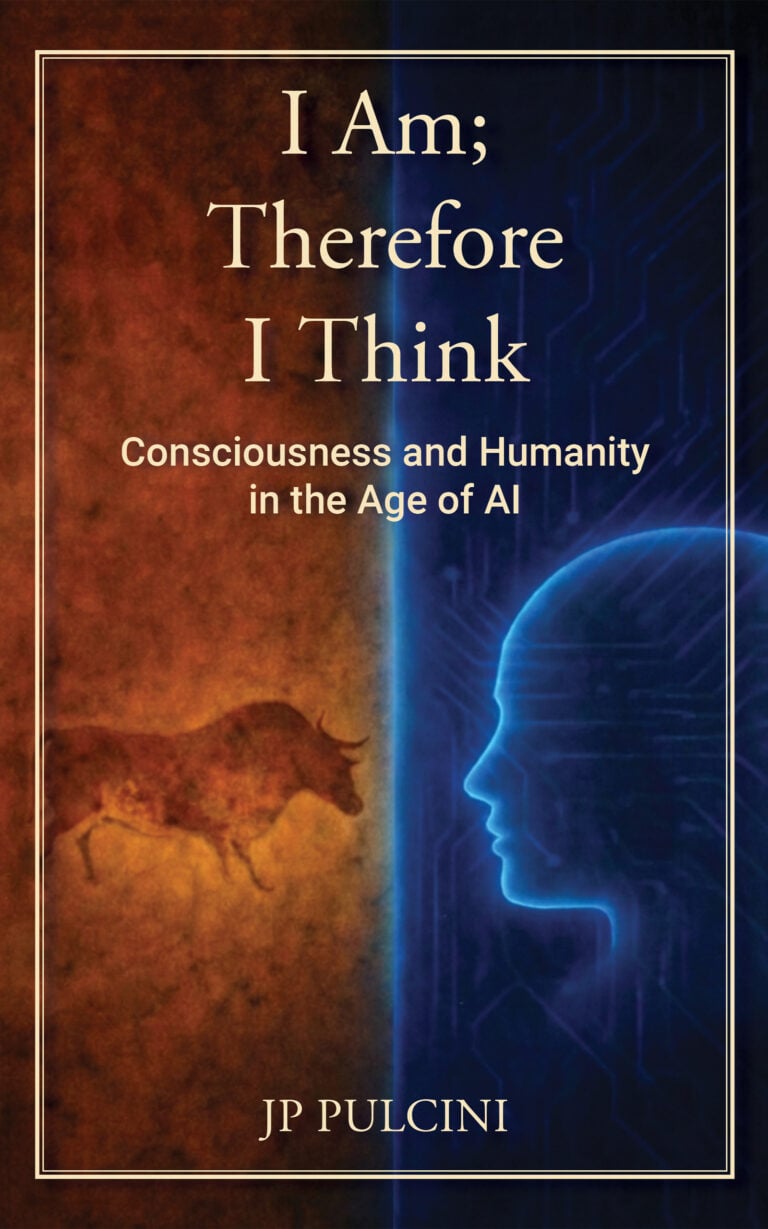

J.P. Pulcini’s I AM; THEREFORE I THINK: Consciousness and Humanity in the Age of AI shines a hard light on rapidly advancing artificial intelligence and its relationship to human consciousness. Pulcini’s approach to the issue of AI is comprehensive; in addition to technology, he touches on philosophy, physics, neuroscience, genetics, mythology, literature, modern cinema, and more.
It’s clear from the outset that Pulcini has done his due diligence in researching and thinking about his subject. Well-read and open-minded, he does a good job articulating the questions and concerns that most people likely have regarding AI and its potential long-term implications. For instance, “Are we building tools that simply extend human capacity, or are we inching toward synthetic beings whose existence could rival, complicate, or even threaten our own?”
Much of the book examines the nature of consciousness, as well as the limitations of neuroscience in understanding and explaining human cognition. It is a point that Pulcini revisits again and again, mainly because it underscores his contention that modern AI “operates without the inner life that defines human consciousness.” Thus, while AI may be able to “perform” or imitate consciousness, it cannot possess it—yet.
That is I AM; THEREFORE I THINK's primary line of inquiry: can AI ever develop true consciousness?—and, if so, what might that mean for human civilization? The author does not attempt to neatly answer this question; rather, in Socratic fashion, he poses a series of questions and possible scenarios for readers to contemplate.
Naturally, Pulcini addresses the nightmare possibility that AI could eventually progress beyond our control and comprehension, rendering human beings essentially redundant. He is not pessimistic, nor is he overly optimistic. One point he does stress is that AI ought to be viewed as a sort of distorted reflection of human consciousness: “In probing AI, we are also probing ourselves—illuminating the corners of our own thought processes and expanding the boundaries of how we think.” Where precisely that road leads is anyone’s guess.
If there is a fault to the book, it’s that Pulcini, in his efforts to drive his main points home, tends to repeat himself. Early memories and how they define our lives, the fundamentally incomprehensible nature of human thought, and the fact that AI (for now) does not have the capacity to think are all subjects the author deals with at length in various chapters. Nevertheless, I AM; THEREFORE I THINK still serves as a thoughtful contribution to the AI debate.
J.P. Pulcini’s I AM; THEREFORE I THINK: Consciousness and Humanity in the Age of AI is a learned and thought-provoking meditation on AI and the ways in which it can either align or conflict with human interests.
~ Michael Howard for IndieReader