
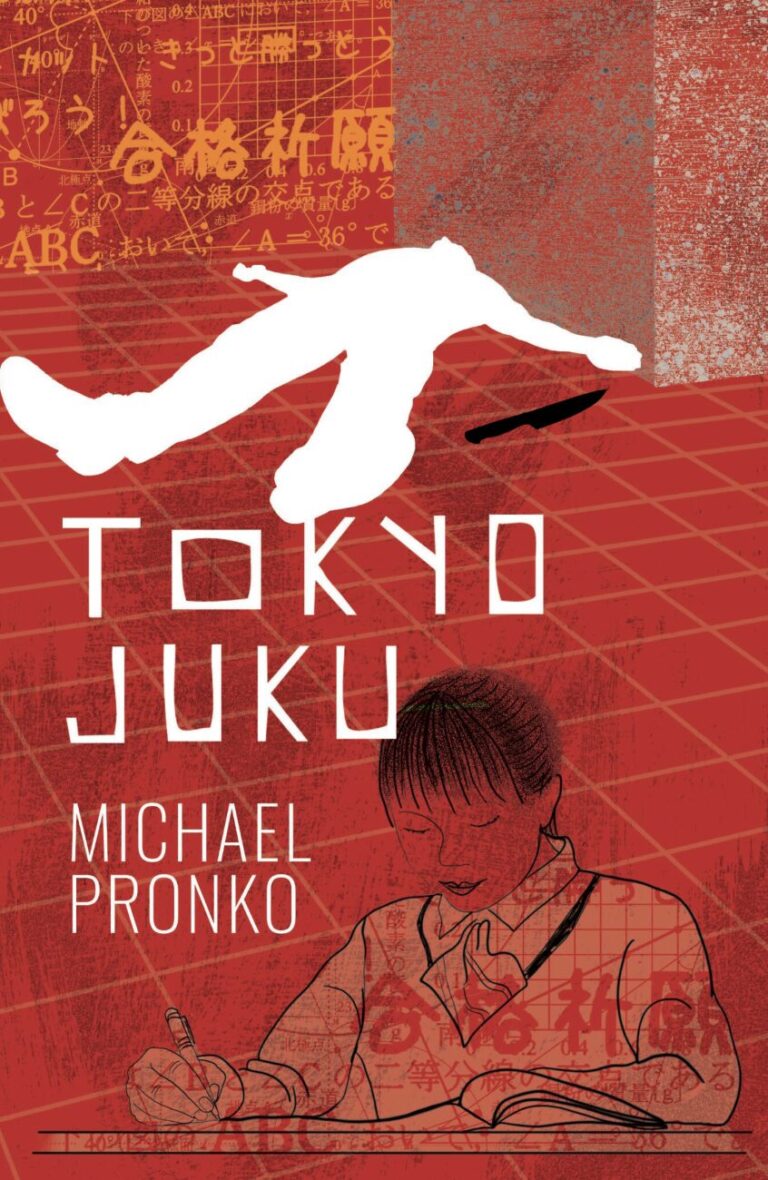
 Tokyo Juku: Received a 4+ star review, making it an IndieReader Approved title.

Following find an interview with author Michael Pronko:
- What is the name of the book, and when was it published?
Tokyo Juku, October 27, 2025
2. What’s the book’s first line?
“Mana woke with a start, confused about where she was. She heard a whomp from somewhere, but she wasn’t sure she was awake.”
3. What’s the book about? Give us the “pitch”.
A young girl named Mana, who is studying for the entrance exam in Tokyo, finds her teacher stabbed in a classroom. She becomes a suspect and sets out to find who did it, putting aside the pressure to pass the upcoming exam. Detective Hiroshi is put in charge of the case even though he’s more of an office person than a street-savvy sleuth. They both get an education in the exam system.
4. What inspired you to write the book? A particular person? An event?
It’s more a matter of accumulating experience as a teacher in Japan. I see the effects of the entrance exam system and what it does to people. Some people’s entire lives are decided by one test on one day. It’s a powerful gatekeeping and social ordering device that doesn’t always get it right. I’ve worked on the exam, which is supposed to be secret, but the secrecy of it is part of the problem. The exam system helped instill a competitive spirit in Japanese culture in the 1950s, perhaps, but it has become outworn and ineffective in guiding students in the current age, and has as many adverse effects as positive ones.
5. What’s the main reason someone should really read this book?
It’s a great whodunnit set in a fascinating city. The characters are unique and compelling, and the story keeps you turning pages. You get a tour of Tokyo beyond the tourist spots at the same time. It’s a straightforward mystery, but the characters, experiences, and situations that unfold in Tokyo are distinct from most mysteries.
6. What’s the most distinctive thing about the main character? Who-real or fictional-would you say the character reminds you of?
Mana, the main female character, is similar to many teenage antiheroes, full of passion but misdirected. Hiroshi is a classic hard-boiled detective with his intuitive side fighting his logical side.
7. When did you first decide to become an author?
It was always part of my hopes for myself from a young age. I wrote a play in fifth grade that we performed for Parents’ Day. However, later in college and after, I became distracted by philosophy, travel, living abroad, and teaching literature—the usual suspects. I’d always written a lot, both at school and for years as a newspaper and magazine writer in Tokyo, with eight deadlines a month at one point. That was a lot of writing, considering I had a full-time university position teaching literature. I was always a big journal writer, then an academic writer, a journalistic writer, and finally a novelist. They all connect.
8. What do you do for work when you’re not writing?
I teach American literature and culture in Tokyo. I love teaching classes on contemporary novels, crime films, comedy films, art, and music. I enjoy teaching both poetry and fiction. Students in the English department take classes in English, although all other aspects of the program are conducted in Japanese. It’s been a great day job, university politics and official duties aside, and an ongoing input of texts, ideas, and material for writing. Poetry gives me the beauty of expression, films provide the structure of stories, novels offer the complexity, and literary theory provides the big picture. Explaining literature and film to students has taught me an immense amount about how literature works.
9. How much time do you generally spend on your writing?
As much time as I can. Because I love what I write, the line between writing and relaxing gets blurry at times. I love jazz, so I write about that, but is that the work of writing? I wander around the city and pick up possible bits and pieces of life in Tokyo, which might be the wellspring of writing. I write, or at least think, a lot on trains, since I have two hours of commuting a day. That’s not writing per se, but it’s time to let ideas incubate, make further observations, and generally let my writing mind run free. That helps things percolate until I can get my fingers on a keyboard. What usually happens is I write in the morning, then head to work. Often, when I get on the train, the solution to whatever writing problem frequently pops up, and I end up trying to scrawl it down on a crowded train. Not so easy some days.
10. Which writer, living or dead, do you most admire?
I was saddened to finish reading Thomas Pynchon’s recent novel, “Shadow Ticket,” thinking it might be his last. He’s been a constant companion over the years, almost like a college friend, one I’ve kept in touch with. I’m not sure he’s the writer I admire the most, since admiration is such a tricky word and sometimes hard to admit. I’d say I’m always impressed by his approach to language, innuendo, humor, irony, and odd situations. And he’s not afraid to slip his own song lyrics into the story, either! I admire that! I wrote a PhD on Charles Dickens, so he’s someone who impresses me with his amazing command of language, insight into the human condition, and what I can only describe as deep pleasure in attaching words to the world. If I could write about Tokyo like he wrote about London, I’d be thrilled. That’s two writers, but the complete list of admired writers would take a long time to write out.