

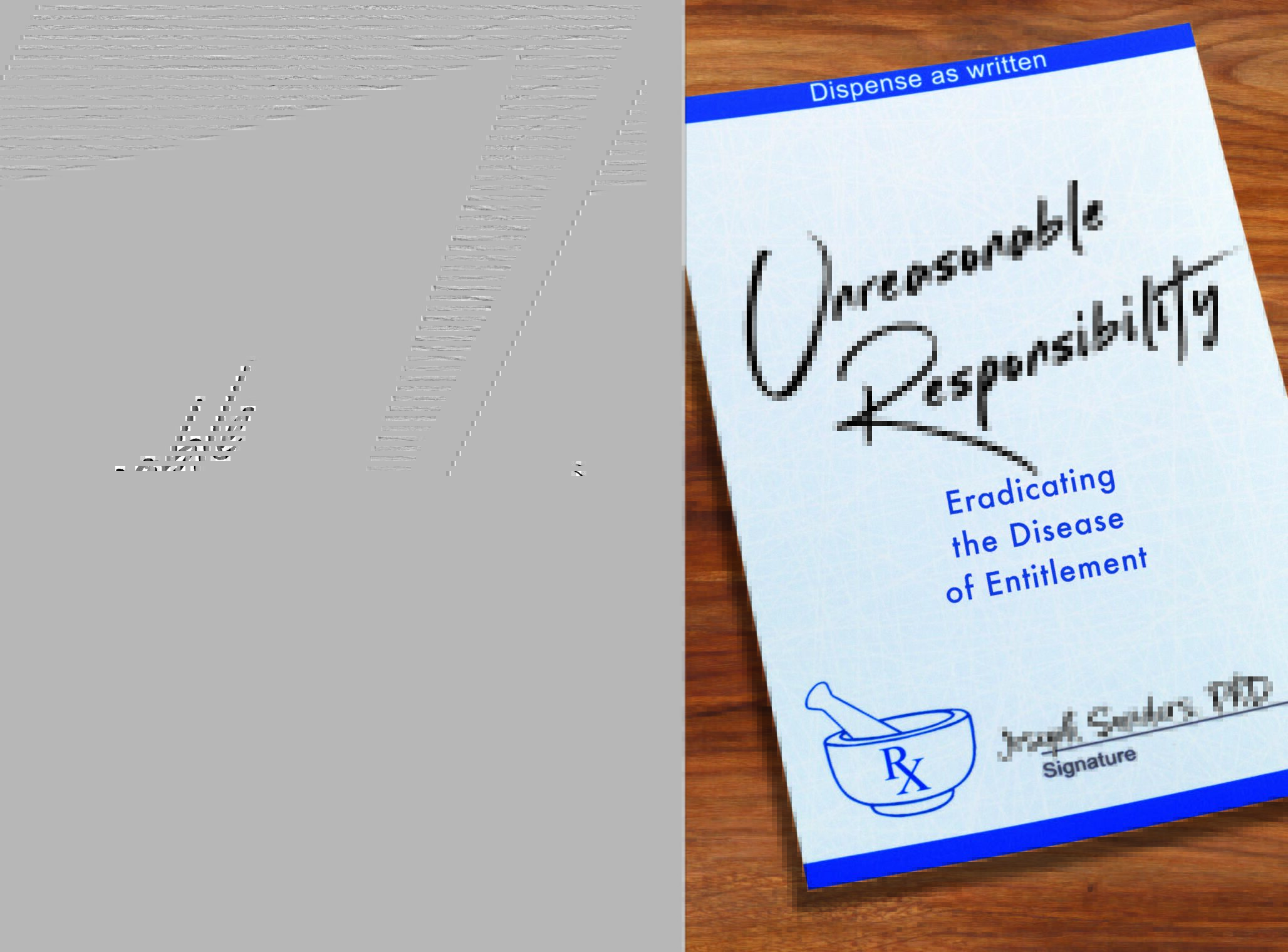
UNREASONABLE RESPONSIBILITY: Eradicating the Disease of Entitlement offers an insightful look into what author Joseph Sanders refers to as “the disease of entitlement,” which he claims has reached “epidemic proportions” in America and harbors considerable “destructive force.” This assertive language is not a one-off. In outlining his thesis (that leaders should discard the “rights-based mindset” in favor of one that foregrounds personal responsibility) Sanders fires several well-aimed broadsides at entitlement. According to him, it’s a “clear and present danger” and a “disease”—one that, like cancer, spreads gradually and strikes at the heart of society. This metaphor is extended throughout the book, with reference to “carriers” of entitlement and its transmission.
Sanders underpins his thesis with far-ranging research, invoking the ideas of Viktor Frankl, the speeches of Eisenhower and John F. Kennedy, and (less intuitively) the work of John Glubb: a British general who fought in World War II and later wrote an essay titled “The Fate of Empires” (whose popular appeal lies in its identification of the inevitability of those mighty institutions’ decline). Sanders shies away from placing American society in Glubb’s final stage, though he does note it’s currently “clearly […] experiencing the marks” of that age. Sanders outlines “patterns of concern,” areas of everyday life in which entitlement can be discerned: family life, the workplace, education, etc. The author’s solution is to assume responsibility; he advocates dismissing the “diffuse, displace, discard” approach, which in his view allows leaders to shirk responsibilities to others.
Sanders’s thesis is welcome and convincing, though principal objections come from the fine detail of his argument. It would have been productive, for example, to include a discussion of “unreasonable responsibility” alongside plain, old-fashioned altruism. Nor is it helpful to include evocations of faith within a theoretical framework that doesn’t call for them; the church, whose attendance Sanders advocates, has been responsible for some dreadful depredations too—and still is when in the form of Christian nationalism (among other things). A passage championing the nuclear family also seems ill-judged in its strident and somewhat unnuanced defense of marriage. It is disingenuous to state that “Parents[‘] … challenges are simply more difficult when there is one parent instead of two (or two who aren’t unified).” If a toxic or abusive environment results from a marriage, it is not hard to envisage scenarios where divorce is the least damaging option for all involved. Lastly, an index would have been a welcome compliment to the useful endnotes.
For all that, UNREASONABLE RESPONSIBILITY is an essential read, as its diagnosis of entitlement and its discontents is not to be trifled with. In a world in which leaders routinely bully, brag, and assert their rights over all others, its central lesson is one we would all do well to internalize.
Joseph Sanders’s UNREASONABLE RESPONSIBILITY: Eradicating the Disease of Entitlement is a well-written, insightful, and compelling meditation on the destructive nature of entitlement and how assuming responsibility for one’s actions offers a useful antidote.
~ Craig Jones for IndieReader