
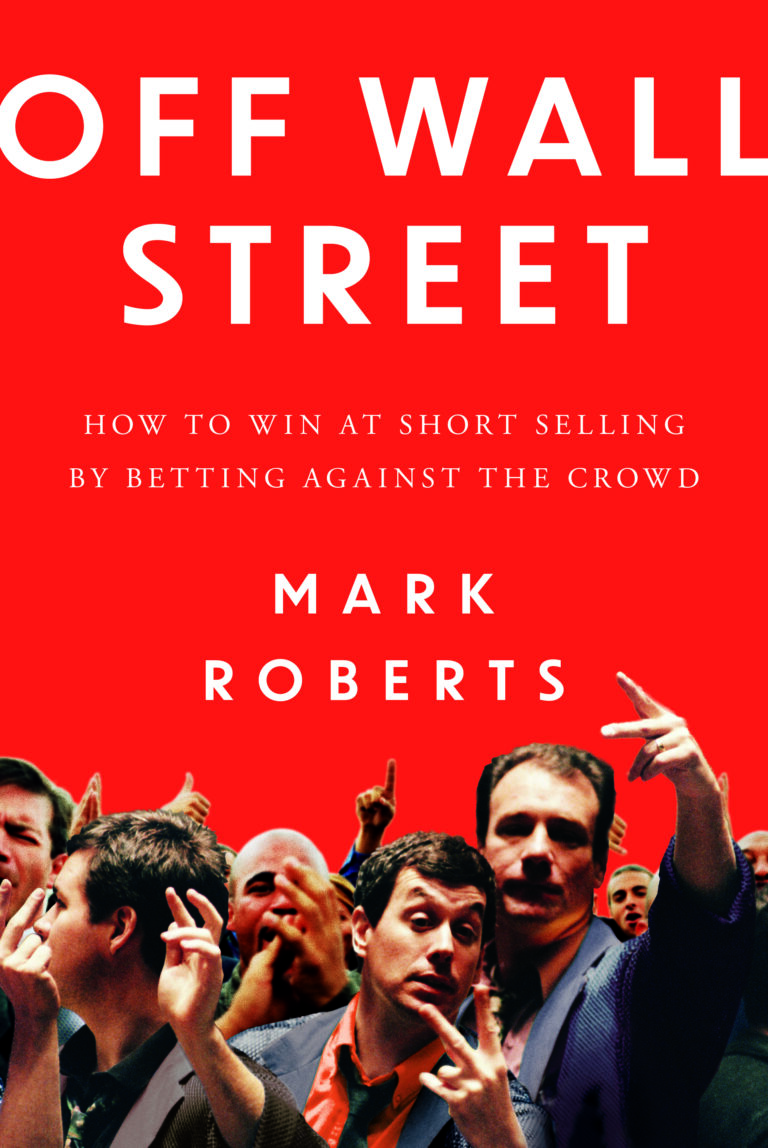

Mark Roberts did not arrive on Wall Street through the usual channels. Before founding Off Wall Street Consulting Group, he had earned a master's degree in French literature, run a family steel business in Boston, sold software franchises across the country, and survived the market crash of 1987 largely by accident. It was that accumulation of what he calls a "long runway" of varied experience, rather than any single credential, that eventually equipped him to do work that most analysts were unwilling or unable to do.
OFF WALL STREET: How to Win at Short Selling by Betting Against the Crowd is part memoir, part intellectual history, and part practical guide to short selling. Roberts moves between these registers with reasonable fluidity, though the book's strongest passages are those where personal history and professional philosophy reinforce each other. The chapter on loss, for instance, traces a direct line from the death of his grandfather when he was thirteen to the emotional psychology that would drive his interest in short selling: a lifelong wariness of catastrophe, and a desire to hedge against it. "Fear of catastrophic loss," he writes, "is a motivation to sell short." That kind of self-aware honesty gives the book a depth that most finance memoirs lack.
The practical sections of the book are its most compelling. Roberts successfully walks readers through how Off Wall Street Consulting Group built its reputation on original fieldwork and research methodology that distinguished it as credible. His firm's early work on TCBY, Summit Technology, and eventually Enron was built on field research rather than management guidance—on financial models that challenged Wall Street assumptions, rather than echo them. The Enron chapter is particularly instructive. Where most accounts focus on accounting fraud and the individuals behind it, Roberts argues that the real story lay in a structurally unsustainable business model—one in which revenue could only grow by accepting ever thinner trading margins. As he notes in the firm's May 2001 report, when Enron's revenue increased by $60 billion in 2000, gross profit rose by only $0.5 billion: a detail that analysts covering the stock had failed to absorb. As he writes, "Traders can generate volume, but it may be at the expense of margin." Off Wall Street closed its Enron position with a 56 percent gain. The firm's 25-year batting average across 620 recommendations came in at 73 percent, a record Roberts presents without excessive fanfare.
Where some readers may need to adjust their pace is in the later chapters devoted to analyst testimonials. Roberts invites several former Off Wall Street analysts to share their lessons and reflections at length. The voices vary considerably in depth and focus, and the transition between them interrupts the narrative rhythm that Roberts builds so effectively in the earlier chapters. However, these reflections provide valuable lessons that are applicable to various aspects of life outside the financial sector. For example, this piece by Stephen Pineault is insightful: “Don’t trust when you cannot verify, and to the contrary, when verification debunks the trust, follow the evidence.”
OFF WALL STREET is an unusually honest account of how a contrarian career is actually built: slowly, through failure, through genuine curiosity, and through the willingness to stand outside the crowd long enough to see what everyone has missed.
Most persuasive when showing what its thought-process actually looks like in practice, Mark Roberts's OFF WALL STREET: How to Win at Short Selling by Betting Against the Crowd is a candid and well-evidenced case for independent thinking in financial markets.
~Gabriella Harrison for IndieReader