
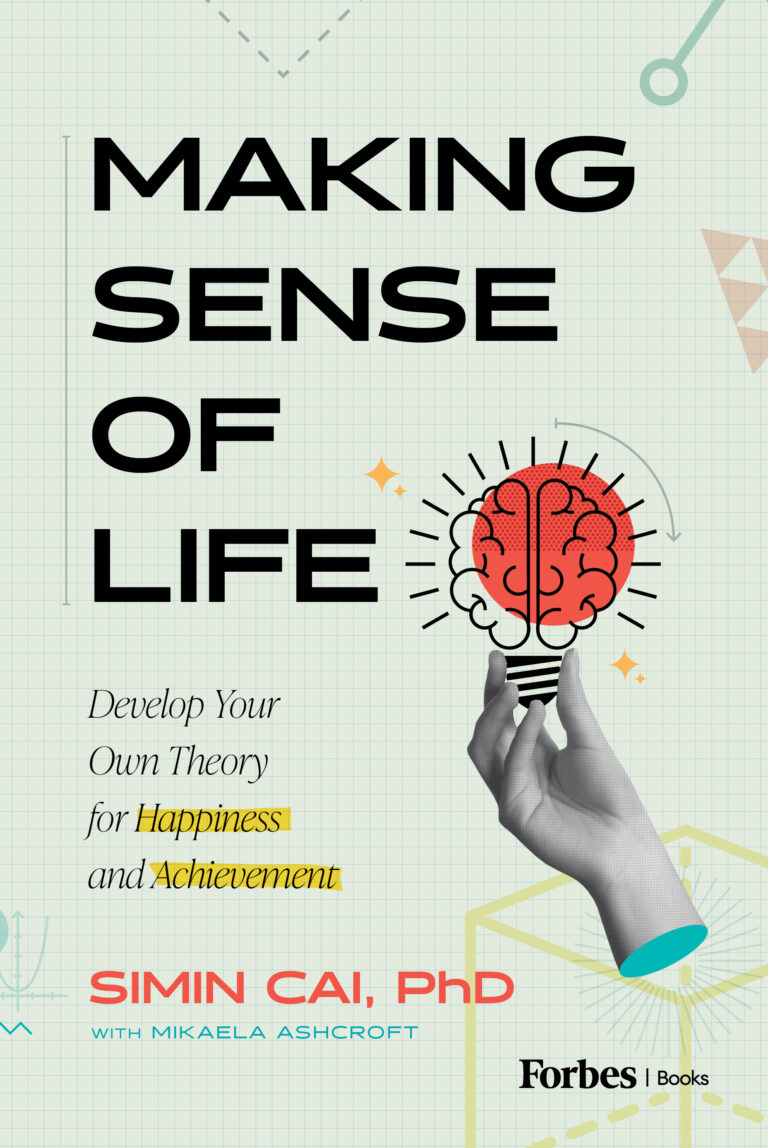

While many self-help books lean heavily on rigid frameworks or prescriptive “fixes,” MAKING SENSE OF LIFE: Develop Your Own Theory for Happiness and Achievement by Simin Cai stands out for its patient, humane approach. Rather than telling readers how they should live, Cai invites them into a conversation grounded equally in science, philosophy, and lived experience. The book lays out complex ideas in accessible language without ever talking down to its audience, creating a reflective reading experience rather than something that feels like a personal to-do list.
One of the book’s greatest strengths is its structure. Cai builds his argument carefully, beginning with humanity’s fundamental drive to understand the world and gradually narrowing his focus to the individual search for meaning. Drawing on his background in physics, he uses the scientific method as a guiding framework, encouraging readers to treat their beliefs, values, and life choices as evolving hypotheses rather than fixed truths. Even readers without a scientific background may find themselves persuaded, thanks to Cai's calm, reassuring prose. For instance, when the author writes, "Things aren't always as they appear. Life can get complicated, and that prevents us from seeing the broader picture," the advice feels more intuitive than imposed. MAKING SENSE OF LIFE is not intended to be consumed quickly, and readers willing to engage with it thoughtfully will find this calm, empathetic tone especially rewarding. Cai writes like the kind of college professor whose classes are genuinely anticipated. Someone whose lectures prompt lingering conversations, and whose ideas continue to resonate long after the class has ended.
Cai also wisely utilizes historical figures to bolster his ideas, drawing from scientists, thinkers, artists, and revolutionaries alike. These examples never feel decorative or included simply to prove a point. Instead, they provide concrete grounding for ideas that might otherwise remain abstract. By showing how others have grappled with uncertainty, limitation, and change, Cai reinforces the universality of the search for meaning without resorting to platitudes or leaning too heavily on personal opinion.
A particularly thoughtful feature of the book is the set of reflective questions included at the end of each chapter. These are not exercises meant to funnel readers toward predetermined conclusions, but open invitations for contemplation and discussion. In this way, MAKING SENSE OF LIFE respects the reader’s autonomy and feels well-suited for book clubs, businesses, or slow, personal reading.
Overall, Cai delivers a work that feels less like a manual and more like a companion—something that nudges rather than pushes, and listens as much as it speaks.
In MAKING SENSE OF LIFE: Develop Your Own Theory for Happiness and Achievement, Simin Cai offers a clear‑eyed, empathetic approach to self‑improvement that favors inquiry over instruction. This is a thoughtful and accessible read that encourages reflection without resorting to easy answers.
~ Jason Munoz for IndieReader