
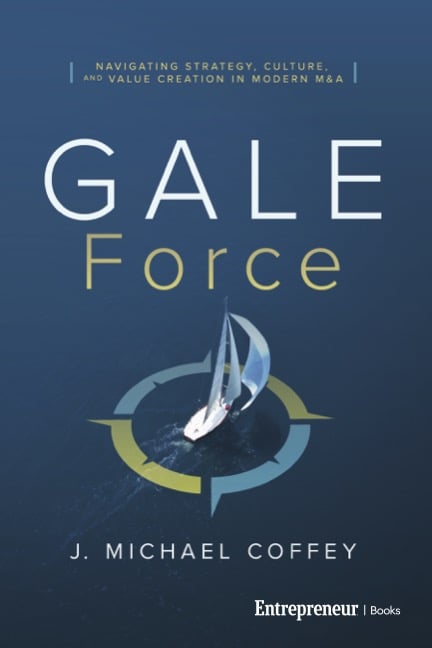

In his book G.A.L.E. FORCE: Navigating Strategy, Culture, and Value Creation in Modern M&A, J. Michael Coffey draws on years of hands-on experience as a business executive to deliver a blueprint for how to approach mergers and acquisitions in an increasingly globalized world. The eponymous GALE Force Strategy is an acronym for “Global Aim, Local Execution,” which Coffey describes as a “hybrid approach” to the challenges presented by international and multicultural markets. In his words, it “seeks to reconcile the benefits of global efficiency with those of local resonance.”
Coffey points to some of the most famous companies in the world (including McDonald’s, Starbucks, and L’Oréal) as examples of how the GALE Force Strategy should work. Each has a major global presence, with different product lines tailored to different consumer bases. The whole point, he writes, is to expand companies “not by scale or brute force alone but by aligning global ambitions with local realities.”
Coffey stresses throughout the book the importance of company culture, both from an employee morale perspective and a customer satisfaction perspective. The primary focus, as the title suggests, is mergers and acquisitions—from valuation to purchasing and “post-merger integration.” This last step involves creating a “unified cultural vision,” without which (Coffey argues) a business cannot sustain itself.
G.A.L.E. FORCE has utilitarian value for business people in that it deals with concrete problems and solutions, rather than abstractions. For example, for the issue of supply and/or revenue being too concentrated, Coffey prescribes a four-point remedy—broaden the customer base, diversify suppliers, build in redundancies, and reduce single points of failure—and goes into more detail from there.
As with most business books, G.A.L.E. FORCE relies heavily on metaphor to flesh out its arguments. At various points, Coffey likens aspects of business to sailing, sports, and even lyrics of popular songs. While the analogies make sense more often than not, they do give the book (or parts of it) a formulaic bent. The same is true of the obligatory acronyms: in addition to GALE, the other big one is DRiiVE (Drive, Restraint, Intelligence, Innovative, Virtue, Ego).
While it's not perfect, G.A.L.E. FORCE still proves valuable to readers who can use some advice on how to successfully navigate mergers and acquisitions in the modern world.
G.A.L.E. FORCE: Navigating Strategy, Culture, and Value Creation in Modern M&A is a perceptive and cogent business manual that reflects author J. Michael Coffey’s in-depth knowledge of the ever-evolving and -expanding world of global commerce.
~ Michael Howard for IndieReader