
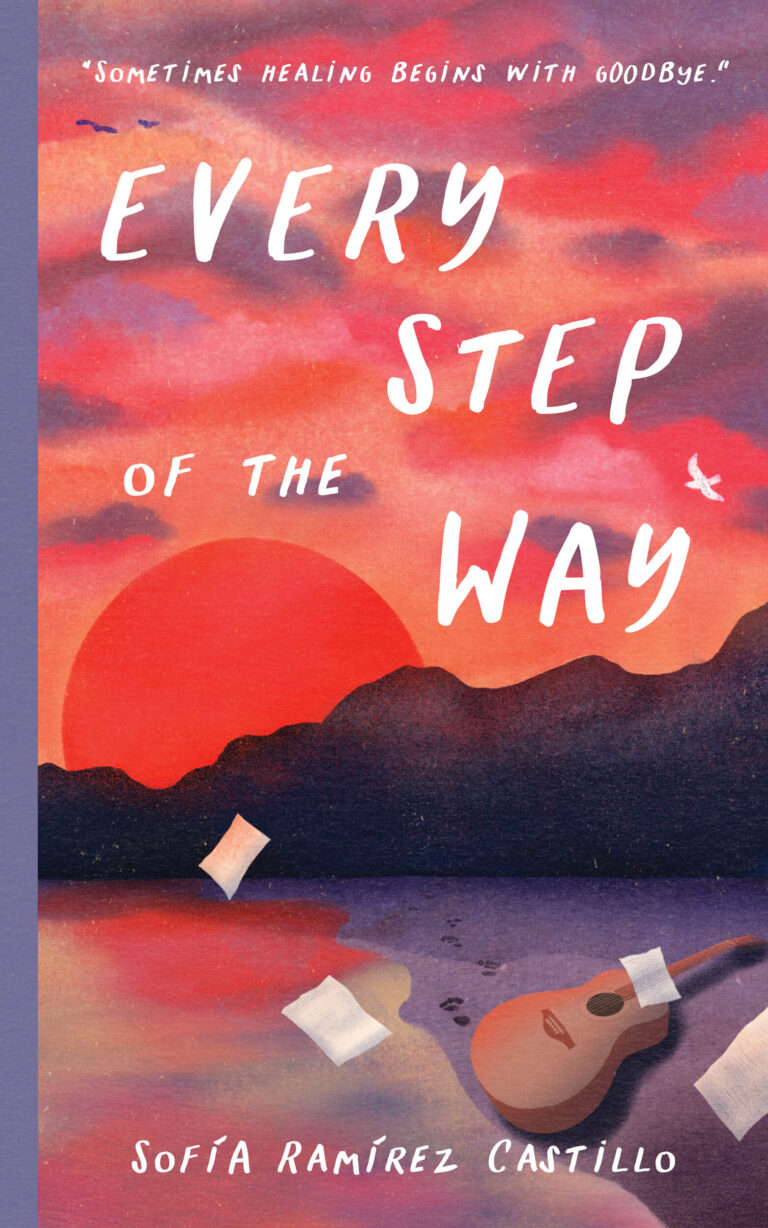
 EVERY STEP OF THE WAY
Winner of the 2026 IndieReader Discovery Awards in Women’s Fiction
What’s the book’s first line?
“What’s your name?”
What’s the book about? Give us the “pitch”.
A lyrical, heart-aching debut about the loves we lose, the roots that call us home, and the fragile, breathtaking courage of starting over.
Noah thought she had her future mapped out—with Derek by her side, music in her veins, and a love she believed could survive anything. But when Derek begins to unravel under the weight of secrets and self-destruction, Noah finds herself fighting for someone who’s already slipping out of reach.
When her life, and everything she dreamed of, collapses, she turns to the one person who has always been her anchor: her grandmother. In the stillness of that familiar home—surrounded by old photographs, lingering melodies, and gentle wisdom—Noah begins the slow, tender work of piecing herself back together.
But grief has many faces, and healing is rarely simple. As time moves forward and the past refuses to stay buried, Noah must confront heartbreak, identity, and the quiet strength it takes to choose hope when the world feels unrecognizable.
A story of love, loss, and the courage to begin again, Every Step of the Way is a deeply emotional journey about the people who shape us, the memories that haunt us, and the healing we find when we return to where it all began.
What inspired you to write the book? A particular person? An event?
The inspiration for Every Step of the Way comes from the unconditional love I have for my grandmothers. They have always been my role models, on both my mother’s and father’s side. They’re strong, ambitious women who were pioneers in their own fields and unapologetically fearless. In recent years, one of my grandmothers has been experiencing a rapid cognitive decline, with her short-term memory now significantly affected.
Adapting to this new reality—having the same conversations repeatedly and witnessing her gradual shift—left me with a complex mix of emotions, ranging from helplessness to anger. At times, it felt overwhelming, like I was grieving someone in real time while still trying to hold onto who they once were. We often talk about the grief that follows death, but less often about the experience of grieving someone who’s still living.
Writing this book became a form of coping and healing. Putting those emotions onto the page allowed me to make them tangible, something I could look at, understand, and gently rearrange. Through Noah’s story, I was able to step outside of my own experience and process it from a different perspective, which made it easier to navigate.
Ultimately, shifting my understanding of grief was essential to my healing. I hope this story offers the same sense of recognition and comfort to readers who are navigating their own experiences with loss and change.
What’s the main reason someone should really read this book?
I would love for people to read this book because grief is something we all experience in one form or another, yet it often feels deeply isolating. I’ve always believed grief is an intensely solitary experience—even when it is shared in a broader sense, no one can fully understand another person’s specific loss or the way they carry it.
Because of that, it can be easy to feel alone in it.
My hope is that this book serves as a reminder that readers are not alone in their grief. While talking about pain makes it real, it can also make it more bearable, and sometimes even the act of recognizing it in someone else’s story can be healing in itself.
I’d also be remiss not to mention that sometimes all we need is a good ugly cry to help us feel grounded and realign our emotions. If you’re ready to open that Pandora’s box, this book might just be what you need.
What’s the most distinctive thing about the main character? Who-real or fictional-would you say the character reminds you of?
I’m going to rebel a little against this question and focus on Grandma Nadia rather than Noah.
While Noah certainly reflects parts of my own experiences and emotions, Grandma Nadia is the character who truly steals the spotlight. She is inspired by both of my grandmothers and blends their unique personalities into one unforgettable character. She’s stubborn, outspoken, rebellious, and occasionally a little foul-mouthed, but beneath it all she has a heart of gold.
I wanted her to embody the fearless spirit of two women who never allowed expectations—or age—to define them, while also capturing the warmth, tenderness, and unwavering love that many of us associate with our grandmothers. Even as she faces the challenges that come with aging, she refuses to let them diminish who she is.
More than anything, Grandma Nadia is my tribute to the women who helped raise me and the crucial role of love and empathy they played in my upbringing.
When did you first decide to become an author?
This question always makes me smile because I honestly never set out to become an author. As a child, I didn’t dream of publishing books or building a writing career. In many ways, Every Step of the Way wasn’t born from a desire to write a novel—it came from a need to make sense of the grief I was carrying.
As I’ve mentioned, the story began as a way to cope with losing the version of my grandmother I had always known, as well as processing the loss of other people I loved deeply. Writing became a lifeline and a way to heal. I didn’t want to write this book so much as I needed to write it.
I first decided to tell this story on my 22nd birthday, December 28th, 2020. Like many people during the pandemic, I was carrying a lot of emotions that I didn’t quite know what to do with. That day, I opened my laptop and wrote what was originally the final page of the novel. After years of revisions and additions, that page eventually became one of the last chapters rather than the ending itself, but it was the moment the story began.
Whether or not I consider myself an author, that was the day I became one.
Is this the first book that you’ve written?
Yes, this is my debut novel.
What do you do for work when you’re not writing?
I work as a trilingual interpreter in English, Spanish, and American Sign Language. I hold a master’s degree in Sign Language Interpretation, and my career is mainly focused on bridging that access to communication between the Deaf and hearing culture.
Outside of interpreting, I’m also a part-time professional wrestler. I like to joke that I’m an interpreter by day and a wrestler by night, but it’s actually true. It’s a unique combination of careers, and while they may seem completely different, both require connection, storytelling, and understanding people.
Needless to say, life is rarely boring.
How much time do you generally spend on your writing?
Well… since publishing my novel, I haven’t dared write a single sentence.
However, during the five years it took me to write Every Step of the Way, I never really had a set writing schedule. I wrote when I felt inspired and when life allowed me the time. At the time, I was a full-time student, working full-time as an interpreter, and pursuing a part-time career in professional wrestling, so free time was hard to come by.
When I did sit down to write, though, I tried to make that time meaningful. One of the greatest gifts of publishing independently was that I didn’t have hard deadlines. I could take as much time as I needed to shape the story and make it the best version of itself without the pressure of due dates or external expectations.
Looking back, I think that freedom was crucial. It allowed the story to develop organically and gave me the time, life experience, and emotional maturity to fully understand the situations I was putting Noah through. In many ways, I grew alongside the book.
What’s the best and the hardest part of being an indie?
The best part of being an indie author is having full creative control over every aspect of the book—from the cover design to the interior formatting and overall presentation. As someone who pays close attention to detail, and oftentimes is described as a major control freak, that level of involvement was incredibly important to me, and I loved being able to shape every element to match my vision as closely as possible.
The hardest part, on the other hand, was not having a clear roadmap when I started. I don’t come from a formal background in writing or publishing, so I had to learn everything from scratch. There were many moments where I didn’t know where to begin or who to ask, and I often had to figure things out on my own, which was at times very frustrating.
It was a process of (many) trials and (a million) errors, and I had to become comfortable with making mistakes in order to learn from them. Over time, though, that process taught me what independent publishing actually looks like and gave me a much deeper appreciation for everything that goes into bringing a book into the world.
What’s a great piece of advice that you can share with fellow indie authors?
When I wanted to give up, what kept me going was this: there is somebody out there who needs to hear what you have to say.
That thought completely changed the way I approached writing and publishing. It shifted the focus away from doubt, comparison, or fear of doing things “right,” and instead grounded me in purpose.
For fellow indie authors, I would say: hold onto that idea when things get hard. Your story does not have to reach everyone—it just has to reach the right person. And often, that one connection is enough to make every difficult step worth it.
Would you go traditional if a publisher came calling? If so, why?
Absolutely!
I did originally explore the traditional route and queried several agents before deciding to pursue independent publishing. At the time, I was drawn to traditional publishing because my main hope was to reach as wide an audience as possible. As a debut author without an established platform, I was aware that self-publishing might limit my initial reach.
As proud as I am of this novel and everything it has achieved independently, I do think there will always be a part of me that wonders about the “what if”—what it might have looked like to have broader distribution and the opportunity for even more readers to connect with this story and its message about grief.
That said, I’m incredibly grateful for the path this book has taken and the readers it has already reached.
Is there something in particular that motivates you (fame? fortune?)
It’s a valid question, but when it comes to this story, fame and money are not what drive me.
I’m very aware that publishing this novel was never going to make me famous, and I’m not even sure I’ve broken even on the initial investment. But I was never motivated by financial gain. What truly moved me was connection.
My motivation has always been to have this story reach readers who might need it—to offer a sense of recognition and comfort around grief, and to remind people that they are not alone in what they’re feeling.
One phrase that carried me through the moments I felt overwhelmed or emotionally stuck was this: everything in life, whether it’s good or bad, will pass. The difficult moments don’t last forever, and they will eventually shift. At the same time, the good moments don’t last forever either, which is why it’s so important to be present in them and appreciate them while they’re here.
That sense of impermanence has been a grounding force for me, both in writing this book and in life.
Which writer, living or dead, do you most admire?
Antoine de Saint-Exupéry.
I read The Little Prince every single year, and every time I return to it, it feels like I’m reading it for the first time. As the years pass and I grow, I find myself connecting with different characters in new ways depending on where I am in life.
It’s one of those rare books that evolves with you, and I admire how simply and profoundly it captures love, loss, and what it means to see the world through different stages of understanding.
Which book do you wish you could have written?
We Are Okay by Nina LaCour.
I often reference this book as inspiration for my own work because it was one of the first times I saw an elderly character portrayed as a central presence in a story. I’ve always had a soft spot for older generations, and I feel they are often overlooked or forgotten in fiction, and unfortunately, oftentimes in real life too.
What struck me most about Nina’s novel was how present and meaningful the grandfather’s character was within the story. It opened my eyes to how important it is to include these voices in literature.
Elderly characters, both in fiction and in real life, carry so much wisdom and lived experience. We have so much to learn from them, and it was a privilege to read a story that honored that perspective so beautifully. I will always quote this book as one of my favorites.