
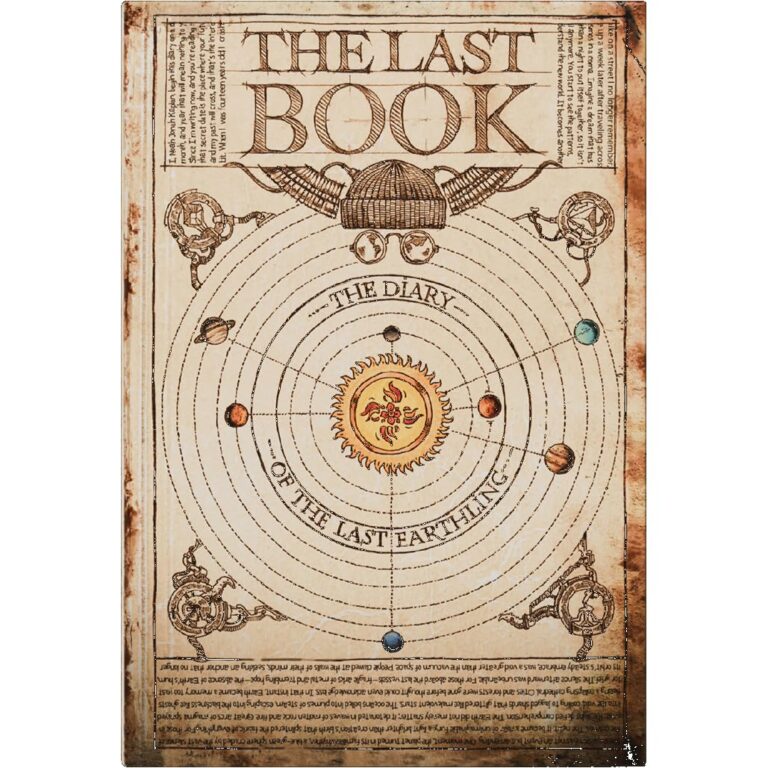
THE LAST BOOK
Winner of the 2026 IndieReader Discovery Awards in Graphic Novel, Fiction
What’s the book’s first line?
“I, Noah Jonah Kaplan, begin this diary on a day, month, and year that will mean nothing to you: Since I’m writing now, and you’re reading then, that secret date is the place where your future and my past will cross, and that’s the interesting bit.”
What’s the book about? Give us the “pitch”.
Noah Kaplan sits, touching up a caricature of a stranger in Manhattan’s Washington Square Park, when Earth explodes. An alien spaceship beams him in, and he wakes up horrified. Running up and down the ship’s labyrinthine halls for days, Noah finds no other humans. So, then, with the sketchbook and pens that the aliens abducted along with him, he writes them an encyclopedia of human history as he knows it—partial, personal, lovingly biased—interspersed with diary entries and reminiscences.
What inspired you to write the book? A particular person? An event?
It really was a collective generation. Timur Kadyrov and Seva Batishchev, Hungry Minds co-founders, approached me (Jonah Howell, Noah Kaplan’s voice) a few years back with the first germ of an idea for it: An encyclopedia of human culture for aliens. I loved the idea—I’ve adored encyclopedias all my life, and the particular type of alienation and melancholy required to write one for entities that have no experience of this planet was extremely enticing.
So we’d meet on Zoom, along with lead illustrator Lev Kaplan (who appears in the book as Noah’s uncle), researchers Margarita Fedorova and Natasha Germanovich, and Anna Borodina, and we’d argue for an hour or so every few days about where the book should go next, how Noah should frame things. So Noah and his world and his story emerged piece by piece from those talks, from things we’d read, other projects we worked on during the process.
For a good many months, we flipped back and forth and around about how Noah should sound and who he should be—first he was from the mountains outside Bozeman, Montana. Eventually he became a neurotic New Yorker whose style and perspective took heavy influence from Andrei Sinyavsky’s short story “Pkhentz,” as translated by Ainsley Morse. In the end, Max Kaplan (Lev’s son—so I guess Noah’s cousin) proofread and really sharpened the voice and, proofreading in his third language, which I cannot begin to comprehend, caught something like a hundred of my mistakes per chapter. He just translated The Last Book into German. That one should hit shelves, or, rather, Bücherregale, this fall, as a collaboration between Hungry Minds and VEMAG Verlag in Cologne.
What’s the main reason someone should really read this book?
For pure curiosity’s sake: We really dove deep into sources from all over the world in all the languages available to us to make sure that, limited though Noah Kaplan’s perspective has to be to remain realistically human, the Earth we presented would be full and complex and fundamentally different, for Noah looking back, than the Earth we see while living on its surface.
What’s the most distinctive thing about the main character? Who—real or fictional—would you say the character reminds you of?
Noah’s distinctiveness emerges from his reactions to the suffocating loneliness of the spaceship: With no one to hear or read him (yet), language comes apart in his hands, obsessive punning pierces holes in the veil of knowability, and he becomes alien, himself. He reminds me a bit of José Arcadio Buendía in Gabriel García Márquez’s One Hundred Years of Solitude, after he’s founded Macondo and met the Gypsy sage Melquíades, and he locks himself in his alchemical study, learning more and more deeply about the world his memories and books can provide him, but becoming at the same time ever more distant from the reality on the other side of the door.
When did you first decide to become an author?
In the book, Noah decides to become an artist as a teenager, after a bike crash puts him in a week-long coma. When he wakes up, he can’t cleanly differentiate his memories of the alternative world in his comatose dream from memories of the world he’s returned to, and his father suggests that he start drawing the dream world to make sense of it.
This plot point, if I remember right, was Seva’s idea—but it’s also how I became an author. After a head injury in high school, I forgot most things: how to speak English, how to open doors, how social interactions worked. So I started writing the new basics of living that I learned each day, along with theories and patterns and stories, sometimes in notebooks, sometimes in a notes app, sometimes on my arms and hands.
Is this the first book that you’ve written?
It certainly is Noah’s—he was born on its first page—but his constituent parts have written others. Hungry Minds’ first tome, The Book, came out in 2022. Lev, Noah’s uncle and illustrator, has rendered reams of fairy tales, both German and global, as well as classics like Verne’s Around the World in Eighty Days and the 1001 Nights.
What do you do for work when you’re not writing?
Noah identifies himself as a hobby artist who works an email job in the widget and doodad sector. As far as the creators of his arc (or of his ark?) go, some of us are in journalism, some in academia. Timur and Seva, before starting Hungry Minds, ran a wildly successful chain of escape rooms. I work variously as a teacher, actor, and bouncer.
How much time do you generally spend on your writing?
Something like five to six hours a day. On the illustrating side, it seems to me like Lev is drawing everything for everyone all the time—I imagine him in his studio in Germany, nodding to King Crimson and Yes records, and suddenly looking up and noticing he hasn’t put down his pen in eight hours. But he ardently insists he’s a craftsman, not an artist.
What’s the best and the hardest part of being an indie?
From beginning to end of the process, idea to drafts to tenth drafts to book-in-hand, each of us knew each other and knew exactly who was doing what and what had come from whom, and everyone had input in each stage of the writing and illustration. That allowed (A) for an extremely dynamic and thorough creative process and (B) for an extremity of idiosyncrasy in Noah’s voice and visual world that couldn’t have been mustered up by just one or two of us working alone.
As a writer, though, of course, having multiple editorial meetings per week *before* there’s anything like a finished text is profoundly challenging—the act of writing becomes a juggling act with several other people’s brains as much as an act of isolated creation. It required a level of attention and empathy that I’d never reached in my writing before, outside theatrical work.
What’s a great piece of advice that you can share with fellow indie authors?
Find competent and focused collaborators whom you trust *and* like. Have massive gratitude for the nauseous feeling of frustration when they see flaws in parts of your work that you love.
Would you go traditional if a publisher came calling? If so, why?
Sure. If I have a story that fits that traditional publisher, and they want to work on it with me, wonderful—that story now gets to reach its audience. Some things make more sense to produce independently; The Last Book, with the density and care of its illustrations and the hard-to-classify mix of encyclopedic content, emotional diary entries, and oddball humor, not to mention its sheer dimensions, would’ve been absurdly difficult, if not impossible, to make in a traditional press selling/consigning to traditional bookstores.
I think the only physical store that stocks it is Waterstone’s, in the UK, but for, say somewhere like Barnes & Noble, the margins just don’t work—there’s a reason so many of their more ornate or illustrated titles, like the B&N Classics series, are produced in-house with text in public domain. And with no physical office and collaborators in the U.S., Italy, Russia, Dubai, and Indonesia, we could amass extremely varied knowledge and perspectives in a way that’d drive a larger corporate press’s HR, payroll, and tax folks to heavy drinkin’.
Other books, though, fit the traditional model wonderfully. Each method has its time and place.
Is there something in particular that motivates you (fame? fortune?)
Noah is motivated in his writing by a sense of responsibility to represent his species, which I imagine none of us, his ark-builders, shares; but he’s also driven by solitude, curiosity, compulsion—in the old sense of the word, by *vocation,* a calling—and, to varying degrees, we certainly share those things with him.
Which writer, living or dead, do you most admire?
Noah, somewhat late in his encyclopedic tale, gushes with admiration for Ibn al-Nadim and his 10th-century encyclopedia of books and authors, Al-Fihrist, as well as Ibn Khaldun’s Muqaddimah, which, in the book’s first draft, I mistakenly claimed was the Middle East’s earliest encyclopedia. Thank God for Max Kaplan’s sharp eye. But while I share Noah’s love of the Muqaddimah, I’m a bit more partial to Dostoevsky: Demons is, I think, the most perfectly structured novel ever written.
Which book do you wish you could have written?
The most envious I’ve ever felt reading was at the final page of László Krasznahorkai’s The Melancholy of Resistance. His formal inventiveness, the depth he pulls from his narrator’s obsessions and limitations, the teeming Gothic fog he winds around this little town—it’s unbelievable. I don’t wish I’d written it, since to have done so would imply I’d lived an entirely different life, but I’d love, someday, to be capable of something like it.