
An Open Book with Jonathan Kieran
Awarded 4+ stars and the IndieReader Approved seal—here’s what the author has to say.
About the Book
In 150 words or less, give us your back-jacket summary — what’s this book about?
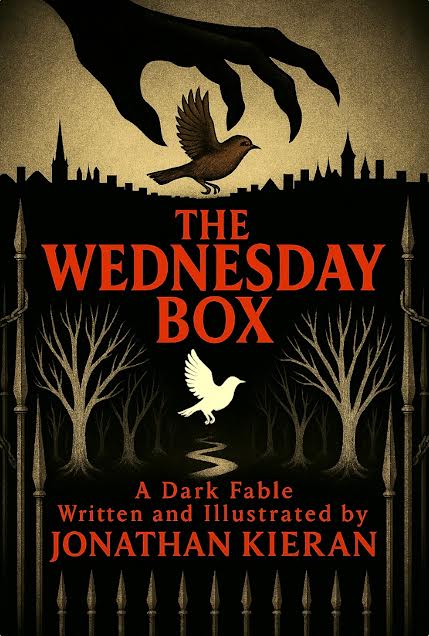
The Wednesday Box is a dark fable about the loneliness and neglect suffered by a young, wiser-than-her-years bookworm named May and the perils—both worldly and supernatural—that lurk in the shadows, waiting for children like her to slip through the cracks. This is a story about the way a timeless Evil preys upon society’s “forgotten” ones, the unlikely magical allies that can be made in the most terrifying places, and the courage required to break the veil between worlds and get back home … even if the same old life awaits.
What’s the book’s first line?
May first saw the man in the splotchy raincoat on the subway car.
What inspired you to write this book?
I have been intrigued by the fantastic and the magical, by worlds seen and unseen, since I was a child. My early interest in books and fairy tales and my eagerness for adventure was not welcomed by my family at all. I grew up in a very remote, harsh environment where stern practicality was prioritized and excessive imagination was discouraged. Being clever by nature and sheer necessity, I found a way to blend various elements of “acceptable” behavior with my inner sense of wonder, but it was a lonely life. I was a complete mystery to my parents; they knew only the insular, hardscrabble, dismissive world in which they grew up. Existence could be brutal and you had to hold it in, which, in some cases, can be akin to soul-murder for a sensitive kid.
For this reason, when I left home and discovered the wider, more wonderful (but still challenging!) world on my own, I never forgot that child “left behind”. As my adventures took me across the globe and informed my writing, as well as my personal character, that young boy who had to grow-up too fast stayed with me and I always wanted to create a truly magical adult story centered upon the witchy, wild experiences of a child forced to live with an adult mindset but ever-desperate for a loving family and the permission to simply be a kid, instead of absorbing everyone else’s stress–monsters. Obviously, there’s a lot of myself in May, the protagonist in The Wednesday Box. And, of course, there are monsters and ghosts included, because life will always be full of those. One simply has to get the best of such enemies and writing a soulful, dreamscape novel filled with those themes is a great way to do that!
Make the case — why should someone read this book?
I don’t consider The Wednesday Box to be a book limited to fans of fantasy works, dark or otherwise. There is an enormous amount of craft, heart, and universal human pathos woven into the narrative of May and her battle against an unthinkable being intent upon enslaving her. Beneath the fantastical elements of this novel, one will be confronted—in an entertaining way—with themes common to life’s most elemental struggles: the scourge of loneliness; heartbreak due to the loss of a parent; needfulness when vulnerable; the insult of being misunderstood and abused; and the allure of visiting a magical world, an alternative world that is both harrowing and filled with fascinating lore, personalities, and backstories. It also asks serious questions about the real origins of human life, and those worlds we can’t see, as well as the powers that rule them.
All of this is on display while that dangerous, imprisoning, parallel realm forces a youngster to draw upon the competing aspects of her nature, i.e. the grown-up mindset she has been forced to assume due to neglect and circumstance, and the childlike innocence that rightly seeks refuge amid helplessness, remaining pure enough to choose goodness and compassion amid total chaos. That is key for May, my protagonist, and it is key for me.
It’s dark and shocking and deliciously suspenseful, loaded with magic, but it’s also a broader parable for our lives and how most of us are, essentially, thrown to the wolves from birth but still capable of resilience. The book is also a gift of beauty from the spirit. I write not for my own pleasure, so much, but to share. My prose has a lyrical quality, I have been told, and I like the idea that every sentence might charm the minds of readers due to craft. I want people to hear a comforting, whistling wind through the forest trees … even if I’m writing about monsters and the souls who do battle with them. Finally, the book is illustrated and I drew/painted each one of the forty-five full-color works. You won’t find that often in this era and the hard work is worth acknowledgement. This is the second book I have released that is rife with my lavish illustrations and even with the first one, in 2013, people asked me, “Did you use computers to do that?” NO.
Share a line from the book you’re particularly proud of.
Must I pick one? Give me a minute! Okay:
Standing on the highest step before a crumbling altar between the Little and Great Orchards, the Grinder—again unclad and haggard, with the Lenashee’s stolen braids blowing sideways in a fiery wind—gazed upward in the shredded light and held in one taloned hand a human skull, white as chalk and grimacing in a rictus of Agony Ever After.
About the Author
When did you first decide to become an author?
Probably in the womb. I certainly emerged full of stories and a general, wondrous view of a life I had no ability to understand or probably survive. But I survived. Imagination was my best friend at a very young age. I was reading at age two, composing little stories and songs and poems at age five, and the Muse stayed with me for a lifetime. I’m grateful—imagination and wordsmithery have been twin refuges since I can remember. As far as writing actual books, I used to print-out little short stories for my grandmother when I was nine or ten. Granny was the only one in the family who “got” me—I owe her the world. I’d compose tales and “format” the rudimentary books, make covers (because I could draw), and then staple them together for her. She seemed to be thrilled with them but time flies and I never knew what happened to these little booklets after I moved away.
When my Gran died and I flew back for the funeral in New York, my Dad presented me with a box full of the tiny books I had made for her years earlier. She had kept them in a little treasure chest near her bed. I couldn’t believe it. Needless to say, a few tears were shed. I still have them and cherish them because she cherished them. I did look through them. They weren’t bad for a ten year-old.
As for serious novel writing, I had won essay prizes, Regents scholarship awards, and contest entry awards throughout my teen years. I had to put myself through school after that, as a young adult, so writing tales took a back-seat to work and study, but things changed when I found a “rediscovery” moment a few years later in my life and then determined to move to France for a year and complete a novel, from start to finish. It seemed pie-in-the-sky (I figured I’d have too much fun living in France to get a lot done) but I fulfilled it in a big way. I got a one-way-ticket to Paris and then traveled the country—as well as other parts of Europe—for just over a year and finished a four-hundred page novel. Best, most satisfying experience of my life, to this very day. It was an adventure no one else on the earth could understand or with which anyone could interfere. No one shall ever be able to remove the merest grain of sand from it.
What else have you written?
After completing most of my higher education I went into business for an ad company immediately. I had a flair for copy and jingles and graphic design, so I rode a little wave in that regard, then opened my own company, which did very well for five years. If I could do it on my own instead of for someone else’s primary benefit, why not? I had an entrepreneurial streak and followed it. But the inner-self disagreed, after a time, and said, “Move to France and write a book.” I obeyed, as noted above.
Upon return from the USA I relocated to California and built a whole new life in business and new entrepreneurial ventures. I had an entertainment lawyer but not one who could agent material to the NYC houses, so I took some meetings in NYC and met a few spectacular people but also a number of questionable ones. For about a year and a half I enjoyed a gig writing satirical guest columns for New York Times essayist Cintra Wilson’s Dregulator online magazine. She was and remains the best: a spectacular talent who was on the same page (no pun intended) in terms of style and she was a whip-crack brilliant editor. One of the sharpest I have ever encountered. I learned a lot from her uncompromising professionalism and laser-like Sauron Eye.
I flew to NYC to meet and sign with her agent but the gentleman experienced an unraveling personal tragedy just as I was in New York. The moment I was there. It was no one’s fault. Life happening. At all events, that torpedoed my NYC ambitions and I turned quite soon to small press opportunities. Within that framework, I launched a fantasy series called The Enchanted Heritage Chronicles, based upon a character named “Rowan Blaize.” I illustrated the first work profusely and it was well-received but the books were also released during the biggest tectonic shift in publishing of the 2015s and it was difficult to gain traction. In such a situation, everything becomes a learning curve that changes month-by-month.
In 2020 I released a very dark psychological/supernatural thriller entitled Wistwood. This was supposed to be the breakthrough—Kirkus Reviews raved about it and they chose the book (and review) for inclusion in their print magazine. Only six percent of the well-reviewed works are selected for their print edition, as I was told when they relayed the information that my book would be included. As fate would have it, however, Wistwood’s release date was April 20, 2020, which was within a few days of the worldwide and USA COVID lockdowns. As most recall, that tragic episode, in which millions of lives were endangered globally, made publishing a book seem very insignificant. The world became understandably fragmented and disconnected. My own life and the lives of my friends were subjected to upheaval, so the book was shoved to the periphery by me and everyone concerned. I’ll definitely look to revive it, but the entire episode was unimportant compared to the wellbeing of loved ones, friends, and neighbors.
What do you do for work when you’re not writing?
I am a carpenter, woodworker, and I oversee my small ranch in the remote, eerie woods of the Big Sur Highlands and Santa Lucia Mountains in California. If I’m not working with my brain, I am creating things by hand or sawing logs. It’s all-day work. We have had a lot of catastrophic fire activity in this part of California (as in most every place in the state) and I like to repurpose our beautiful oak trees that have been felled by fire damage by creating staves and walking sticks. I have quite the woodshop full of waiting remnants, but for now, The Wednesday Box comes first.
What does your writing process look like?
Idea. Pondering for a few days. Long walks in my woodland seclusion. First sentences. I have to feel a story coming like a rainstorm. If it does, I follow a policy of strict honesty in writing. Don’t force anything, EVER. Let it come from the soul and the natural dialogue between imagination and body and page … or the screen of a device. I am also an obsessive note-taker and list-maker. Keep your devices handy, or a pad of paper if your device is charging, then get off your butt and don’t let that slippery minnow of a thought that swam through your head go unmarked. Write. It. Down. I write bits on paper, in journals, and definitely on my PC. Significantly, with iPhone and iPad (great for notes) I email a first sentence or first paragraph to myself and things often burgeon from there. You can do it in bed because, let’s face it: if you’re a writer, material comes to you while your head is on the pillow after a long day or even in a stray dream. Keep notes or you will hate yourself in the morning.
What does being an indie author mean to you?
Freedom and control with serious self-discipline. You’d not only better be a vampiric self-editor, but you had better surround yourself with qualified pros and support systems who will “eagle-eye” the work. It’s staggeringly difficult to do such work on your own. You had better be in your wheelhouse. Moreover, you’re pushed and pulled between seeing how jammed the marketplace is, currently, and how various genres are succeeding while quality is questionable. Press on. Hold yourself to the highest standard, and surpass that.
Structural support is, for me, crucial. I am currently working with a force-of-nature marketing and design specialist who is the best collaborative talent I have ever encountered. She is a Book Khaleesi, if you will. Genius in her own right and, when artists meld in this kind of manner, excellence arrives. And it’s a thrill. Yes, headstrong artists working with other headstrong artists make for a few “blips” along the radar but that’s the magic. Find marketing and editorial support who will challenge you and push you forward. Little fits of pique will mean zilch, because your talented book manager will kick your butt when needed and provide you with an overarching flood of excellent ideas, advice, artistic insights, etc.
What do you wish you’d known before you published?
Nothing! Because then I might not have done it! My theory: If you have the guts to write and actually finish a book, to complete the final sentence … you are already a hero. If you can do that, you can publish the work. It means you’re driven and don’t let anyone take that away from you, no matter what you write.
What’s a great piece of advice you can share with fellow indie authors?
Do your homework. Dive deep into the options, don’t be swayed by “too-good-to-be-true” come-ons, no matter who advertises them. Read everything about the business of being Indie. Gather support in the best way you know how. Pay for a gifted designer and editorial collaborator. Write honestly, no matter your genre. Aim for a streaming agent. Bring your freaking best talents. Every sentence. Don’t pay attention to people online who critique your book with nonsensical reviews, with clearly demeaning or envious remarks that have little to do with your work. Picture them with six years of cast-off bellybutton lint coagulating beneath their sofas.
What are you reading right now?
Fun question! I’m an avid reader, unquestionably, but I suspend all reading that might entertain me while I’m in writing or editing mode. I never want other writers’ patterns or voices to seep into my work. I think that’s important. With a break now, however, I like to revisit favorites that I keep like jewels stored away for perpetual admiration. To that end, I have started rereading Jonathan Strange & Mr. Norrell by the sublime Susanna Clarke. One of the great works of the 21st Century, I believe, and a big, juicy, epic story of unique magnificence. I’m also browsing a couple of academic books—I have an academic background and my house is flooded with journals and tomes about ancient Egypt and Byzantium, particularly.
What’s next for you?
Well, that’s pushy! No, it’s a fair question, without doubt, but my “next” is coming very soon and it is supposed to be a big secret. Even so, I will let the good people at Indie Reader and their admirers into the loop: I’m launching a series that will take over the world as we know it. Hee.
This post may contain affiliate links. This means that IndieReader may earn a commission if you use these links to make a purchase. As an Affiliate, IndieReader may make commission on qualifying purchases.