
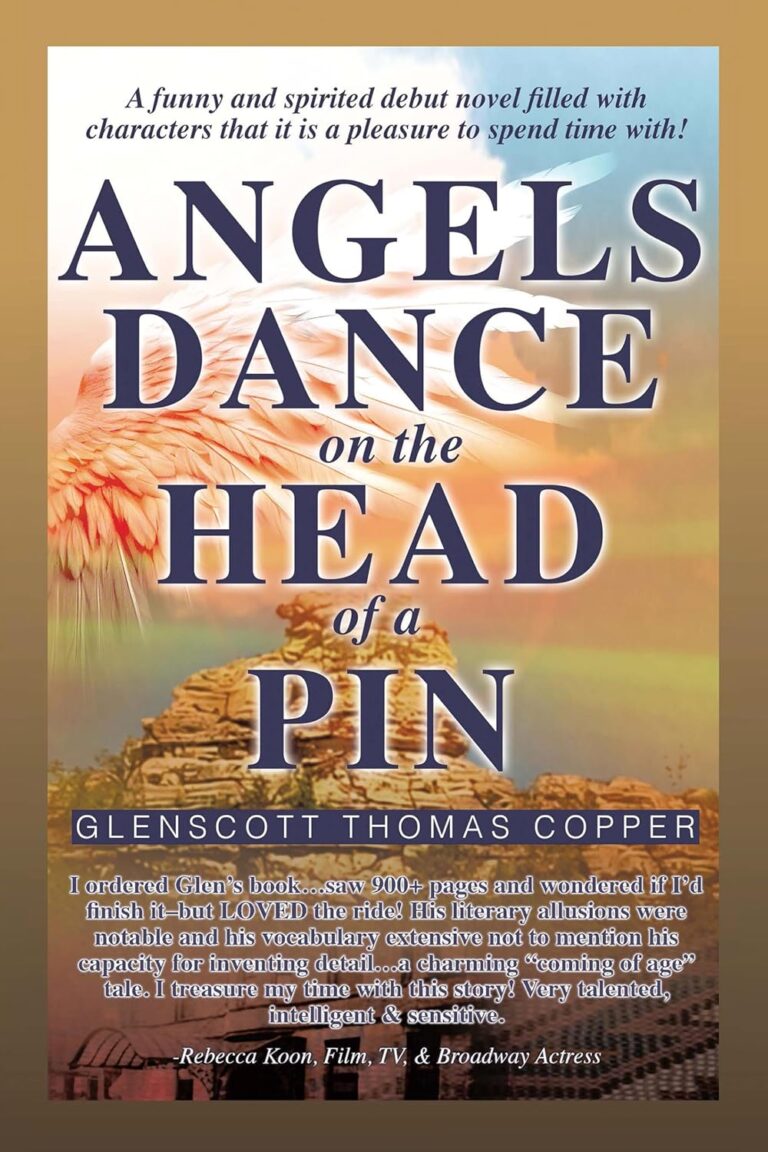
 ANGELS DANCE ON THE HEAD OF A PIN received a 4+ star review, making it an IndieReader Approved title.

Following find an interview with author Glenscott Thomas Copper:
What is the name of the book and when was it published?
Angels Dance on the Head of a Pin was originally published in December of 2022, and since then has been updated with a new cover, an Epilog, a Character List, and more. It also features a list of Discussion Questions for book clubs and teachers.
The title derives from a quote attributed to St. Thomas Aquinas in which he is clarifying that Angels have spiritual bodies and so they do not occupy space. Therefore, 10,000 may dance on the head of a pin. My contention is that they could appear to spiritually also occupy the spirit (soul) of a person, animal, plant, or any other substantial thing, and spiritually communicate with any receptive being. The key word being receptive.
What’s the book’s first line?
“Father Weber was taking his time at the Memorial Prayer-there were lots of newly dead to be remembered.”
What’s the book about? Give us the “pitch”.
Train rides play an important part of this uplifting story, along with family tensions, supports, and tragedies; but it mostly tells how two young people come to depend on each other, alone together in a remote Wisconsin cabin in the middle of beautiful but challenging surroundings. Unknown to Scott and Willie, their indigenous neighbors have been silently watching from afar all along. But no one could guess what guardian angels would be needed next, as Scott struggles to become an honorable man over one memorable year, struggling with puberty and morality in a world full of examples of what NOT to do.
What inspired you to write the book? A particular person? An event?
The book’s inspiration came from a combination of a number of influences. First was the book “A Biography of Mountain Wolf Woman” as told to and translated by Nancy Lurie. The character of the medicine woman Grandmother, in my story, holds many of the qualities of Mountain Wolf Woman. When “Huckleberry Finn” by Mark Twain was banned from classrooms, as a teacher, I wanted to write something that would show young people growing into adulthood: people who cared for others and who were cared for, themselves, as in Twain’s works. Also, an influence was my own life of 75 years and people who fill(ed) it, including many years in Catholic grade schools and stories handed down of my real Uncle Ode, whom I only met at my Christening.
What’s the main reason someone should really read this book?
The main theme of this book is to help folks understand how young people can, and should, make moral choices on their own.
What’s the most distinctive thing about the main character? Who—real or fictional—would you say the character reminds you of?
The fictional main character, Scott, is roughly based on my experiences as a red-headed, stammering, left-handed youth in various Catholic grade schools and living in public housing on the edge of a fascinating marsh surrounded by forested bluffs, the Mississippi, and its tributaries. My older cousin, David, joined me in many adventures.
When did you first decide to become an author?
I first dreamt of becoming an author when I entered a contest in third grade and won a magazine subscription. Eventually, my wife and I married as Mass Communications college students, and I ended up teaching English, writing, poetry, and philosophy to high school students.
Is this the first book you’ve written?
This is my first completed novel. Long ago, I won the writing award for an early 48-hour movie competition for a script I wrote. In Boy Scouts, I received a bookbinding merit badge for an autograph book I made that included famous sayings.
What do you do for work when you’re not writing?
When I am not writing, I work for Big Brothers Big Sisters of Greater Milwaukee as a Match Support Specialist, helping to match participants and to provide assistance and overview organization for activities after school and at lunch time. I am also a Big Brother myself, for the third time. I’m president of the Milwaukee Bike Collective, which gives bikes away to various youth groups and lets people come in to learn how to work on bikes to earn their own bicycles. I make pastoral visits within the Wisconsin prison system, and enjoy cooking, gardening, sailing, and photography.
How much time do you generally spend on your writing?
Right now, I am in the research and thinking stage for my next project, so time spent writing may be only half an hour, but could grow to 40 hours a week once the story crystalizes.
What’s the best and the hardest part of being an indie?
The best part of being independent is the freedom it offers, with fewer time pressures, and getting help from my wife. The worst parts are the endless phone calls of people wanting us to buy their services.
What’s a great piece of advice that you can share with fellow indie authors?
My advice is to NOT pay anyone to be on their podcasts. Find an agent and a publisher.
Would you go traditional if a publisher came calling? If so, why?
I would go traditional if a publisher appeared. It saves a lot of promotion work and offers a much wider saturation. They know the business much better than we do.
Is there something in particular that motivates you (fame? fortune?)
I am motivated by the idea of teaching by example: how to deal with challenges of becoming an adult, and of how to deal with the pitfalls and stress of going through puberty.
Which writer, living or dead, do you most admire?
My favorite authors include Mark Twain, Leo Tolstoy, John Irving, Anne Lamont, and Thomas Merton.
Which book do you wish you could have written?
I wish I could have written Huckleberry Finn.