
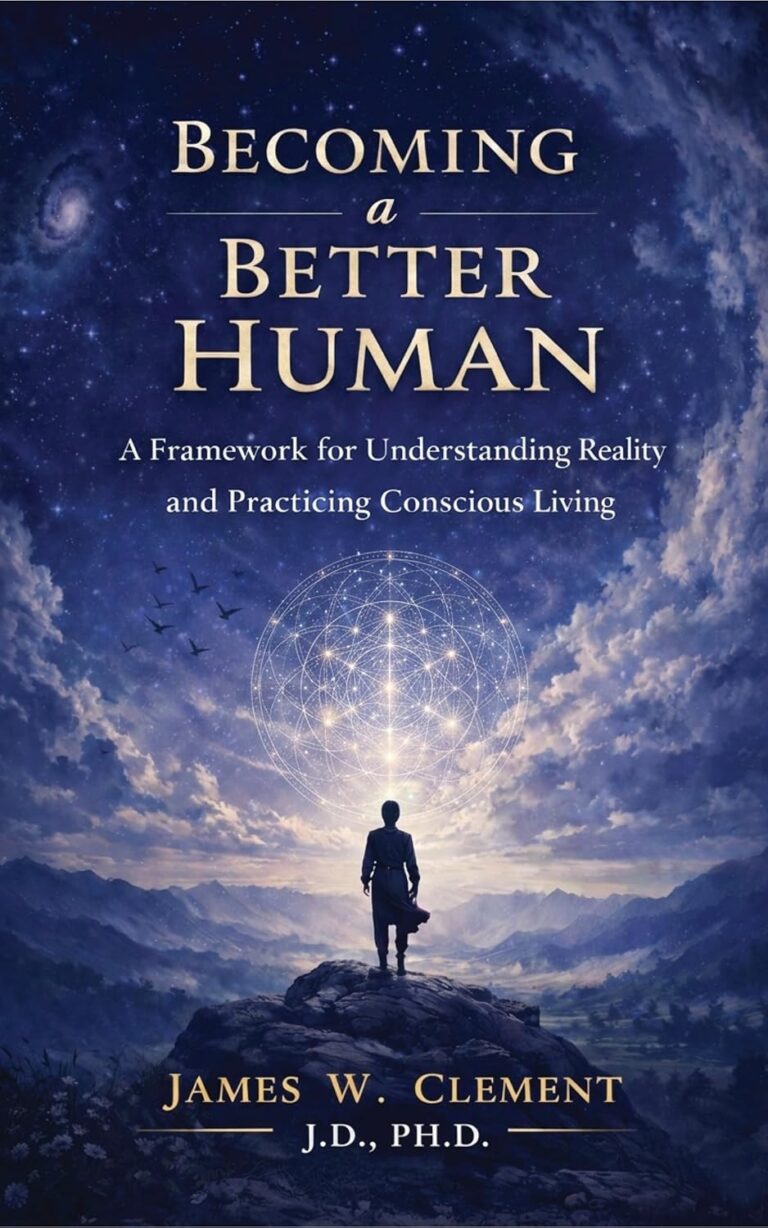
 BECOMING A BETTER HUMAN: A Framework for Understanding Reality and Practicing Conscious Living received a 4+ star review, making it an IndieReader Approved title.
Following find an interview with author James W. Clement:
What is the name of the book and when was it published?
Becoming a Better Human: A Framework for Understanding Reality and Practicing Conscious Living was published in 2026 by Betterhumans Press.
What’s the book’s first line?
“Before we begin, a simple reassurance: much of what is introduced in these opening pages will be clarified, expanded, and made practical as the book unfolds.”
What’s the book about? Give us the “pitch”.
Becoming a Better Human explores one of humanity’s oldest questions: Why are we here, and how should we live? Drawing from philosophy, spirituality, consciousness studies, psychology, and personal experience, the book presents a framework for understanding reality, the nature of self, and the forces that shape human behavior. More importantly, it offers practical exercises designed to help readers become more aware, compassionate, and intentional in their daily lives.
What inspired you to write the book? A particular person? An event?
The book grew out of decades of searching. As an author and scientist, I encountered ideas from science, religion, philosophy, near-death experiences, mystical traditions, and modern consciousness research that seemed to point toward common underlying truths. My method is to attempt to organize ideas from divergent sources into a coherent framework that could help me understand the field better. Once I had done this, I went through a year-long process of creating daily practices to embody the resulting cosmology.
What’s the main reason someone should really read this book?
Most people inherit a worldview without ever examining it. We are taught what to think about careers, success, religion, politics, and identity, but rarely encouraged to ask deeper questions about the nature of consciousness, the purpose of life, or why we behave the way we do. This book provides a framework for exploring those questions while offering practical exercises designed to help readers live with greater awareness, compassion, and intention. Whether readers agree with all of its conclusions or not, my hope is that it encourages deeper reflection and more conscious living.
When did you first decide to become an author?
I’ve been writing professionally for much of my adult life, as a lawyer, founder and co-publisher of h+ magazine, and as a researcher. The desire to write this particular book emerged gradually over many years. After spending decades exploring questions about consciousness, human development, and the purpose of life, I reached a point where I felt compelled to organize what I had learned and share it with others.
Is this the first book you’ve written?
No. I previously authored The Switch, a science-based book focused on nutrition, metabolism, and healthy aging. Becoming a Better Human explores a very different set of questions, focusing on consciousness, meaning, and personal development.
What do you do for work when you’re not writing?
I am a Ph.D. medical researcher, running my own 501(c)(3) nonprofit research organization. I am most noted for my work on Supercentenarians which was covered by a New York Times feature Science section article by pulitzer-prize journalist Amy Harmon. I’ve conducted numerous human clinical trials in the area of longevity research and coauthored a number of scientific papers and one health book, called The Switch. My research interests have recently broadened to include the scientific study of consciousness and reports of non-local phenomena.
How much time do you generally spend on your writing?
I’m a full-time researcher for my nonprofit organization. I spend considerably more time researching than writing. Becoming a Better Human grew out of decades of reading, experimentation, and investigation, followed by roughly a year of developing and testing the daily practices described in the book. During active writing periods, I often devote 8-10 hours each day to drafting, revising, and fact-checking.
What’s the best and the hardest part of being an indie?
The best part is creative freedom. Independent authors can pursue ideas because they believe they are important rather than because they fit a particular market category. The hardest part is visibility. There are many thoughtful books in the world, but helping the right readers discover them can be as challenging as writing the book itself.
What’s a great piece of advice that you can share with fellow indie authors?
Write the book that genuinely needs to be written, not the one you think the market wants. Trends come and go, but authenticity endures. Readers can tell the difference between a book written from conviction and one written primarily to satisfy an algorithm.
Would you go traditional if a publisher came calling? If so, why?
I would certainly consider it. Traditional publishing can provide broader distribution and marketing resources. However, I would want to preserve the integrity of the book’s central ideas and voice.Also, sometimes time is a factor, as it takes much longer to publish a book through the traditional processes.
Is there something in particular that motivates you (fame? fortune?)
My primary motivation for both books is sharing the insights which have come from very extensive research in the subject matter fields. I like to use the Golden Rule in my endeavors — do what you would like to see others doing, which in this case is helping to educate others on important, complex questions. If my book helps even a small number of people approach their lives with better understanding of their lives, I consider it successful.
Which writer, living or dead, do you most admire?
To pick a deceased writer who is relevant to my book, I would say Pierre Teilhard de Chardin. He attempted something very few thinkers have successfully done: integrate science, evolution, spirituality, and humanity’s future into a single coherent vision. Whether one agrees with all of his conclusions or not, the scope of his thinking remains extraordinary.
Which book do you wish you could have written?
Thomas Campbell’s My Big TOE trilogy. Tom is an extraordinary, living author. He’s a physicist by training and an experimentalist in non-local consciousness. His books present a Theory of Everything based on his extensive, multi-decades experiences in Out-of-Body travel.