

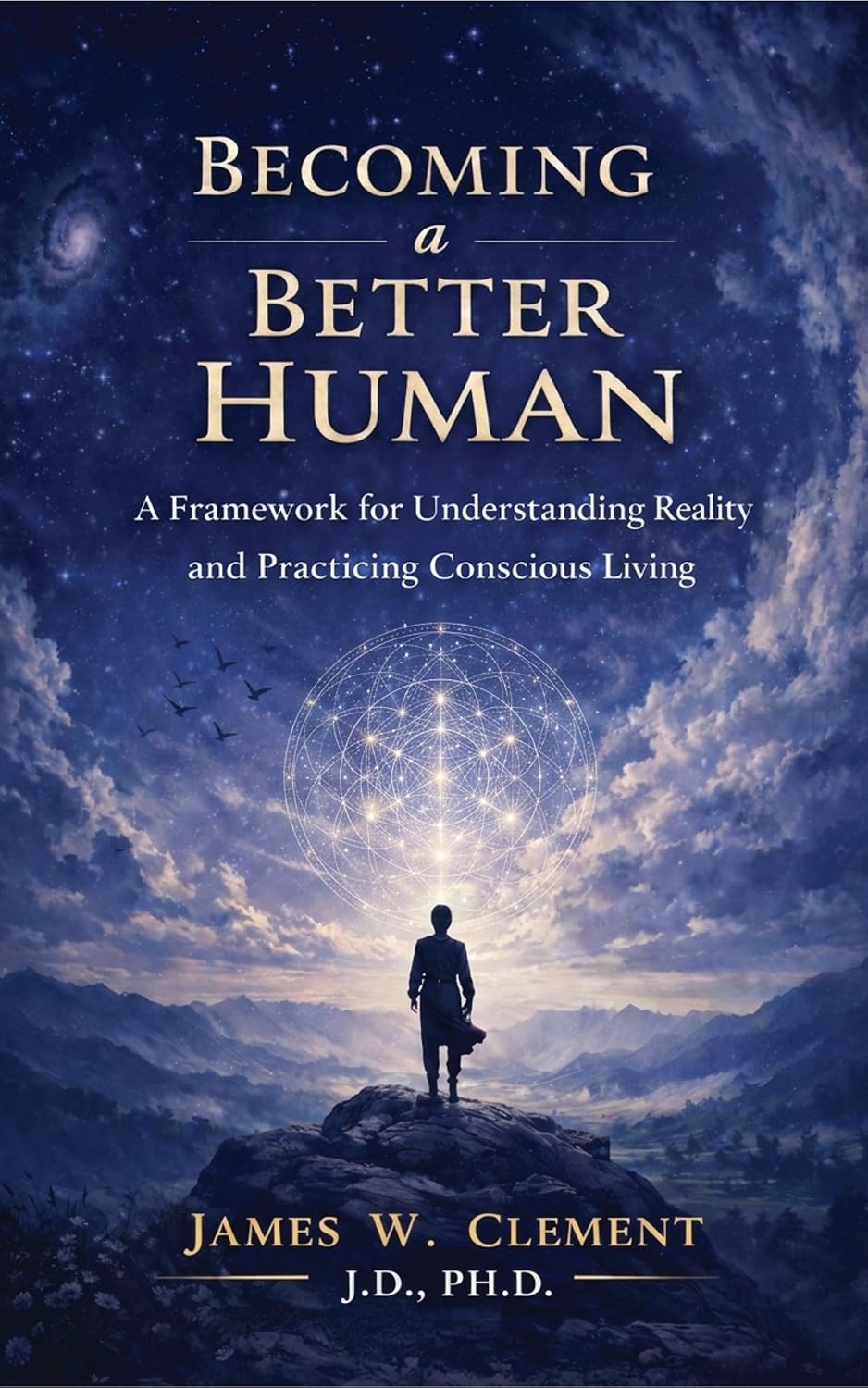
James Clement’s BECOMING A BETTER HUMAN: A Framework for Understanding Reality and Practicing Conscious Living offers up a philosophy of the universe, the soul, and humans in relationship to consciousness and the whole. Drawing from a number of mystical, spiritual, and religious traditions, Clement suggests that incarnated souls—humans and other sentient beings existing in bodies—are simply one particular type of outgrowth of a deeper, unified consciousness that seeks to learn and understand itself in various ways. That includes through exploring behavior and gaining insights within the limitations of bodily incarnation in a physical reality.
From this, he draws some interesting and thought-provoking conclusions about human relationships, ingrained beliefs, reactions, and thought processes. He also suggests some reframing of viewpoints, as well as practical activities designed to help improve people's awareness of their deeper selves and let them behave in more thoughtful, loving, spiritually aligned fashion. Like most metaphysical ideas, his are not scientifically provable (not in this incarnation, anyway); but they are supported by insights from various cultures and religions around the world—suggesting at least that he is not alone in his ideas.
Clement’s philosophy and the practices he suggests don’t require literal belief in their more metaphysical speculations to be effective, though. They provide instead a frame of reference through which to view human nature, existence, and possibility within a larger spiritual context (and to use that insight to shape actions and perspectives in a healthy way). It is also a very gentle philosophy that invites both self-love and love of others—emphasizing connection over judgmentalism, awareness and perspective over instinctive emotional reactions, and a balanced confidence over fear and doubt.
As might be expected when discussing complicated philosophical matters about the very nature of life, the universe, and everything, the ideas presented here require a substantial amount of deep consideration and practical action in order to be properly digested and made useful. This isn’t a book to read lightly as a pleasant diversion. Clement’s writing can get a bit convoluted in places: “When awareness collapses into unity without embodiment, there can be a subtle drift into spiritual detachment,” for example. However, his tendency to use metaphors to illustrate his points (e.g., describing incarnated souls as waves in the ocean of consciousness, individuated but never separated from the greater whole), his frequent use of short and clear action sentences, and his suggestion of practical techniques make his philosophy more accessible. The inclusion of a glossary that explains some of his more technical terms also helps.
Readers looking for a spiritual and metaphysical foundation to help them explain who we are and what we're here for will at least find in BECOMING A BETTER HUMAN some thoughtful and useful guidance.
The philosophy described in BECOMING A BETTER HUMAN: A Framework for Understanding Reality and Practicing Conscious Living may take some thought to grasp, but it’s worth the effort. James W. Clement suggests a deeper spiritual understanding drawn from a variety of traditions, but his ideas and suggested practices may be helpful even to readers who do not accept all his premises as literally true.
~ Catherine Langrehr for IndieReader