
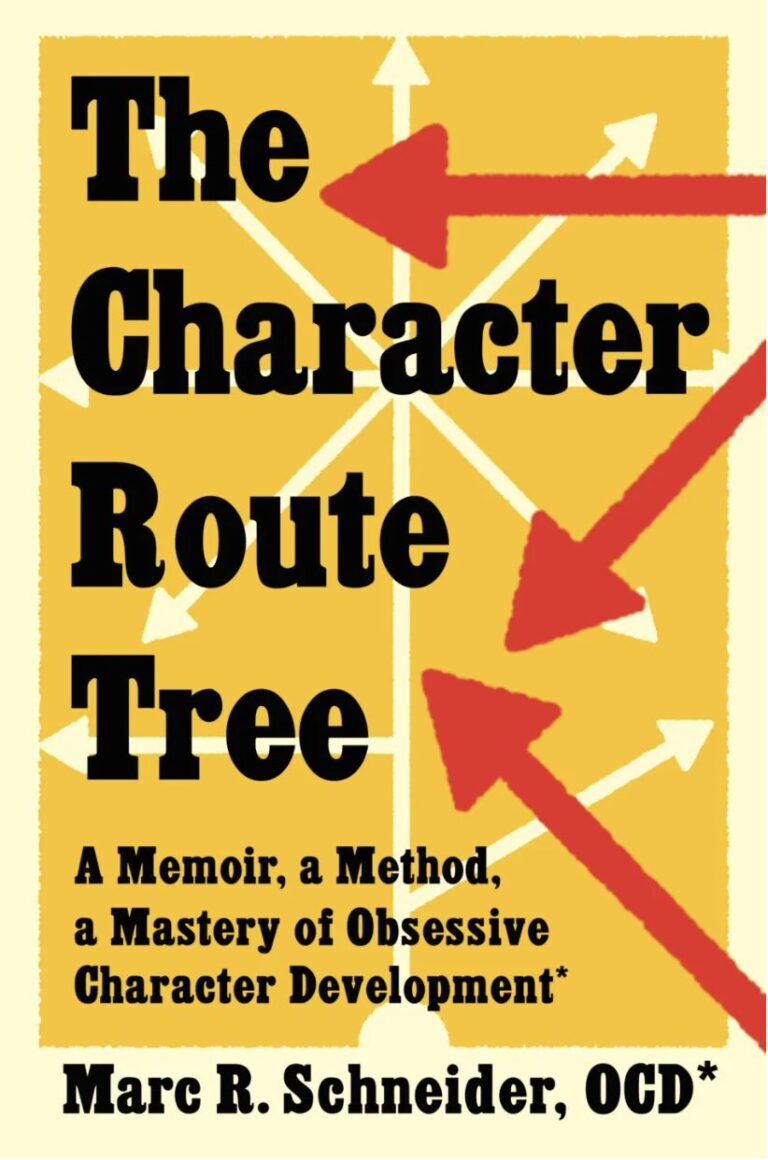
 The Character Route Tree: A Memoir, a Method, a Mastery of Obsessive Character Development: Received a 4+ star review, making it an IndieReader Approved title.
 The Character Route Tree: A Memoir, a Method, a Mastery of Obsessive Character Development: Received a 4+ star review, making it an IndieReader Approved title.
Following find an interview with author Marc R. Schneider:
1. What is the name of the book and when was it published? The Character Route Tree: A Memoir, a Method, a Mastery of Obsessive Character Development. Published: November 27, 2025
2. What’s the book’s first line? It all started for me under a car.
3. What’s the book about? Give us the “pitch”. I wrote The Character Route Tree after a fifty-year battle with OCD, during which I learned to redirect obsessive intensity into a disciplined blueprint for growth. It’s a hybrid of raw memoir and tactical life system—built around football-style routes, daily mental drills, and an 850-acronym glossary that helps people turn chaos into character.
I don’t just tell readers to reach personal mastery; I share the road-tested routes that worked for me and show them how to aim their obsession at the right things. This isn’t motivational fluff or psycho-babble—it’s an engineered training manual for anyone who is overwhelmed, burned out, or stuck, and needs a system instead of a slogan.
4. What inspired you to write the book? A particular person? An event? The inspiration came from realizing that character isn’t something you’re just born with; it’s something you build, mile by mile. I spent nearly twenty years coaching football, and I’ve always been obsessed with the sport. A football coach with OCD is both a workhorse and a racehorse. We are obsessive planners and executors of our craft. I took that OCD into the coaching world and thought, “Wouldn’t it be something if we could be as obsessive about our personal mastery as we are about scouting reports, wins, and losses?” I wanted to create a scouting report for character development—the obsessive kind. The kind that wins. I gravitated toward acronyms like I always have, and it hit me: F.O.O.T.B.A.L.L.—Focus On Obsessions That Build A Lasting Legacy.
This philosophy wasn’t shaped in a library; it was forged in a huddle. In July of 2010, a nine-month quest led me to work for a lifetime idol with one of the most championed pedigrees in NFL history: Bill Curry. I was an unpaid 40-year-old recruiting and wide receiver intern on his inaugural staff at Georgia State. I didn’t just learn football; I honed character.
Coach Curry played for legends like Vince Lombardi and Don Shula, but his greatest impact on me was his ability to speak and share all that is truest in us—the good, the bad, and the ugly. He is an incomparable thinker who taught me that being a proactive and compassionate thinker is the worthiest pursuit of all. His influence inspired me to create a scouting report for the soul.
The Character Route Tree is a “football book” that isn’t about football; it’s a disciplined deep dive into what it takes to move the chains of the mind. I felt motivated to share this because I’ve been at the “point of no return” too many times in my life. I wanted to show others that there is a systematic, coachable way to find your grip and change your trajectory. I didn’t want this book to be preachy—I wanted it to be authentic, raw, and road-tested.
5. What’s the main reason someone should really read this book? Someone should really read this book for its raw transparency alone. In fact, there is more to lose in not reading it. The “FOMO” factor should pull readers in—not out of a trend, but out of the fear of missing out on the greatest lessons that only come through shared vulnerability. The war with the mind requires more than just reading; it requires a deep revealing of oneself. That is why, as the author, I chose to reveal the most private, vulnerable moments of my own life.
I know 760 pages might scare some away, but The Character Route Tree is actually three books in one: A Memoir, A Method, and A Mastery. I could have published three separate, marketable volumes, but there is nothing marketable or appealing about OCD. This level of engineering—Obsessive Character Development—cannot be brief. Retraining over fifty years of reactive thinking takes more than the typical self-help book length. It takes a lifetime; I share mine in these pages.
Don’t look at this as just reading a book; look at it as living a book. It’s a total immersion system designed to remain firm when your world doesn’t. If you want a feel-good story, look elsewhere. If you want to feel what it’s like to elevate your life, then climb The Character Route Tree.
6. When did you first decide to become an author? I first decided to become an author when I was five years old. At the time, I was obsessed with P.D. Eastman’s Go, Dog. Go! and Are You My Mother? I didn’t just read them; I hand-wrote them, over and over again. I was fascinated by how words and pictures could create a sense of urgent movement. I knew then that I wanted to be an author. It took a half-century of life engineering to get there, but when I finally sat down to write The Character Route Tree, I was still that same kid—meticulously handwriting the blueprint of urgent movement until it was complete.
7. Is this the first book you’ve written? Yes.
8. What do you do for work when you’re not writing? I teach high school in the School District of Philadelphia.
9. How much time do you generally spend on your writing? I have written every day for over thirty years—it is my daily mental drill. That discipline is how I first learned to cope with and redirect my OCD. The Character Route Tree was a six-year writing journey that began every morning at 4:30 AM in September of 2019. For three years, I committed to two hours before my day exploded with the demands of coaching and teaching. When I stepped back from coaching in 2022, that intensity didn’t retire; it shifted. Those two-hour sessions evolved into 12-to-18-hour writing days that lasted for the next three years. I don’t just write to tell a story; I write to engineer a system that remains firm when the world doesn’t.
10. What’s the best and the hardest part of being an indie? Being an indie author means I don’t have to fit a traditional publisher’s template. I was able to build a 760-page tactical manual with 850 acronyms because that’s what the system required to be effective. I didn’t have to compromise on the intensity or the raw vulnerability of my story. I am the architect of my own ground, and that can also lead to the hardest part of being an indie.
There is no “front office” to fall back on; much of the journey is a trial by fire. You have to learn the nuances of the industry—from formatting and distribution to marketing and engagement—in real-time, often while you’re still in the heat of the creative process.
11. Would you go traditional if a publisher came calling? If so, why? If a traditional publisher came calling, I would consider it—not for the status, but to experience the grip. As an indie, I am the sole architect of my ground. I own every decision, every experience, and every insight. Letting a professional publisher take hold of my work would be the ultimate trial by fire for my own philosophy. I want to see how I would respond to releasing that level of control. For any writer, navigating the friction between personal vision and industrial demands is one of the most valuable learning experiences possible. It’s one thing to have a system when you’re calling the plays; it’s another to maintain your character when you’re part of a larger machine. I’d go traditional just to see if my routes hold up under that kind of external pressure.
12. Is there something in particular that motivates you (fame? fortune?) When I started writing thirty years ago, I was motivated by the standard dreams of fame—I wanted to be the next Stephen King. But then “all help broke loose”’ in my own life, and the self-help genre came calling. I found a sea of motivational fluff and commercial slogans that couldn’t hold up under real pressure. I was quickly disillusioned.
Then, a friend gave me a book that changed my trajectory: Robert Caro’s The Power Broker. It was massive, dense, and at the time, completely over my head as my life spiraled out of control. Yet, through six apartments and three houses over 33 years, that book remained visible on my shelf. It was a constant. I realized I wanted to do for character what Robert Caro did for power. Caro didn’t just tell a story; he mapped a system. He showed the architecture of how a city is built. I wanted to write a “big book” that did the same for the internal architecture of a human being. I finally did that with The Character Route Tree. My motivation shifted from seeking fame to engineering a legacy—building a system that stays on the shelf because it actually works when the lights go out.
13. Which book do you wish you could have written? I’m a glutton for story, so I’m picking two—The Godfather and Jaws. They are masterpieces, but what fascinates me most is the engineering behind their success. Both Mario Puzo and Peter Benchley did something rare: they stayed in the fight. They didn’t just sell the rights; they wrote for the screen, working alongside brilliant directors in Coppola and Spielberg to ensure their vision survived the transition to the wide-release.
Puzo famously claimed he didn’t know how to write a screenplay when he started The Godfather, but he learned the discipline in real-time. Benchley even made a cameo in Jaws as a reporter, literally standing on the ground he created. I wish I had written them because they represent the ultimate writer’s grip—taking a raw, personal story and scaling it for the world without losing its character. That’s exactly what I aim to do with The Character Route Tree: take the raw intensity of my life engineering into a system that anyone, anywhere, can use to win at life.