
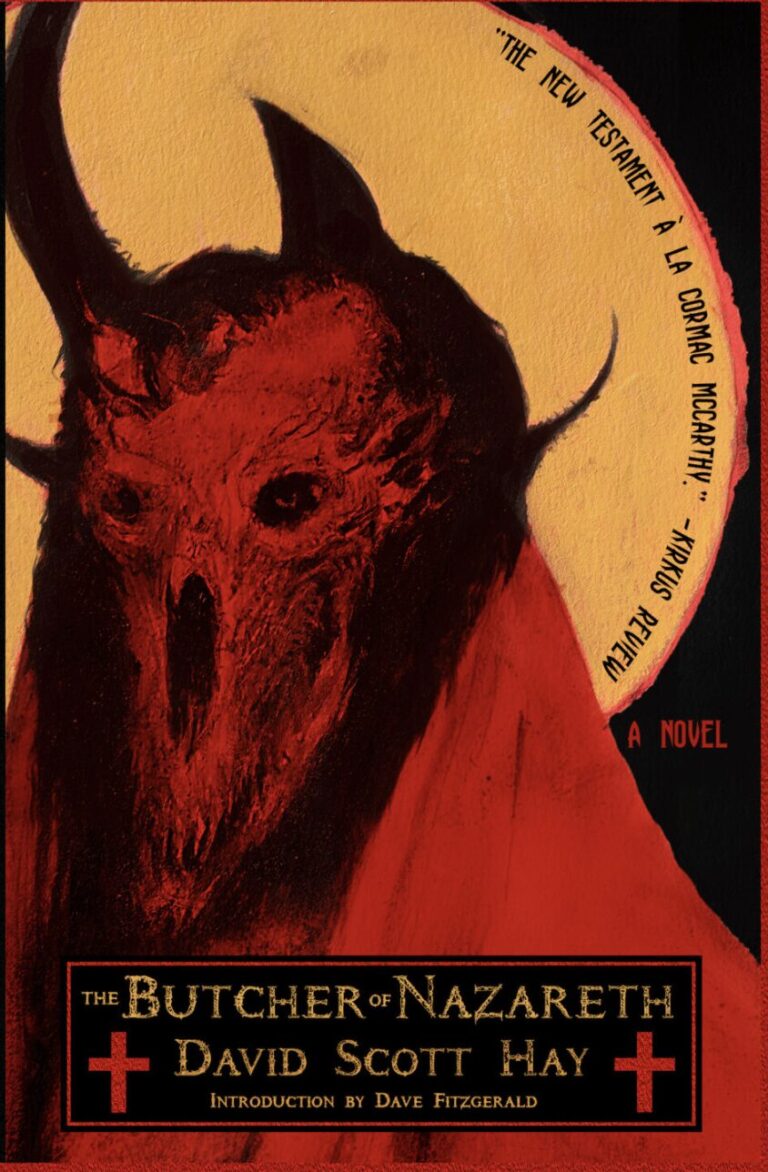
 The Butcher of Nazareth: Received a 4+ star review, making it an IndieReader Approved title.
 The Butcher of Nazareth: Received a 4+ star review, making it an IndieReader Approved title.
Following find an interview with author David Scott Hay:
1. What is the name of the book and when was it published?
The Butcher of Nazareth / 3-13-26
https://whiskeytit.com/product/the-butcher-of-nazareth/
2. What’s the book’s first line?
The Butcher’s task stood simple though arduous: kill one more child.
3. What’s the book about? Give us the “pitch”.
Haunting visions drive a grieving butcher to hunt down an obese, pre-ministry Jesus to prevent a perpetual age of fire and ash.But when the Butcher ‘adopts’ a dead newborn, his hunt for the son of Nazareth takes a personal and horrific turn.From Bethlehem to Jerusalem to Nazareth, familiar events and figures are reimagined with a modern sensibility, building to a gut punch conclusion.A heart of darkness story that explores: fathers and sons, grief, zealotry, and choice. How does one choose between personal redemption and world-wide salvation?
4. What inspired you to write the book? A particular person? An event?
The tiny story in the Book of Matthew about the Massacre of the Innocents. It’s a huge story implication wise, but is only given a few lines and is only in the Book of Matthew. So I wanted to explore those repercussions. My wife mentioned the story in passing when I was considering another much, much lighter project. It sparked enough questions and curiosity that I decided to jump into the deep end. The research was enlightening and I found it thematically rich.
5. What’s the main reason someone should really read this book?
First of all it’s a historical horror novel. Those rock.
Also, maybe you’re craving a thought-provoking, original horror read that does not embrace shock for shock’s sake or blasphemy for its own sake, or let the reader off the hook with miracles.
This is a story that fills in narrative gaps between the Old and New Testament. For instance, we hear two different versions of the Nativity from the Midwife was who there. If that subject interests you in the least, you will dig it.I give a very grounded and gritty depiction of Christ’s life leading up to his last pre-ministry days as seen through the eyes of a grieving butcher. It poses deep philosophical and moral questions about zealotry, religion, grief and choice.The thing I’m most proud of is I’ve received very positive feedback from both religious and non-religious folks. It’s been humbling to see the impact on readers who thought they knew what was going to happen. It’s led to amazing conversations.But be warned, the biblical genesis for this story is infanticide. There is violence. There is loss. It is not a beach read. Yet, also offers thrills, humor, and moments of connection. So many horror books miss out that connection is as strong, if not stronger than terror. Connection feeds the terror.
Please note: this is not your typical Christian fiction, I don’t even consider it Christian fiction. It is not preachy, but questions many belief systems. This is very much a Cormac McCarthy version (according to Kirkus).
6. What’s the most distinctive thing about the main character?
The Butcher’s drive, his zealotry, to complete his mission and how he wrestles with doubt and temptation. And again, he’s not in the wrong, his actions and motivation are justified.
And at the end of the day the book asks and answers: what happens when two righteous men face off?
7. Who-real or fictional-would you say the character reminds you of?
Nothing comes to mind. The character was born of grief, trauma, and a vision from God. His vision, not mine. Ha.
8. When did you first decide to become an author?
When I got kicked out of my rock band in college. I sucked (guitarist).
9. Is this the first book you’ve written?
No, I’ve written a handful previously. Mostly when I was younger. Then I pivoted to theatre and playwriting and honed my story chops for over a decade in Chicago and then one day I had an idea that became my novel The Fountain. That book has had its own journey.
I’ve also written essays, written and directed a feature film, written several screenplays and stage plays. But novels and screenplays are the bulk of my work these days.
10. What do you do for work when you’re not writing?
I write screenplays with my wife. She’s a Hollywood pro, but her and I both started out as playwrights. I edit and mentor on the side as well.
11. How much time do you generally spend on your writing?
I used to be a 2,500 words/day when writing, but I’m married with a son and I find 500-800 words a day when I’m in the writing process hits the sweet spot for me.
This most recent book, I did mostly voice-to-text and it was rewarding as opposed to the my previous book [NSFW] which I essentially wrote on a phone.
The writing is richer with voice-to-text. I’m not assholing my way from 1,500 to 2,500 words. I do one or two recording sessions (working off a rough outline) and then edit it at the keyboard.
My eyes are fresh, because I have no memory of having written it. It gives me great distance.
12. What’s the best and the hardest part of being an indie?
Autonomy.
I’ve been with my publisher long enough and worked enough festival tables with her, that I essentially handle the production end of my own books. Cover, interior, copy editing. Marketing materials. ARCs, reviews, etc.
Hell, I pitched her a horror imprint, HEADLESS, and she put me in charge, so that exercises a different set of muscles. I was a literary director for a Chicago theatre company for over a decade, and it honed my story scouting abilities.
Also, I’ve gotten to work with excellent writers in helping them develop their books, both fiction and non-fiction. I love that part of it, kinda like being a record producer.
The pay sucks, so there’s that.
13. What’s a great piece of advice that you can share with fellow indie authors?
Study the CRAFT. Read anything and everything. Fill your toolbox. And if you land a deal, be prepared to market and pitch and network your ass off. Make friends. Find your community. And again: Study the CRAFT.
14. Would you go traditional if a publisher came calling? If so, why?
Maybe. To potentially gain a wider readership. But I know that grass is not necessarily greener. At all.
15. Is there something in particular that motivates you (fame? fortune?)
Exploration of a subject. And the challenge of putting a narrative puzzle together. My brain craves that stimulation.
Also, every book or story is in a way a journal entry of my life at the time I was writing it.
16. Which writer, living or dead, do you most admire?
Tough question. I will say Alan Moore had the biggest impact on me as a writer.
His revolution in comic writing (Swamp Thing, Miracle Man, Watchmen) flipped so many switches in me at a young age. His BBC Maestro series on writing is brilliant. Even now I use tools I picked up from him from back in the 80s to last year.
17. Which book do you wish you could have written?
Blood Meridian by Cormac McCarthy