
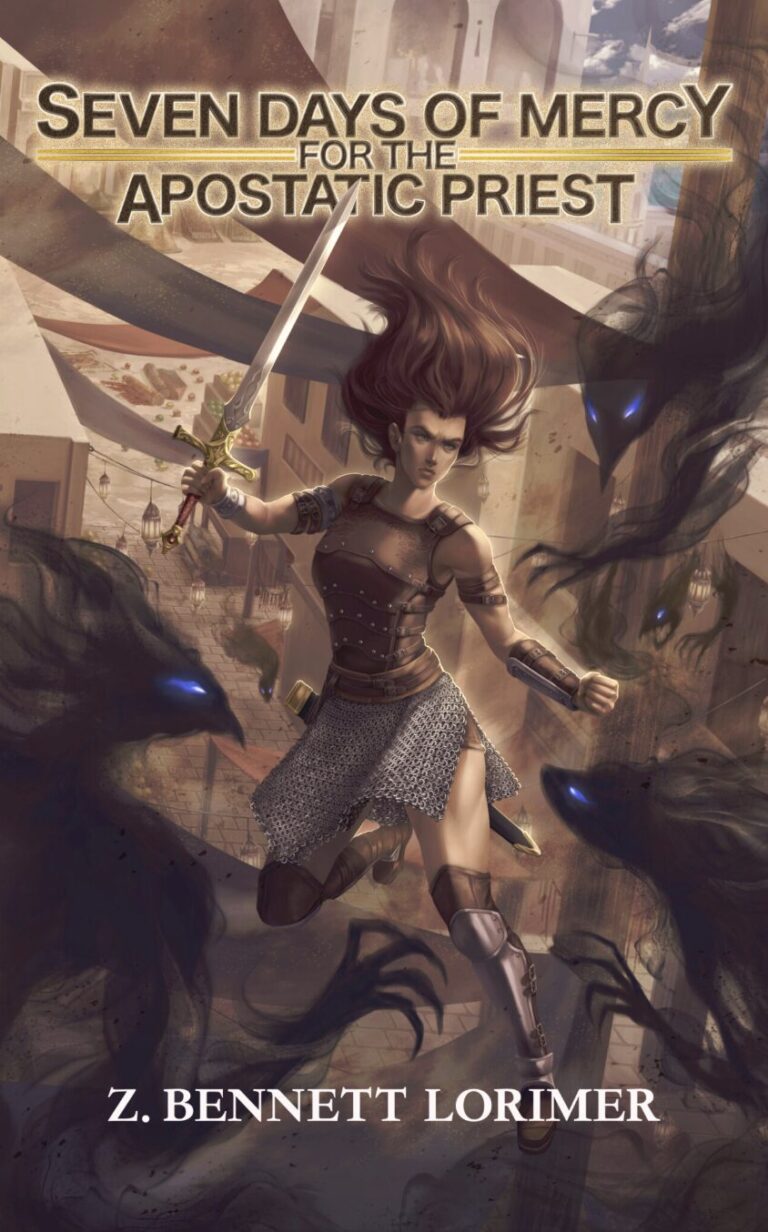
 Seven Days of Mercy for the Apostatic Priest: Received a 4+ star review, making it an IndieReader Approved title.

Following find an interview with author Z. Bennett Lorimer:
1. What is the name of the book and when was it published?
Seven Days of Mercy for the Apostatic Priest is the first book in The Divine Heretic series, my modernized take on the sword and sorcery genre. It is slated for publication on January 13, 2025 and available for pre-order wherever books are sold.
2. What’s the book’s first line?
“You are more.”
3. What’s the book about? Give us the “pitch”.
Seven Days of Mercy is a contemplative fantasy thriller about a warrior-priestess on a time-sensitive mission to assassinate a resurrected G-d. She and her sorcerer companion, Gerritt, travel to the Holy City Mahakalpe to intercept the God-child at the final stop on his pilgrimage, where she plans to kill him before he can receive his final investment. She soon discovers that the revenant G-dhead is a sweet adolescent boy, and that the metaphysical state of play in Mahakalpe is more complicated than her priesthood let on.
4. What inspired you to write the book? A particular person? An event?
This project was a long time gestating. A few years back I got the chance to meet and spend some time with David Anthony Durham, the brilliant author of the Acacia series and hard-hitting works of historical fiction like Pride of Carthage. Talking to David about his process and discussing his approach to digesting the raw material of history through fantasy was what ultimately planted the seed of Hebdomar. Readers who also enjoy historical fiction will likely see the influence of that genre on Seven Days of Mercy.
I tabled the concept for a while after writing a few chapters that would later be adapted into Seven Days of Mercy. Before I made the decision to withdraw all my manuscripts from consideration with traditional publishers and launch High Trestle Press, I spent a lot of time thinking about the dominant trends in epic fantasy and where the genre might be heading. I tried to distill these thoughts into an essay a few months ago. That thought experiment sent me rifling through my library for classic sword and sorcery stories from the early 20th century – Robert Howard’s Conan the Barbarian stories, Karl Wagner’s Kane and, most critically, C.L. Moore’s Jirel of Joiry. These stories became the key that unlocked The Divine Heretic series. I abandoned the broad, multi-POV approach that I had originally mapped out and zoomed on Ruxindra’s singular POV. The story explores themes of fanaticism vs. doubt, the role faith plays in weaving a social fabric, and the challenge of questioning one’s deeply held beliefs.
I think these themes are timeless, so readers will likely find quite a few real-world synchronicities, but Seven Days of Mercy is a work of fiction and any perceived connections to real people and events is entirely incidental. Outside of satire, I tend to have a low opinion of explicit allegory in fiction and an even lower opinion of stories written with a clear didactic purpose.
5. What’s the main reason someone should really read this book?
I think the central cast is compelling and complex, and early reviews and reader responses confirm that hunch. Seven Days of Mercy walks the line between modern epic fantasy and the golden age sword and sorcery stories that inspired it, so it should appeal to a wide spectrum of genre readers. Anyone who likes their kinetic fantasy action seasoned with a healthy dose of character interiority, philosophical musings, and original worldbuilding will likely find something to enjoy.
6. What’s the most distinctive thing about the main character? Who-real or fictional-would you say the character reminds you of?
An ARC reader described Ruxindra as “Red Sonja in realistic armor,” and I think that’s right. On the surface, she’s a classic sword and sorcery hero in the mold of Conan, Elric, and Jirel of Joiry, but she’s also flawed and full of contradictions. I love writing in her voice, and I think my own passion for the character shines through in this novel. She’s a soft-hearted heroine wrapped in a heavy pauldron of priestly stoicism and black cynicism. She’s also kind of funny when she wants to be. The book probes some heavy themes, so those moments of levity are important.
7. When did you first decide to become an author?
I feel a bit like I was born to tell stories, though I took a roundabout path to the written word. When I was younger, I dabbled in music and theater, but I wasn’t very good at either. I think I mistook my passion for storytelling for a desire to perform. Once I realized the storycraft at the core of all these efforts held the real appeal, things started clicking into place. I’ve been writing with professional intention for about 20 years now. I’m a lifelong reader, which helped speed my self-education, but I had so much to learn when I was starting out. I sold my first piece of fiction in 2012, so I guess you could say I’ve been a professional author since then. In 2014, I hit a major #lifegoal and got accepted to the Clarion Science Fiction & Fantasy Writers Workshop, which became a formative experience. I got my first exposure to the inner SFF cabal at Clarion, and I never looked back. I quit my job, applied to funded MFAs, moved from LA to Iowa, and now I sit in my lightly heated attic writing stories about dead G-ds and flying whales.
8. Is this the first book you’ve written?
Seven Days of Mercy for the Apostatic Priest is the ninth novel-length work that I’ve completed. The first three books I wrote were very much learning experiences. They’re all unpublishable messes that live in my desk drawer where they shall remain until the heat death of the universe. The first publishable novel I wrote is titled Shattered: The Girl Who Woke the Moon. That’s the book that landed my first agent and my first failed attempt at traditional publication. A revised version of that novel is slated to be published in November. After that, I wrote an epic space opera that took me years to really get my arms around. The first book is titled The Politics of Fear and will be published through High Trestle Press in July. Next came the first trilogy in the Tales of Ciel. The first book, Ardent Wings on Jealous Skies, was published back in November and the next two are slated for release February 3 and April 21, respectively. I finished the first draft of Seven Days of Mercy for the Apostatic Priest in late 2024.
9. What do you do for work when you’re not writing?
I work in digital media as a content director, but I’m moving toward writing full-time with High Trestle Press.
10. How much time do you generally spend on your writing?
I’ve got two young kids (3 and 4 months) and a full-time day job, so time is always at a premium. I try to knock out a few hours every evening after the kids are in bed, with more concentrated sessions over the weekend when they’re both napping. On a good week, I probably put in 20-30 hours of writing.
11. What’s the best and the hardest part of being an indie?
The best part is the creative control and the ability to set an aggressive publication schedule. The hardest part is mastering skills that don’t come easy. I don’t have much of an eye for design, so I need to hire a lot of professional help with covers and layout and other visual elements. Marketing is always a challenge. I don’t use any social media personally, so sometimes it feels like I’m fighting with one hand tied behind my back. I just have to hope the quality of the content will speak for itself and good word-of-mouth will build over time.
12. What’s a great piece of advice that you can share with fellow indie authors?
It’s the same advice I’d give to any fiction writer, but I think it’s even more essential for aspiring fantasists: serious writers need to be serious readers. Read widely and voraciously. The first step to writing any novel is to cultivate a love of reading them. I would also remind my fellow indies that even Gene Wolfe needed a professional editor. Don’t skimp.
13. Would you go traditional if a publisher came calling? If so, why?
That’s hard to answer in the abstract. It would depend on the terms of the contract on offer. I understand why big traditional publishers like to swoop in and scoop up successful indies for their lists. The author absorbs all the risk at launch and the publisher only puts up cash once the author has proven their commercial viability. If a trad publisher decided to tender an offer, the advance would need to be substantially higher than my current revenue run rate. I would also ask for favorable terms of recoupment, something more author-friendly than a typical first-novel contract. I’d also ask for guarantees vis-a-vis future publishing timelines. I’ve made a promise to my readership to continue publishing series SFF with speed and consistency, and I wouldn’t want to renege on that promise. If a big publishing house agreed to those terms? We could talk.
14. Is there something in particular that motivates you (fame? fortune?)
In my mind, fame would be the worst possible consequence of success. I’m more amenable to fortune. I’d love to be able to support my family with my writing, and I can think of a thousand places I’d love to donate any excess. I’m motivated largely by love of storytelling and language. I’m happiest when I’m locked into a manuscript and the words are flowing freely. I love reading stories, thinking about them, talking about them, and most of all creating them.
15. Which writer, living or dead, do you most admire?
Ursula LeGuin, RIP. One of the most imaginative writers to ever walk this plane, and an exquisite prose stylist. Her work taught me how to write new worlds with beauty and simplicity.