
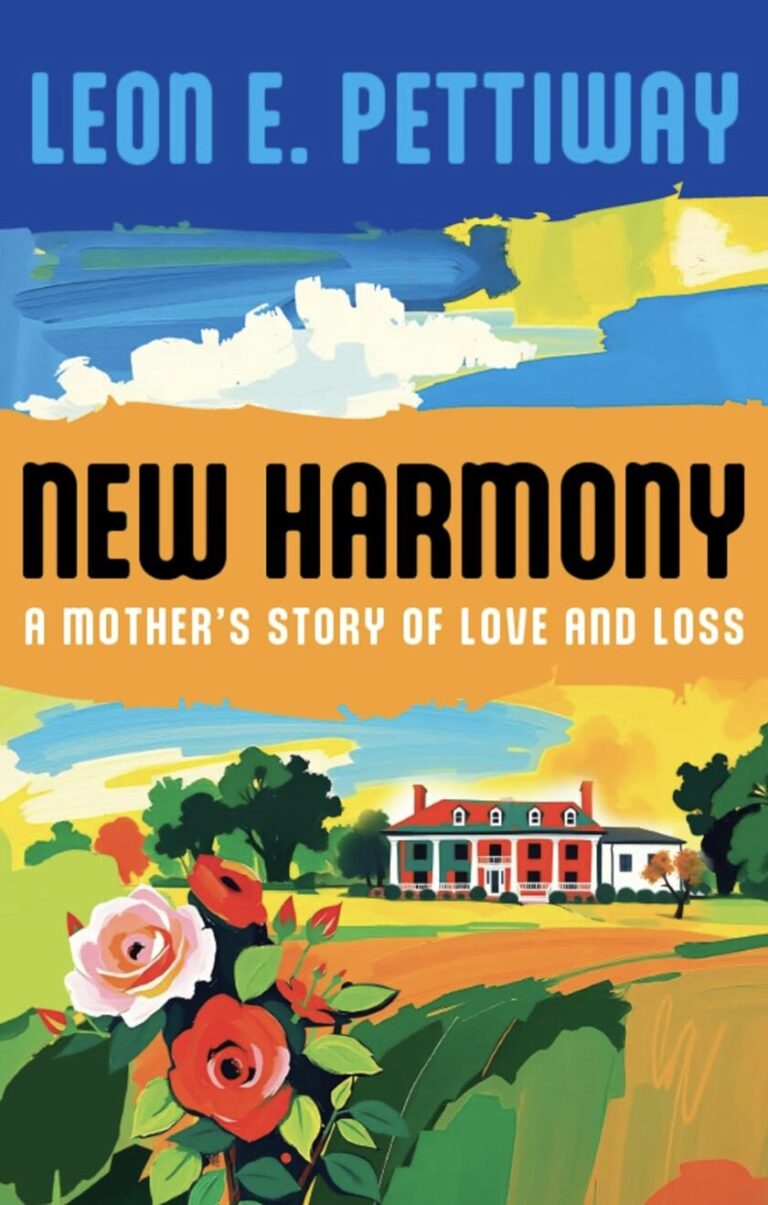
 New Harmony: A Mother’s Story of Love and Loss: Received a 4+ star review, making it an IndieReader Approved title.

Following find an interview with author Leon E. Pettiway:
1. What is the name of the book, and when was it published?
The book’s title, when published, was New Harmony: A Mother’s Story of Love and Loss.
2. What’s the book’s first line?
The book’s first line is: “The day belonged to the dead, and our lamenting floated down the worn steps of Calvary Baptist Church, past grave markers and upturned stones, drifted down Chestnut Street and onto Main, around the bend, and down into the next hollow.”
3. What’s the book about? Give us the “pitch”.
New Harmony finds its soulfulness in the struggles and victories woven into Southern life, shaped by the complexities of race, sexuality, and gender in New Harmony, South Carolina. At its core is Margaret Butler, a deeply spiritual Black woman born in 1905, who bears the echoes of her enslaved ancestors and the grief of her murdered sixteen-year-old son, Thad. Through Margaret’s perspective, New Harmony becomes both an elegy and a reckoning, reflecting on faith and fury, bigotry and beauty, while highlighting the violence that wounds and the love that endures.
Through Margaret’s soulful narration, which is rich in dialect and steeped in wisdom, love, and loss, the story unfolds against the haunting backdrop of a young Black boy’s death in a town that dares to call itself New Harmony. New Harmony explores the delicate balance of normalcy within the paradoxes of hatred—how hatred intertwines with desire, love, and greed until each emotion becomes indistinguishable from the others. Desire fuels Floyd’s dangerous clash with Margaret, yet it also sets the stage for questionable parentage. Love also provokes a hatred so intense that it justifies murder, while greed leads to framing the innocent. Yet, beneath everything, hatred runs through New Harmony as an unspoken truth, creating a current that affects everyone’s lives. The story that unfolds is one of revelation and reckoning, where the truth behind the murders shows not only how some people confuse hatred for love but also fail to consider the fragile humanity of those left behind.
4. What inspired you to write the book? A particular person? An event?
When I was promoted to full professor at Indiana University, Bloomington, I wanted to try a different way to discuss issues of race, class, and crime. While this was a departure from my academic training, I saw the novel as a way to explore aspects of the sociological and criminological perspectives on race and crime.
5. What’s the main reason someone should really read this book?
There are moments in our lives when we suffer, and it feels like there is no way out of despair. While Margaret’s story is about loss and grief, it is much more—New Harmony is about honesty, resilience, and standing up against the weight of inherited injustice. There is always hope when someone understands the realities of unconditional love.
6. What’s the most distinctive thing about the main character? Who-real or fictional-would you say the character reminds you of?
The most defining trait of the main character is her strength. She reminds me of my mother and many Black women I have known. That’s why I dedicate the book to women.
7. When did you first decide to become an author?
When I was in high school, I wanted to become a writer. A close friend of mine tried to encourage me to major in English before I went to college. However, I lacked confidence and thought I wasn’t good enough, and it took years to get that foolishness out of my head.
8. Is this the first book you’ve written?
My first book, Honey, Honey, Miss Thang: Being Black, Gay and on the Street, is a nonfiction work based on field research I conducted in Philadelphia. The National Institute on Drug Abuse funded the research.
9. What do you do for work when you’re not writing?
I’m a Buddhist monk, and that keeps me quite busy. After retiring from the university, I started a monastery in Indianapolis. So, when I’m not writing, I spend my time practicing Buddhism and teaching at the monastery.
10. How much time do you generally spend on your writing?
Unfortunately, not as much as I would like. Although I retired some time ago, I have more to do now than when I was a university professor.
11. What’s the best and the hardest part of being an indie?
Marketing is the hardest part of being an indie author.
12. What’s a great piece of advice that you can share with fellow indie authors?
The best advice is to stay patient and keep honing your craft.
13. Would you go traditional if a publisher came calling? If so, why?
I am always hopeful that my writing will support the monastery and its activities. Therefore, all the profits from selling books are donated to the monastery, and I want the monastery to retain the rights to my creative work. So, I’m somewhat hesitant to go with a traditional publisher.
14. Is there something in particular that motivates you (fame? fortune?)
My motivation is always to serve others, and I hope what I write benefits those who read it, making their lives better.
15. Which writer, living or dead, do you most admire?
Hands down, Toni Morrison