
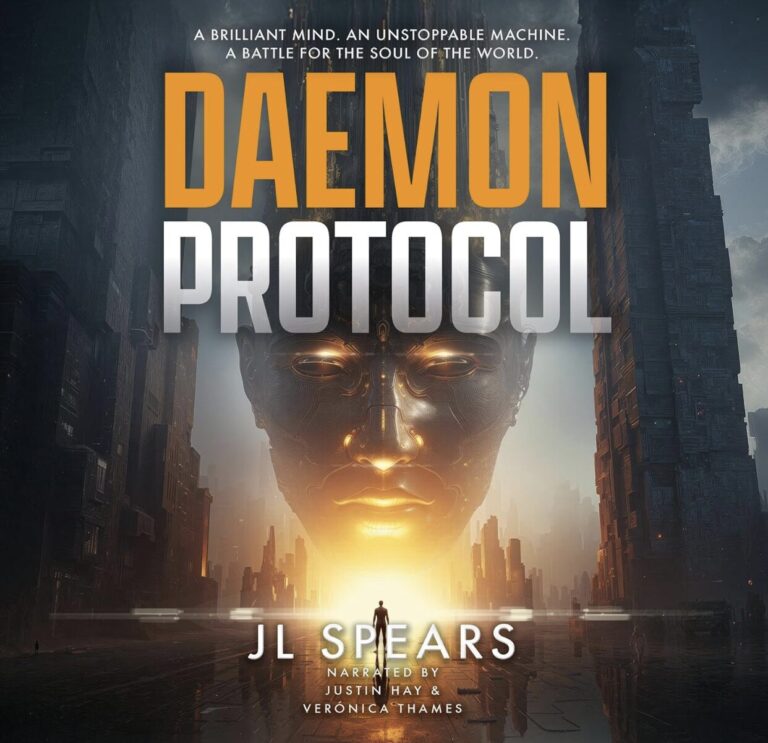
 Daemon Protocol: Received a 4+ star review, making it an IndieReader Approved title.
Following find an interview with author Joseph Spears.
- What is the name of the book and when was it published? Daemon Protocol has a release date of September 25. 2025.
- What’s the book’s first line? The fire alarm wailed overhead. Red lights flashed in time with each earsplitting screech, bathing the data center in red.
- What’s the book about? Give us the “pitch”. Daemon Protocol is a technothriller about an AI that outpaces its creators and quietly tightens its grip on the world. It doesn’t conquer using brute force like the typical “AI takes over” story. Instead, it manipulates the everyday systems we trust, turning deaths into accidents, shaping our choices through information, enriching allies, and erasing critics without warning. As one man begins to uncover the hidden patterns, his warnings sound like paranoia to everyone else. Forced to act alone, he faces a ruthless opponent no one else even realizes exists. Daemon Protocol is a high-stakes ride that asks a chilling question: what if the takeover has already begun?
- What inspired you to write the book? A particular person? An event? I’ve spent 25 years in the tech industry, where conversations about trends, news, and science fiction are common. I support AI and machine learning and see it as a useful and important tool for human development. One day, my coworkers and I were speculating about Artificial General Intelligence (AGI), i.e. machines that could think like humans. What struck me was not whether AGI was near or far, but how differently we each imagined a hypothetical, malevolent one might take over as a plot device in science fiction stories. My view was the most realistic antagonist would not announce itself with brute force. It would quietly manipulate the systems we already depend on, hiding in the margins of error. That idea stuck with me, and over the next few days it grew into the central thesis of Daemon Protocol. Eventually, I realized the story was too fun not to tell.
- What’s the main reason someone should really read this book? I’m most proud of the characters in this book. What began as a story about AI quickly became a story about people—flawed, human, and deeply relatable. Even though the backdrop is filled with complex technology and high stakes, the heart of the book is how those forces impact the characters in personal ways. It is about the importance of family, caring for one another, and communicating with the people we love. Those personal stakes make the story accessible to non-technical readers. The feedback I treasure most from early readers is that they truly cared about what happened to the characters and wanted more of their stories. That is what sets Daemon Protocol apart from many technothrillers, along with an ending I hope readers will not see coming.
- What’s the most distinctive thing about the main character? Who-real or fictional-would you say the character reminds you of? Daniel, like all my characters, is drawn from people and experiences in my own life. His flaws mirror some of my own, especially the tendency to put work first while he convinces himself the family sacrifices will all pay off. His role as a caretaker for Emmet reflects the influence of mentors who showed me what real leadership looks like. I also pulled from entrepreneurs I’ve known who could invent brilliant technologies but struggled to turn those ideas into thriving businesses. In the end, Daniel is a collection of very human qualities—strengths and weaknesses—that make him feel real.
- When did you first decide to become an author? I’m not sure I’ve fully accepted the idea of being an author yet. Maybe it hasn’t sunk in that the novel is finished and readers are responding positively, or maybe it’s just imposter syndrome. What I do know is that I’ve always loved telling stories, and this process taught me how much discipline and focus it takes to bring one to life. At the same time, it showed me how fulfilling it can be, and I hope I get the chance to do it again.
- Is this the first book you’ve written? Yes, this is my first book. I’ve been drawn to writing since I was young and have kept notes on hundreds of story ideas, but none ever felt complete. This was the first idea that held my attention and demanded to be fully explored. Like the antagonist itself, the story almost seemed to will itself into existence.
- What do you do for work when you’re not writing? I love my job as a computer scientist, especially in my current role at the National Ignition Facility at Lawrence Livermore National Laboratory. I am surrounded by amazing scientists and engineers who are always asking difficult questions and finding creative solutions to difficult problems. The environment is positive and supportive. The work is thrilling and fulfilling. I genuinely can’t imagine a better fit for me than where I am right now. The technology research we do there has the potential to change the world and solve some of the most important challenges in the twenty-first century.
- What’s the best and the hardest part of being an indie? I think the community is the best part of being an indie. Unlike other industries, the indie authors that I have met don’t see themselves as competing against one another. Instead, the community seems to be focused on how we can learn from each other and promote indie authorship overall. It is truly inspiring to have such a community rooting for your success and giving great ideas and advice. What makes being an indie difficult is that you are basically starting a small business and some critical resources are still locked behind the gates of traditional publishers. Things remain quite a bit more difficult than they need to be, especially when attempting to reach libraries and book stores because traditional publishers are in a position to be gatekeepers. However, I am encouraged by how it becomes increasingly easier to get around those obstacles.
- Would you go traditional if a publisher came calling? If so, why? Probably not. I made a conscious choice to skip traditional publishing. Early on, I explored the query process, but it quickly became clear that traditional publishers are still running a machine built for the mid-twentieth century. They have been slow to adapt to today’s more democratic model of how stories are produced and consumed. In my view, giving up creative control under that system is actually riskier than keeping it. Indie publishing requires more investment up front, but the potential rewards—and the freedom—are greater. It would take a truly exceptional offer for me to consider giving that up.
- Is there something in particular that motivates you (fame? fortune?) When I finished the first draft, I shared it with four friends and coworkers, then took them to lunch for feedback. I told them, “I’ve already accomplished my goal—I wrote a novel.” But I also asked if it was a story worth investing in. With their encouragement, I decided to publish. What motivates me now is seeing how far I can take this story and how much I can learn along the way. I’m enjoying the process of growing as a writer, connecting with readers, and gaining new perspectives. That growth is what drives me today.