
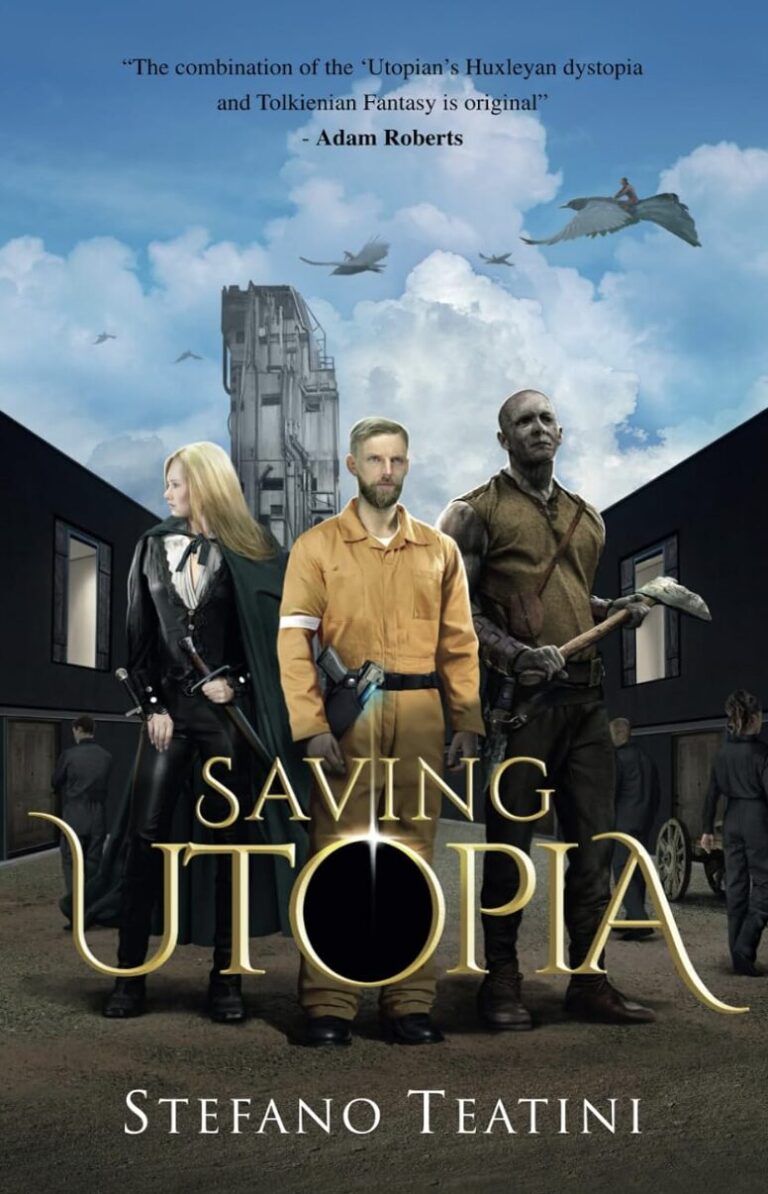
 Saving Utopia: Received a 4+ star review, making it an IndieReader Approved title.
Following find an interview with author Stefano Teatini.
- What is the name of the book and when was it published? Saving Utopia – March 22, 2025
- What’s the book’s first line? Parsif felt like he could not breathe as he emerged from a black slumber.
- What’s the book about? Give us the “pitch”. Saving Utopia is a mix of science fiction and fantasy, where the typical ‘races’ of fantasy literature are presented as natural evolutions of Humans. In the novel, there are no supernatural elements, but religions are very important, although they only have a subjective value. Saving Utopia also attempts at reconciling dystopian and utopian fiction. The two genres have obviously much in common. I tried to overcome the lack of plot and action that is typical of utopian novels and the pessimism that generally characterises dystopian ones. The protagonists of my novel are in their 20s, and, for this reason, I would also label Saving Utopia as New Adult. The final result is a novel that blends political science fiction and a good amount of romance.
- What inspired you to write the book? A particular person? An event? It started for fun. I’ve always been a fan of classic fantasy and an avid RPG player. At the same time, I’ve always loved soft science fiction. One day, I began thinking about the possibility of blending the two genres, and from there came the initial idea of creating a world where fantasy races were post-apocalyptic evolutions of human beings. Then, starting from a particularly difficult moment in my life, the world of Saving Utopia gradually became something more personal and psychologically important.
- What’s the main reason someone should really read this book? To have fun. I had a lot of fun while I was writing Saving Utopia, and my greatest ambition is that my readers find my book entertaining. I love reading books and watching movies that entertain me, and playing games. I think this attitude inevitably influenced the character of my novel. Some people who have read Saving Utopia, and whose opinions I deeply respect, told me that they had a great time reading my novel. And they knew nothing of what I just said. I couldn’t receive a more pleasant feedback.
- What’s the most distinctive thing about the main character? Who-real or fictional-would you say the character reminds you of? The protagonist of my novel is an orphan, and the fact that he has grown up alone is an unhealed wound for him. Over the years, he has built a little network of friends, that have become his certainties, and his greatest fear is losing them. Besides this, he’s certainly also driven by issues of identity and by the difficulty of finding his place in the world, that are both typical of adolescents and post-adolescents, like him. My protagonist has obviously much in common with me, but he’s not my clone: he has his own identity, and many aspects of his personality don’t belong to me at all. There is actually a little of me in all the main characters of my novel: different aspects of my personality—and of my story—that have emerged in different characters, along with traits that are exclusive to each of them.
- When did you first decide to become an author? As soon as I started writing, I decided that I wanted to do it as seriously as I could. I soon realized that I first needed to improve my writing skills, and I decided to try and find a PhD program in Creative Writing. In Italy, Creative Writing is generally not taught in universities, so I made applications to universities all over the English-speaking world. In the end, I received two offers, one from a university in England, and the other from Aberystwyth University, in Wales, that is where I decided to do the PhD. At first, I was terrified by the idea of doing a PhD in a language that is not my native one, a PhD in Creative Writing what’s more. I often thought I would never make it. Eventually, the PhD turned out to be the best thing I did in my life. What I learned at Aberystwyth University is invaluable, and the experience has changed my mind, and my life.
- Is this the first book you’ve written? I published a novella, titled Gangkou, il cuore e l’universo, in Italy, in 2018. It is the prequel of Saving Utopia, but it’s stylistically very unripe. The plot is solid, though, and the next book I publish in English will be an edited and extended version of Gangkou, il cuore e l’universo. It won’t be a novella, but a novel, and I’m already working on it. Many people who enjoyed Saving Utopia told me that they would like to read more about the backstories of certain characters, and to know what happened before the events narrated in Saving Utopia. This confirms to me that publishing a revised version of Gangkou il cuore e l’universo in English is the right thing to do as a next step.
- What do you do for work when you’re not writing? I work as a high school English teacher. I’ve been doing this job for 15 years, save for four years spent as a SEND teacher, also at the high school level. My goal for the near future is to become a full-time writer, tough; in order to have more time—and attention—to devote to my novels.
- How much time do you generally spend on your writing? At the moment, it depends a lot. When I was attending the PhD, I could write full time because I was on a paid leave from school. Now, having resumed my work as a teacher, I obviously have less time, but I still use every spare moment to write. Overall, I think I write around 15 hours a week, on average: more during Summer and less during the school year.
- What’s the best and the hardest part of being an indie? I’ve always been an indie author, so I’ve got no comparison to be able to say what is best about it. I think the best part is probably having virtually complete control over your contents. What I’m sure about is what is the worst part: having to promote yourself, and to work as an agent and an entrepreneur besides being an author. It’s very distressing, because authors often don’t have the right competences for doing this, and I would like to focus solely on writing.
- What’s a great piece of advice that you can share with fellow indie authors? Never stop believing! And another advice would be: always have fun. The true writer, in my opinion, is the one who enjoys writing. If writing is just the price to pay to achieve success—and all that comes with it—then we are speaking of something totally different… Sure, we have to pay bills before writing, and the time left is often too little, and we are often too exhausted to write as much and as good as we would like to, but I think writing should always be our comfort zone: never one more chore.
- Would you go traditional if a publisher came calling? If so, why? I would if the deal is honest, if there are gains and duties for both me and the publisher, which sometimes unfortunately isn’t the case. I would because, as I mentioned before, having the opportunity to delegate the editorial production, marketing, and post-publication activities to professionals, and being able to focus only on writing, would make the difference. If one adds economic independence to it, then it really means being a full-time author.
- Is there something in particular that motivates you (fame? fortune?) Having the opportunity to establish a contact with my readers. In our society, it’s becoming increasingly difficult to communicate. I think most writers write because they want to be read. It seems obvious, but I think we simply feel the need to share our stories, our worlds, and our feelings. Seen in this sense, perhaps everyone is a writer; and everyone has a story to tell for sure. Communication is a central—and transversal—theme in Saving Utopia. My motivation is the dream that I can share my world.
- Which writer, living or dead, do you most admire? J. R. R. Tolkien was the beginning of everything for many of ‘us’. There are things I don’t like about his works now that I’m an adult living in the third millennium: the sharp contrast between good and evil, for example, and between the Northwestern and Southeastern regions of his world; and the fact that good characters and creatures can turn evil, but it’s impossible for evil ones to redeem themselves. This is something that really doesn’t work for a modern reader, in my opinion. But, apart from this, Tolkien is Tolkien. But if you ask me to name one author I admire most stylistically, as an adult, and as a writer, and not specifically as a fantasy writer, then it’s not Tolkien, but Ernest Hemingway.
- Which book do you wish you could have written? This is hard. I mean, it’s hard to name just one. But I’m sure I’ll move to graphic novels here. I’m an avid reader—and collector—of graphic novels, and, in Saving Utopia, I tried to develop a technique inspired to what, in sequential art, is called “aspect-to-aspect transitions”. Studying the style of Hemingway was crucial in this regard: his use of the camera, and his simple language and paratactic style, in particular. Raymond Carver was a source of inspiration, too. But I don’t want to dwell too much on this. I’ll just answer your question: I wish I could have written Blankets by Craig Thompson. It’s so immensely beautiful that I couldn’t explain why I love it in less than pages.