

The Heroine’s Labyrinth: Archetypal Designs in Heroine-Led Fiction was the winner in the Pop Culture category in the 2025 IndieReader Discovery Awards, where undiscovered talent meets people with the power to make a difference.
Following find an interview with author Douglas A. Burton.
“This is absolutely amazing! It’s my hope that The Heroine’ Labyrinth takes its place on bookshelves everywhere & provides a real alternative to the hero’s journey–and this is another big step toward that goal! Thanks to Indie Reader for hosting the awards, providing judges, & doing so much for authors such as myself. Being a writer can feel lonely sometimes, but the truth is: you have so many supporters. I’d like to thank my mother & father, who helped me with many of the big ideas in the book. Thanks to Jeniffer Thompson & her whole team at Monkey C Media. Thanks to Luci Williams, one of the original inspirations for this book. Also, thank you to my wife, Crystal, my two sons, Jacob and Lucas–having support at home is a big deal! Thanks to Kamran Pasha & Christopher Vogler for their early encouragement! And thanks to Heath Robinson, James & Elliot, DBJ, Retro Nerd Girl & Mike Poulos for all their incredible help & insight. The book just wouldn’t have been possible without you all!”
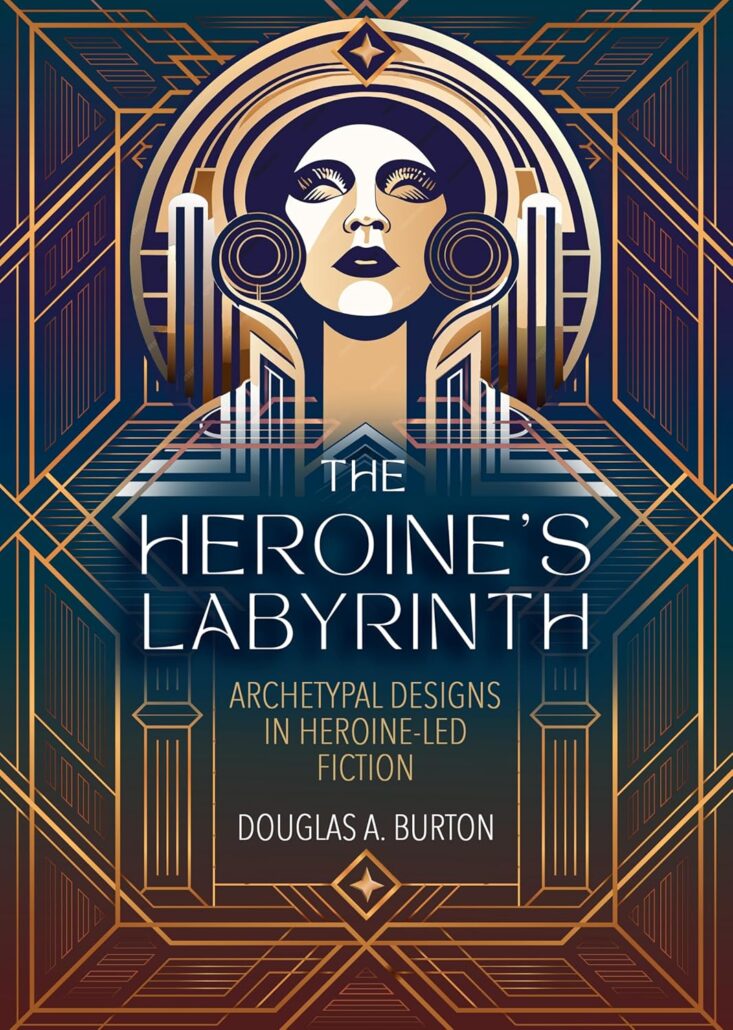
What is the name of the book and when was it published?
The Heroine’s Labyrinth: Archetypal Designs in Heroine-Led Fiction and it was published in March of 2024
What’s the book’s first line?
“This is a book for writers–novelists, screenwriters, role players, memoirists–anyone who loves and cares about storytelling.”
What’s the book about? Give us the “pitch”.
The Heroine’s Labyrinth is a practical alternative to Joseph Campbell’s hero’s journey, in which the archetypal patterns create a powerful narrative arc in numerous stories across numerous genres that have a heroine as the lead character. The patterns are immediately useful to storytellers who can harness the patterns for their own stories, while also confident that patterns will have a beginning, middle, and end. Instead of the classic departure and return so prevalent in the an outward journey, thy labyrinth explore the social, psychological, and cultural conflicts inherent in the inward journey within one’s native culture. It has infinite applications to story.
What inspired you to write the book? A particular person? An event?
While writing my debut novel, which was a biographical account of Byzantine Empress Theodora, I discovered the hero’s journey didn’t work very well in terms of organizing my story. When I searched for a concise alternative for heroine-centric stories, I didn’t find one so immediately useful and easy to understand. So, after four years of studying heroine-centric tales, I wrote the book I never found.
What’s the most distinctive thing about the main character? Who-real or fictional-would you say the character reminds you of?
Since the book is non-fiction, the narrative explore some of the most iconic and memorable heroines in literature, film, and pop culture.
What’s the main reason someone should really read this book?
Writers should read this book to give themselves a fresh perspective about how a story can be structured and to discover the powerful archetypal power in scenarios that aren’t featured in the hero’s journey. Although the heroine’s labyrinth was derived from studying heroines, the labyrinth model is universal and can apply to any character.
If they made your book into a movie, who would you like to see play the main character(s)?
Well, as non-fiction, I’d love to see this as a six-part Netflix documentary with Sigourney Weaver as the host! 🙂
When did you first decide to become an author?
6th grade.
Is this the first book that you’ve written?
No. I write an award-winning historical fiction novel called ‘Far Away Bird’ that details the early life of Byzantine Empress Theodora, who went on to influence a legal codex that included some of the first ever legislation that could be considered women’s rights! She’s incredible. And her story is incredible!
I’m a real estate appraiser and utterly happy father of two boys.
How much time do you generally spend on your writing?
Two to four hours daily, six days a week.
What’s the best and the hardest part of being an indie?
The cost of admission. The cost of visibility.
Would you go traditional if a publisher came calling? If so, why?
Possibly. Only because it’d be nice to have a helping hand who you get your book in front of more people…to have an ally.
Is there something in particular that motivates you (fame? fortune?)
I’m motivated mostly by the insatiable urge to communicate. For example, Theodora’s story is so awesome, I have an almost pathological urge to tell the story. And when I gleaned the heroine’s labyrinth from her story, I have an almost pathological urge to share the ideas with as
many writers who might be able to use it!
Which writer, living or dead, do you most admire?
Leo Tolsoy.
Which book do you wish you could have written?
None. Every book is a direct product from the imagination of another creative mind. I would never want to write what someone else was meant to write!