
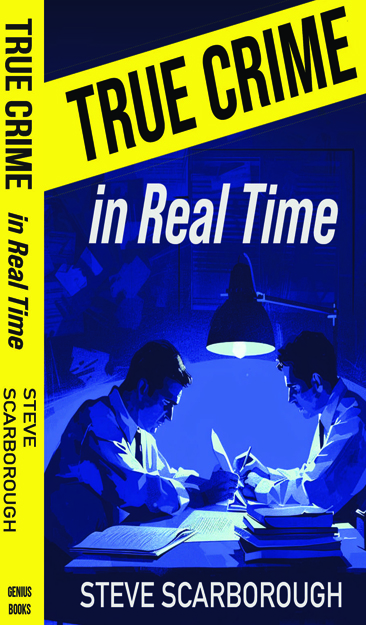

Steve Scarborough’s TRUE CRIME IN REAL TIME offers a second-person account of 11 criminal investigations that puts readers in the role of detective. Most of the time they’re trying to identify a murderer; the one outlier is a chapter wherein it’s discovered that their late uncle was a homicide detective, and they read through the extensive notes he made about his most famous case.
As the title suggests, the events portrayed are taken from real life, although they are, according to Scarborough, fictionalized to an extent. In an introductory note (also written in the second-person), he states that “[t]he crimes are real, and the evidence comes from the actual case files. Your partners are fictional characters based on a composite of real detectives and others who investigated these crimes. All the evidence that’s uncovered is based on police reports, interviews, court transcripts, and contemporary news reports.” One could argue that endnotes and sources are called for here; curious readers will want to know where the author obtained his information about the crimes. (There are pages after each chapter titled “Notes,” but they’re blank—presumably for the reader to write down their ideas.) It would also make sense to identify the real-life cases, perhaps at the end of the book. Readers intrigued by the evidence will naturally want to read more about the case in question, especially if they’re unfamiliar with it, but they can’t do so if they don’t know the real names of the cases on which the stories are based.
Putting that aside, TRUE CRIME IN REAL TIME is written in a straightforward and matter-of-fact style, with grisly descriptions delivered in a neutral tone. Scarborough, who includes hand-drawn maps to help the reader visualize the crime scenes, lets the drama of the crimes speak for itself. His dispassionate voice is admittedly consistent with what one might expect from experienced homicide detectives going about their business, but it also has the effect of discouraging emotional investment on the part of the reader. It’s a double-edged sword.
The last chapter is a “Performance Review,” a review of the reader’s detective skills. This would seem a good place to reveal the official result of each real-life investigation. Instead, Scarborough poses a series of open-ended questions and concludes with, “good luck on your next case.” It’s an abrupt ending that feels premature and somewhat perfunctory, especially for a book over 300 pages in length.
Steve Scarborough’s TRUE CRIME IN REAL TIME is a quick and entertaining read, notable for its unorthodox form and detailed analysis of 11 criminal investigations. However, Scarborough’s failure to provide sources or identify the actual cases that inspired this narrative count against it, and ultimately make the book feel incomplete.
~ Michael Howard for IndieReader