
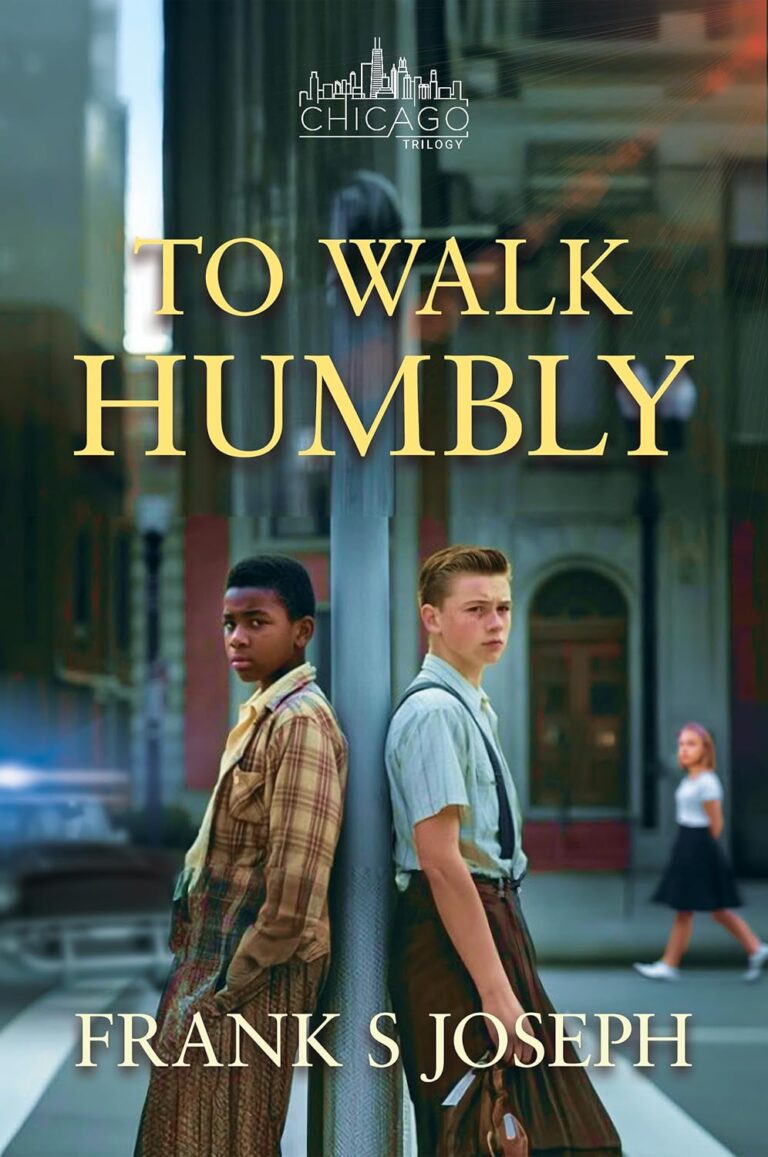

Historical fiction can feel like a cracked windowpane; through its fractures, you glimpse not just the past but the trembling human hands that shaped it. Frank S. Joseph’s TO WALK HUMBLY, the second volume of his Chicago Trilogy, opens such a view onto mid-20th-century Chicago—a city exhaling soot and ambition, its streets thick with the mingled scents of stale butter, Lysol, and piss from crumbling theater lobbies. The novel centers around the unlikely connection between two teenage boys—Steve Feinberg, a Jewish kid from Hyde Park, and Jesse “Sass” Trimble, a Black youth from Bronzeville—whose lives intersect after a mugging that spirals into deeper entanglements.
The novel’s central device is a silver heirloom inscribed with Hebrew text, lost and found and lost again, which becomes both MacGuffin and metaphor. Through this talisman, Joseph probes questions of inheritance, both material and moral. Steve’s grandfather Nathan, owner of the struggling Calumet Theater, employs Sass despite (or perhaps because of) their earlier conflict over the stolen heirloom. Their evolving relationship forms the novel’s ethical backbone as urban renewal schemes grind through Bronzeville, displacing Black residents while white liberals wring their hands from a safe distance.
Joseph is particularly deft at capturing the linguistic tightrope Sass walks, code-switching between Black vernacular and what he calls “speaky-spokey”—the white-approved English he hopes will unlock doors to advancement. Steve, meanwhile, ping-pongs between liberal platitudes and harsh reality as his grandfather’s stroke forces him to confront both personal and societal legacies. When Emmett Till’s murder (Till is fictionalized in the novel as “Ezell Thomas”) enters the narrative, Joseph has laid the groundwork so carefully that this historical atrocity feels both shocking and grimly logical—the violent end point of a thousand daily degradations his characters have witnessed and endured.
The novel’s missteps are few but notable. Some expository passages read like newspaper clips awkwardly wedged into the narrative, as when Mister Lucky speaks with Joe about a murdered minister: “What’d they do, string him up? Blew his brains out with a shotgun…. It’s a damn shame they treat us colored so bad down there though, for registering to vote of all things…them ‘fays been riled up ever since the Supreme Court said the colored can go to their schools.” There is also a subplot involving a teenage romance that threatens to veer into melodrama. But these are minor flaws in a work of such moral and narrative ambition.
“What doth the Lord require of thee?” asks the Hebrew inscription that haunts these pages. “To do justice, to love mercy, and to walk humbly with thy God.” Joseph’s achievement is to show how these simple commandments become nearly impossible in a society built on racial hierarchy. His characters stumble toward understanding, their humility hard-won through confrontation with their own limitations.
Frank S. Joseph brings journalistic chops and novelistic insight to this ambitious novel about Chicago’s racial fault lines in the 1950s. Through the tangled fates of two teenagers—one Jewish, one Black—TO WALK HUMBLY explores how systemic injustice plays out in individual lives and how good intentions crack under pressure from fear and self-interest.
~Edward Sung for IndieReader