
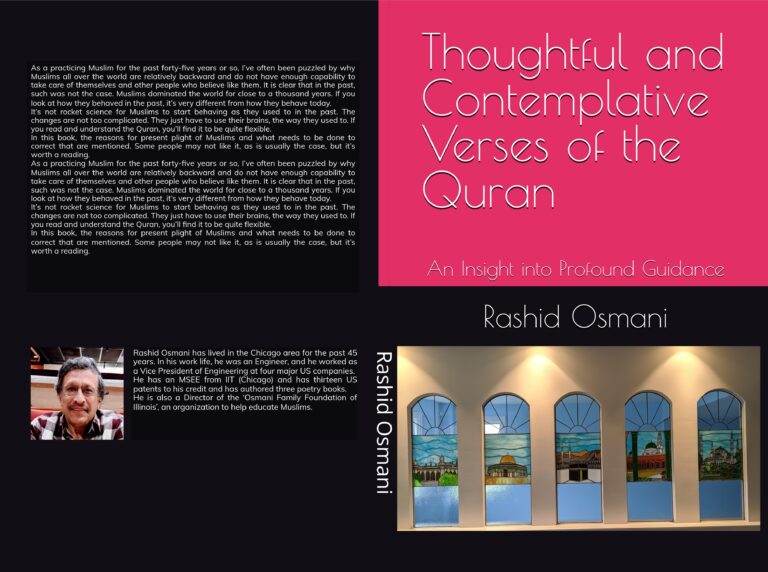

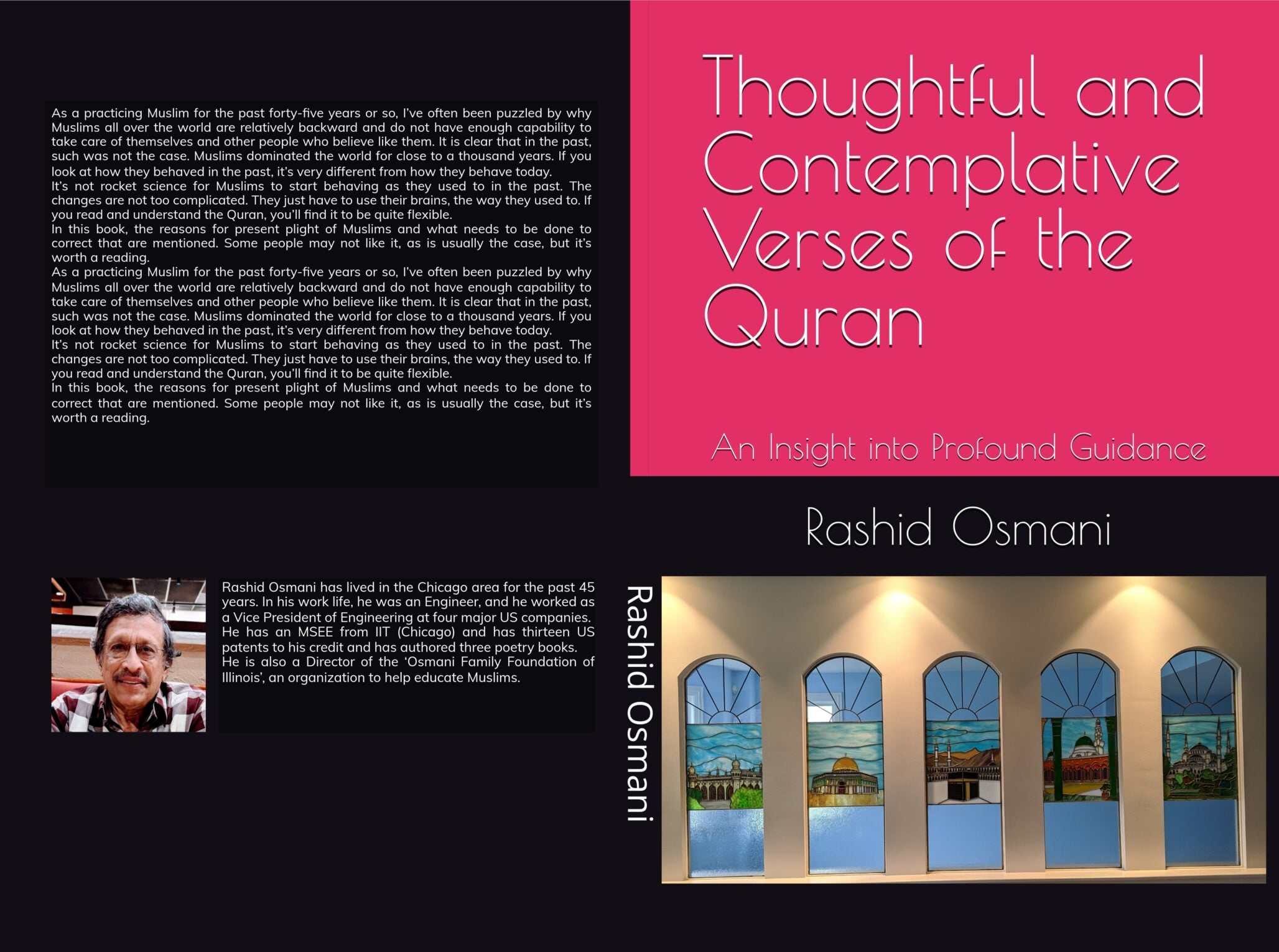
Rashid Osmani, author of THOUGHTFUL AND CONTEMPLATIVE VERSES OF THE QURAN, has spent many years reading the Quran and reflecting on its message. This book is his attempt to understand why Muslims around the world are so “backward” despite impressive accomplishments in the past and no lack of spiritual guidance from the Holy Book in the present. He theorizes that this is because of three reasons: a lack of understanding of the Quran, carelessness towards sins, and negligence of the truth.
Osmani urges readers to engage with the Quran in their own languages, including a selection of verses to help kickstart their journeys. However, without any additional context of time, place, or reason for revelation, readers are left to drift from verse to disconnected verse and pick up whatever enlightenment they can in their individual capacities. He references no other major, minor, ancient, or modern works of Quranic commentary and instead uses the preface, introduction, and conclusion to take wild leaps between bits of science, pseudoscience, history, philosophy, and personal opinion. The author mentions Muslim rulers, such as Sultan Baybars and Sultan Bayzit I, as being successful conquerors and rulers because they followed Islam the “right way”—but there are no references to their religious practices to help prove this point. He blames modern, “narrowly educated” Imams for the downfall of the Muslim community, comparing them to the more “broadminded” scholars of the past. However, he once again fails to present any examples.
Oddly enough, Osmani insists that Muslim scientists need to disconnect religion from their pursuit of knowledge— an argument that seems contrary to the thesis presented in his book. Similarly, in some places he seems to want the practice of religion to somehow be purely practical. He wonders, for example, why simple Arabic recitations of Surahs are necessary when the sound cannot “echo through the universe forever, and tangibly influence things in the ‘hereafter.’”
The author also does not appear to be particularly confident about the benefits of Islam as they may apply to him personally. He doubts the effectiveness of prayer and has found the Hajj “underwhelming.” There are no examples of how understanding the Quran, adherence to the truth, and taking more care to avoid sins have altered his own life—no incidents where particular paragraphs affected him deeply or provided solace in troubled times. Worst of all, there is no humility in Osmani’s writing style. From the very first line, he appears to look down on people (even fellow Muslims) whose worldviews or ways of life he does not understand. It’s ironic that one of the few different quotes by Muslim scholars he does include can stand in as a succinct review for THOUGHTFUL AND CONTEMPLATIVE VERSES. For example, this one by Ibn Arabi: “Do not believe your own faith exclusively so that you disbelieve all the rest. If you do this, you will miss […] the whole truth of the matter.”
Rashid Osmani’s THOUGHTFUL AND CONTEMPLATIVE VERSES OF THE QURAN lacks the depth of thought or rigor of study that is necessary for any commentary on religious scripture.
~ Sakina Hassan for IndieReader