
Publisher:
Regal House Publishing
Publication Date:
09/23/2025
Copyright Date:
N/A
ISBN:
9781646035809
Binding:
Paperback
U.S. SRP:
20.95
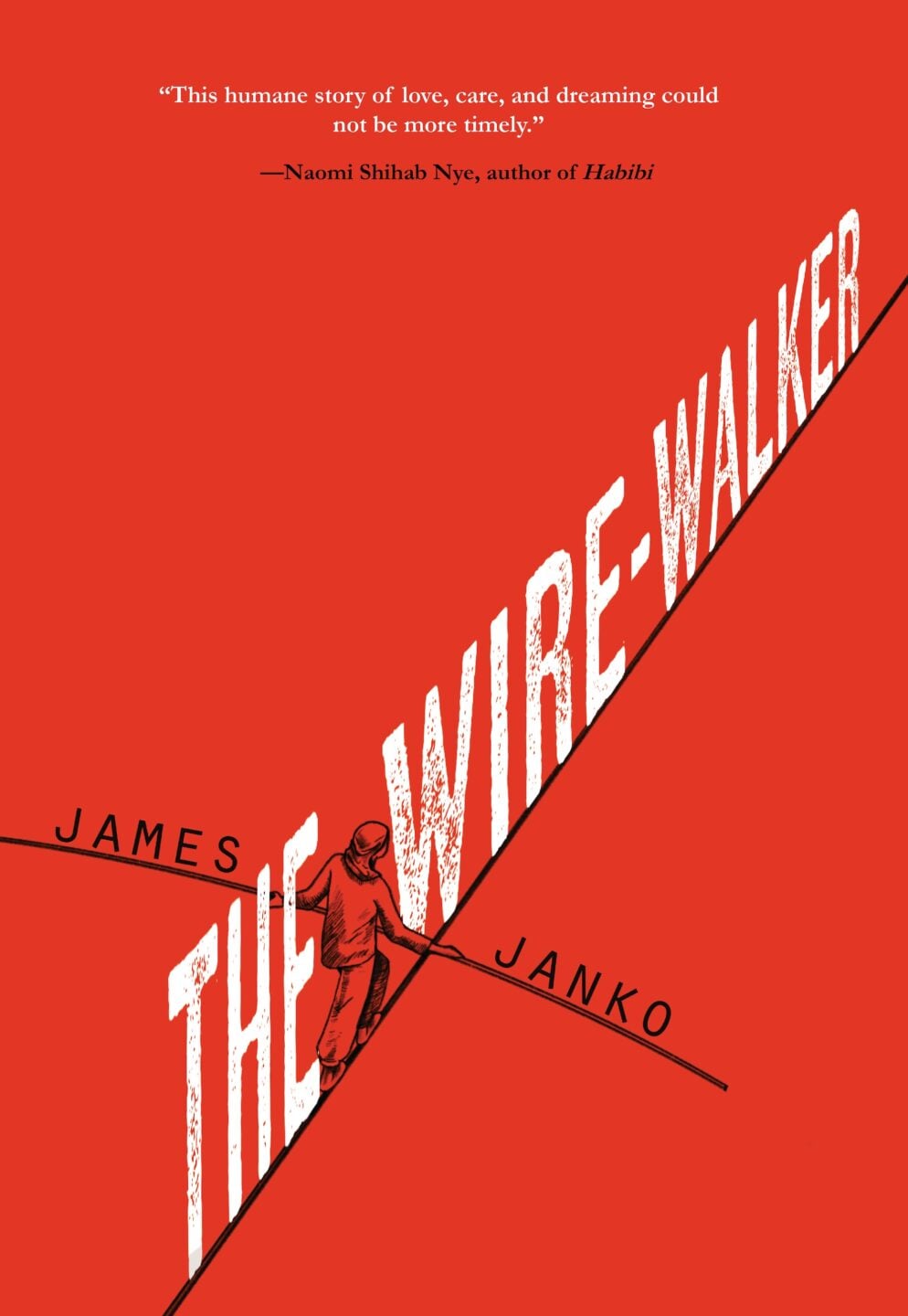
THE WIRE-WALKER
By James Janko

- Posted by IR Staff
- |
A 16-year-old Palestinian wire-walker struggles with the humanity of the Israelis who deny her own.
Like her family and everyone else in the Balata refugee camp, 16-year-old Amal lives a cramped life strictly bounded by the threat of violence. A single, shared phone serves as a point of contact with the outside world, and it’s how she nourishes her love of circus arts—especially wire-walking, which she practices in the house and ruins of the camp. The same device, however, connects her to youths in Israel who live lives strangely similar to, and conspicuously different from, her own.
There are many ways to tell the difficult story of the Israeli government’s actions in Palestine, but James Janko’s THE WIRE-WALKER holds together on the strength of the body. Amal’s life as an athlete frames the action, and that gives real heft to the embodied experience of the text. Amal feels out of place in Jaffa not only due to her Palestinian identity, but from within her hungry, skinny body—so much unlike that of her well-fed Israeli friend, Tali. That embodiment also compounds the tension of real or possible violence: when Amal is threatened with torture, the fear is not merely pain but lifelong disability. This embodiment forms a network with the physical fabric of Palestine, so that even the nearest mountain has a body and “looks powerful and lazy, like a giant asleep on its side.” Circus itself has a body, too; it “fits in cracks and crannies, even cages,” just like Amal herself. These rich thematics allow THE WIRE-WALKER to transcend the violence against the Palestinian body—displacement, concentration, bullets and bombs, famine—and invite the reader into that body’s humanity.
The text develops its themes further through physical space. Again, this has a humanizing impact. Amal does not merely live in a house: “[Her] family shares one room with sleeping mats and kitchen things, but [they] divide it in three with plywood and curtains.” The camp is not divided by streets but by alleys, and she and her friends use theirs to make art. The suffocating proximity of Israel—especially Jaffa—is the physical axis of the story. Amal’s grandfather was born there, but he will never return; it’s politically impossible for him to do so, even though the camp is just a short drive from the coast. At the beginning of the story, Amal has only ever left the Balata camp through YouTube: she never expects to touch the Mediterranean in her life. As she herself puts it, she has “seen the Mediterranean Sea on a screen the size of [her] palm, but [she] will remain ignorant until [she feels] it on [her] body.” Although there are moments one might expect in a tale about the Palestinian refugee experience—flyovers and drone surveillance, sudden checkpoints, meaningless and cruel bureaucracy—it’s these simple moments situating the human body in a limited physical space that truly convey the horror of the Israeli government’s policies.
The result is a triumphant, humbling, and moving text. Like all art—especially art about making art—THE WIRE-WALKER is fundamentally about how to recognize our shared humanity, as well as how to live with it.
James Janko’s THE WIRE-WALKER is a powerfully imagined and lithely executed tale of moral clarity.
~ Dan Accardi for IndieReader
Publisher:
Regal House Publishing
Publication Date:
09/23/2025
Copyright Date:
N/A
ISBN:
9781646035809
Binding:
Paperback
U.S. SRP:
20.95
- Posted by IR Staff
- |
THE WIRE-WALKER is a deeply moving tale of struggle and finding self-expression in the darkest times and unlikeliest places. James Janko writes with a passion that's unmistakable, using metaphors, vivid imagery, and sensory descriptions to make what could easily be mistaken from a memoir. THE WIRE-WALKER is moving, vivid, and written with the emotions of a true survivor.