
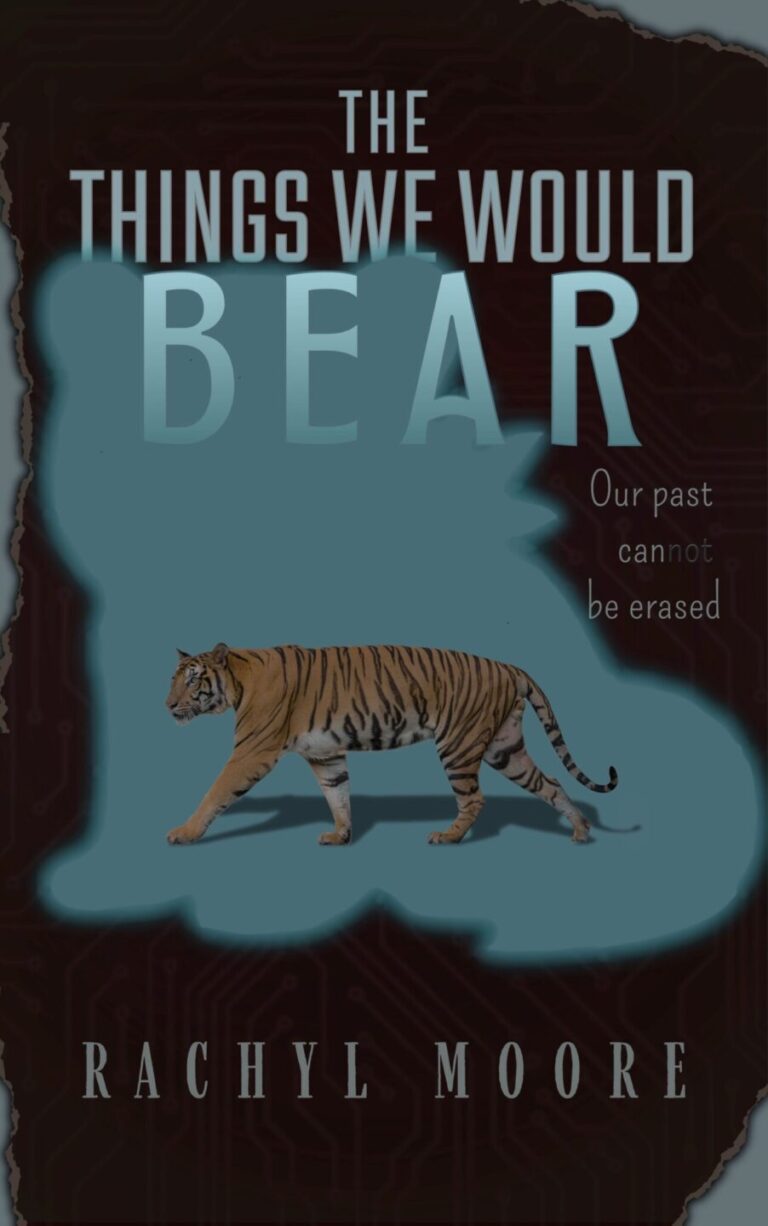

Rachyl Moore’s THE THINGS WE WOULD BEAR is a character-driven science-fiction thriller that explores the uneasy boundary between technological efficiency and human compassion. Set in a post-conflict society governed by predictive AI systems, the novel follows multiple people whose lives gradually intersect as they uncover troubling patterns in military, medical, and civic decision-making. While the book leans heavily on concept, it is the emotional core, particularly the bond between veteran Leo and his illicit companion AI (named Bear), that gives the narrative its resonance and anchors its speculative elements in lived experience.
Moore’s prose is often spare and intimate, especially in moments centered on trauma and recovery. The opening chapter’s clipped internal narration efficiently conveys Leo’s panic while establishing an immersive tone: “I can’t breathe. Chest is tight… I’m drowning. No. Not drowning.” This restrained style recurs throughout the novel, favoring short, sensory fragments over exposition while creating an atmosphere of constant psychological pressure. At times the author shifts into more lyrical description, as when Bear’s calming presence is rendered through tactile warmth and light: his fur is “glowing a faint blue” as Leo’s breathing steadies, providing a gentle emotional counterbalance to the otherwise sterile, machine-dominated world. These tonal contrasts reinforce the novel’s central question of whether empathy can survive inside systems designed primarily for efficiency.
The narrative structure rotates through four central viewpoints, allowing Moore to examine the same ethical dilemma from different institutional angles. Mina’s hospital chapters highlight the unsettling neutrality of predictive care systems, while Odessa’s military perspective underscores the danger of delegating moral judgment to adaptive algorithms. Rowan’s archival investigations add historical depth, grounding the futuristic setting in a legacy of past technological compromises. This multi-threaded approach deepens the thematic scope, though enough exposition accumulates to occasionally slow momentum in the middle sections. Even so, the gradual convergence of the protagonists is handled with precision and ultimately rewards readers with a cohesive, emotionally grounded payoff.
Characterization remains a consistent strength as well. Each protagonist is defined less by plot function than by interior conflict, and Moore resists simplifying their motivations into clear-cut heroism or rebellion. Meanwhile, the dialogue is understated enough to allow tension to emerge through implication rather than declaration. The result is a novel more interested in moral recalibration than dramatic upheaval. By the final chapters, the narrative favors subtle systemic shifts over sweeping change—a choice that aligns with the book’s reflective tone and reinforces its emphasis on personal connection as a quiet but meaningful form of resistance.
At its best, THE THINGS WE WOULD BEAR delivers a nuanced meditation on memory, responsibility, and the human need for connection within increasingly impersonal systems. Moore’s confident voice, strong characterization, and evocative prose make this a compelling and thought-provoking read for fans of reflective, ethically driven science fiction.
Offering strong characterization and evocative prose, Rachyl Moore’s THE THINGS WE WOULD BEAR is a contemplative and emotionally grounded sci-fi novel that thoughtfully examines the cost of optimization in an AI-driven society.
~ Megan Parker for IndieReader