
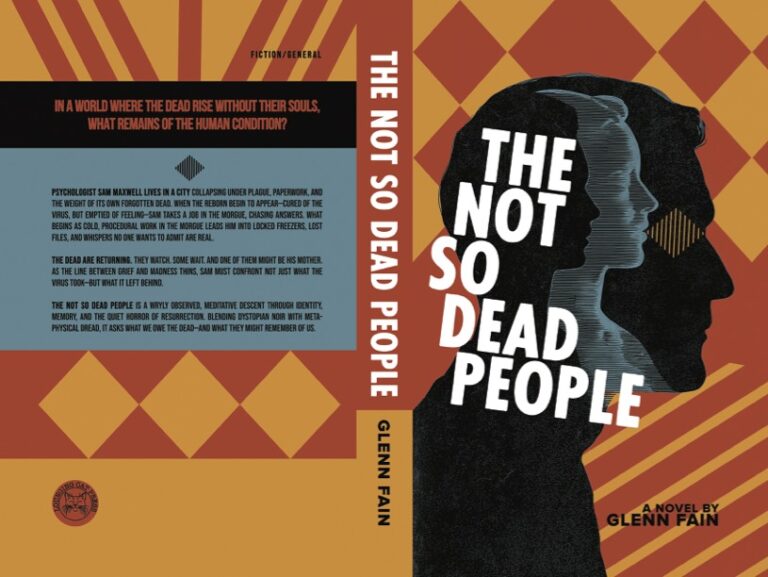

Glenn Fain’s THE NOT SO DEAD PEOPLE is set in Portland, Oregon in 2041. The protagonists (morgue worker Sam, and Susan) live in a United States that is going to the dogs. An authoritarian government muzzles protest, a second civil war has devastated the country, internet access is now the province of the wealthy, media is under the control of a single, vast conglomerate called Stellar Corp, and a millenarianist religion has won millions of followers. Even more unsettlingly, a virus has appeared that can raise the dead: zombies can and do walk the streets. Fain draws deeply on imagery borrowed from the COVID-19 pandemic, invoking social distancing, mask wearing, and the foreswearing of hugs and handshakes.
So far, so The Walking Dead. But the zombies—or Reborns, as Susan (who is herself one) christens them—do not enjoy their freedom for long: they are whisked away to government facilities, where experiments are performed on them. Susan (or rather, the entity who inhabits Susan’s re-animated body) develops a sexual relationship with the scientist tasked with interviewing her, with the purpose of manipulating him into setting her free. In the meantime, Sam (who finds solace against the hardships of his life bouncing between rented rooms and a shelter for unhoused people in the local church) fantasizes every night about sex with an acquaintance just before going to sleep, but finds those fantasies harbor a strange and otherworldly secret.
Weighing in at over 350 pages, the story is a slow burn. Fain’s viewpoint, as inserted into Sam’s monologue, is that humanity is a hopeless case, that humans are “the incorrigibles of the universe.” This doomerism adds a veneer of believability to Sam’s smoke-‘em-if-you-got-‘em approach to life. Fain reasons simply: when everyone is faced with existential threats, society loosens up. Good music, real food, and decent smokes are the order of the day, and the evocation of a collapsing civilization is skillful. However, at times, especially in the earlier chapters, dialogue sounds like narration; characters describe events, people, and their internal monologues in ways that no one does in real life. For instance, everything in the following quote is spoken through dialogue: “Then they did something that made me jump back. They all smiled, all at the same time. It sounds innocuous, but believe me, it wasn’t. Their smiles were seriously creepy, conveying amusement, cruelty, and perhaps I imagined this, but I thought of executioners when I saw them. […] I looked questioningly at Dave and Renee. ‘Who are they?’ I croaked. ‘Dead people,’ Renee said. ‘They died five days ago.’” When the expository burden is lifted, the story gathers pace, and the two storylines merge organically.
The overarching dilemma—with humanity’s own survival on the line, how will it treat what Sam and others apprehend as a new species?—doesn’t quite hit the mark: the genre beats, tonal disjuncture, and the not-infrequent quips mixing in with utter seriousness militate against giving weight to this deeper moral message. But THE NOT SO DEAD PEOPLE, which attempts to accomplish a lot, mostly succeeds. The combination of zombie-lit and action works well, and Sam’s everyman persona is nuanced and believable.
Glenn Fain’s THE NOT SO DEAD PEOPLE mixes action with zombie lit, providing an interesting meditation on humankind’s moral obligation to other species.
~ Craig Jones for IndieReader