
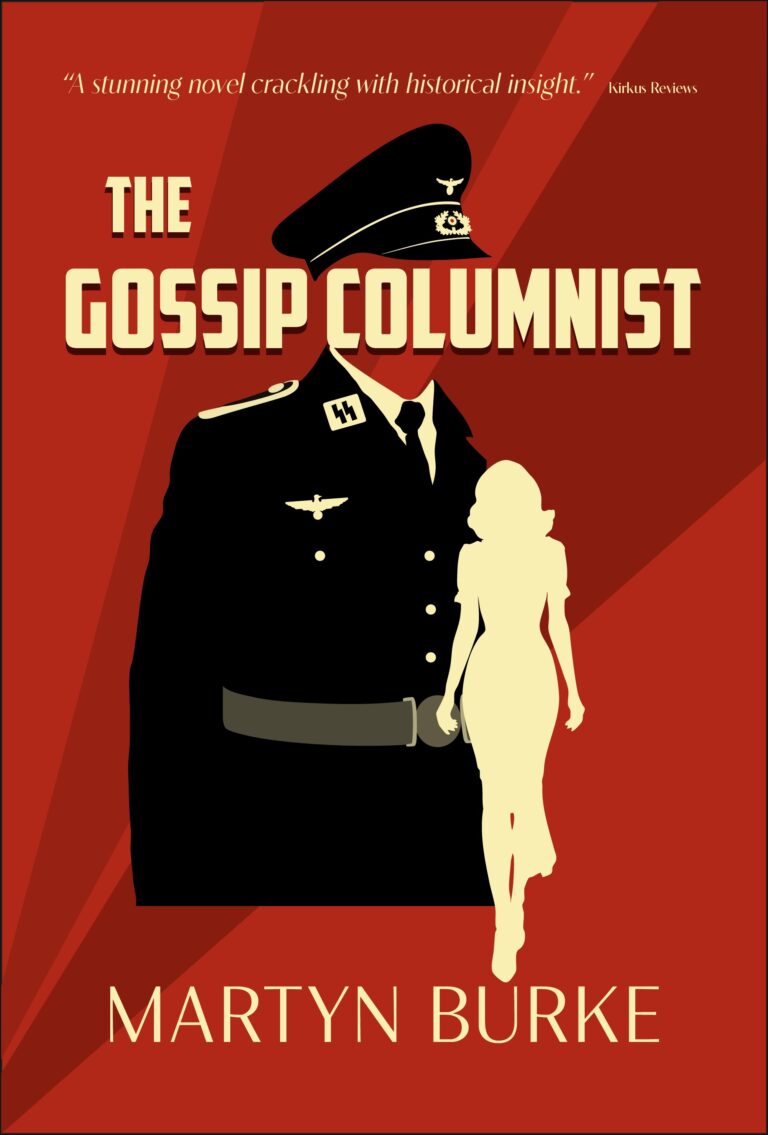

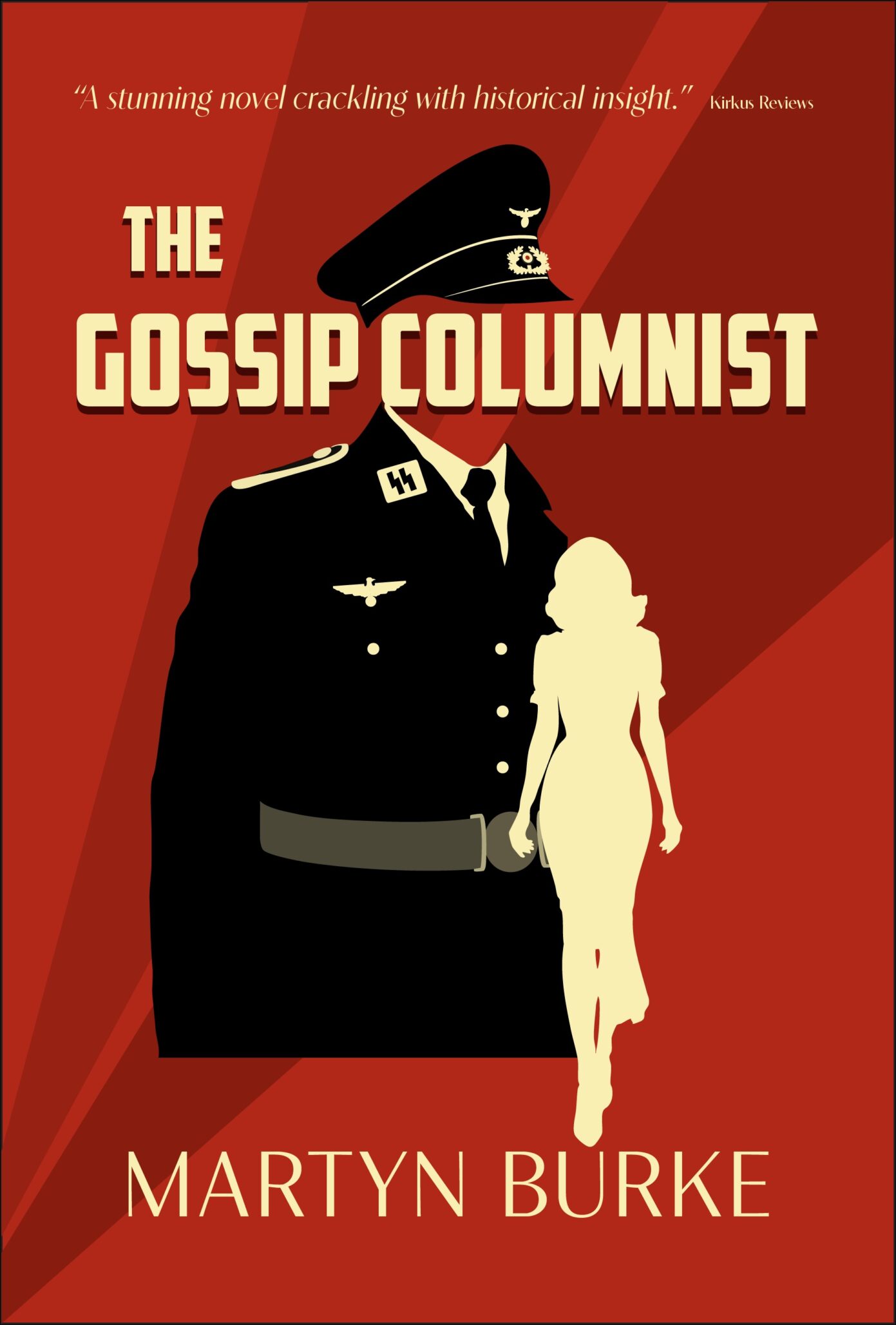
The Third Reich is remembered as a regime of orchestrated, thunderous volume—the mechanical shriek of air raid sirens, the cacophony of jackboots on pavement, the distorted bark of a demagogue’s speeches. Beneath this wall of noise, however, was a sound the regime could never quite drown out: the whisper. As the epigraph that opens Martyn Burke’s novel THE GOSSIP COLUMNIST states, “Censorship had raised gossip to the level of official communication.” In Nazi Germany, where Josef Goebbels controlled every newspaper and radio broadcast, and the press was strangled into a singular voice of propaganda, the only reliable information was found in rumors that circulated like contraband.
THE GOSSIP COLUMNIST begins with a harrowing sequence in the apocalyptic landscape of Berlin in 1945. The war is in its final days, and the city is under siege by the Russian army. Bella, a former journalist, bicycles through the ruins on a desperate mission to save her younger sister, Karin—an actress at the UFA film studio—from looming danger. This prologue culminates in a chaotic scene of Russian soldiers overrunning the studio, a grotesque circus of violence cut short by a bombing that allows Bella and Karin to escape. The story then jumps back sixteen years, when Bella lands a job writing society columns for the prestigious Vossiche Zeitung newspaper, just as the lights of democracy are being snuffed out.
As the Nazis rise, Bella and Paul—her editor and eventual lover—transform their frivolous gossip column into an instrument of resistance. They learn to package subversive truths as celebrity scandals, using sophisticated innuendo to bypass censors. Bella is eventually fired when the newspaper is “Aryanized.” Paul is also fired, and briefly sent to a concentration camp. Upon his release, the pair take refuge in a brothel, where they launch Mundfunk (mouth-radio), an underground gossip network that sends the Nazi hierarchy into paroxysms of rage as they hunt down the source. The novel’s parade of lurid tales—Goebbels as the “Goat of Bablelsberg,” a sexual predator running the film industry like a personal harem; Hitler stepping in as a marriage counselor to the Goebbels family; an SS brigade ordered to dress in drag for a musical number because the studio needs “larger” chorus girls— can strain credulity. Fortunately, Burke inserts documentary-style interludes (titled “What Is Now Known”) into the narrative that confirm the madness is not an invention but a matter of historical record.
Burke, a documentarian, captures the nightmare of a city eating itself alive with visceral, tactile precision. A bombed-out skyline is described as “naked structures having spewed their innards onto the road like dying creatures embarrassed to be seen holding their entrails in front of them.” A paranoid populace adopts “der Deutsche blick—the German look, which had us looking around in all directions before talking to anyone on the streets.” Karin’s entry into the seedy decadence of the Weimar years is described as “going onstage at the Himmel u Hölle nightclub where she shed her clothes as naturally as a discarded chrysalis.” The depiction of the Russian siege of Berlin in the novel’s final section is brutally effective and historically sound, though readers should be prepared for graphic depictions of sexual violence.
For readers interested in Nazi Germany from perspectives beyond the usual military or political narratives, THE GOSSIP COLUMNIST elevates the concept of information warfare beyond the usual spy-novel tropes. By suggesting that gossip columns can be sites of resistance and movie star scandals can be political acts, Burke offers a fresh, surprisingly resonant lens through which to view the world’s darkest century.
Martyn Burke’s THE GOSSIP COLUMNIST offers a fresh perspective on the Third Reich, revealing how whispers became a weapon against a regime of deafening propaganda. Centered on a society reporter and her editor, who turn celebrity scandal into resistance, this visceral historical novel blends documented absurdities with a propulsive fictional narrative. Burke’s novel is a potent reminder that even frivolous words can fight totalitarianism.
~ Edward Sung for IndieReader