
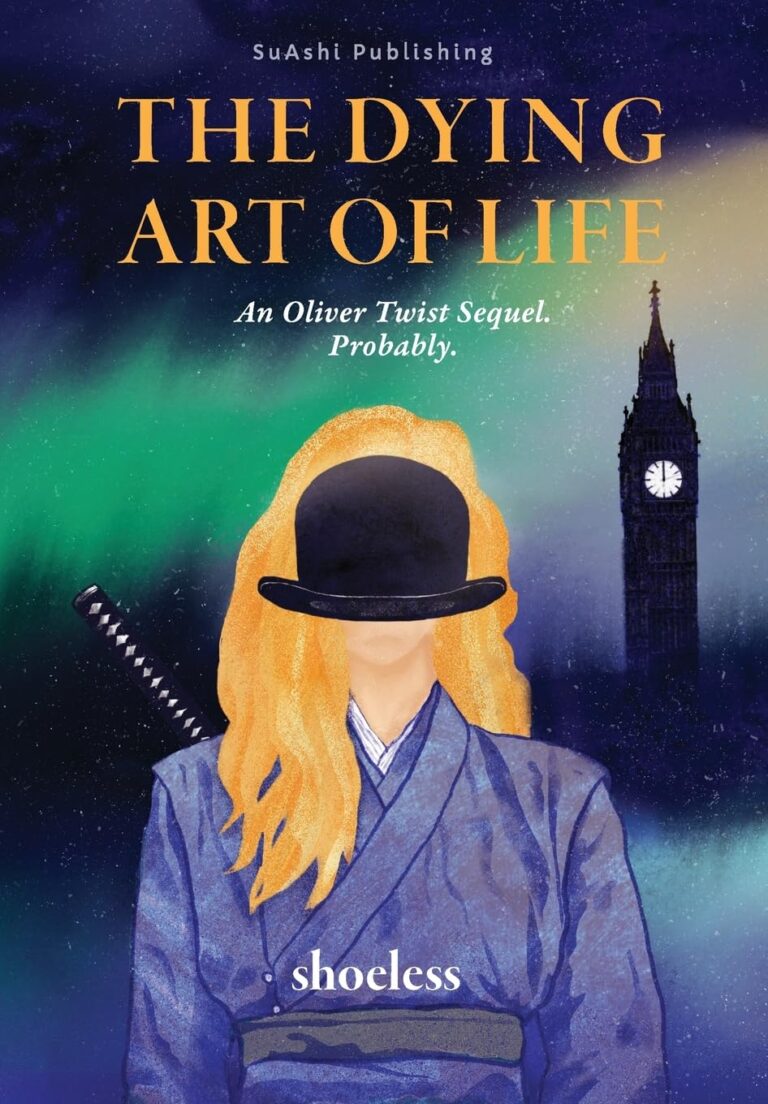

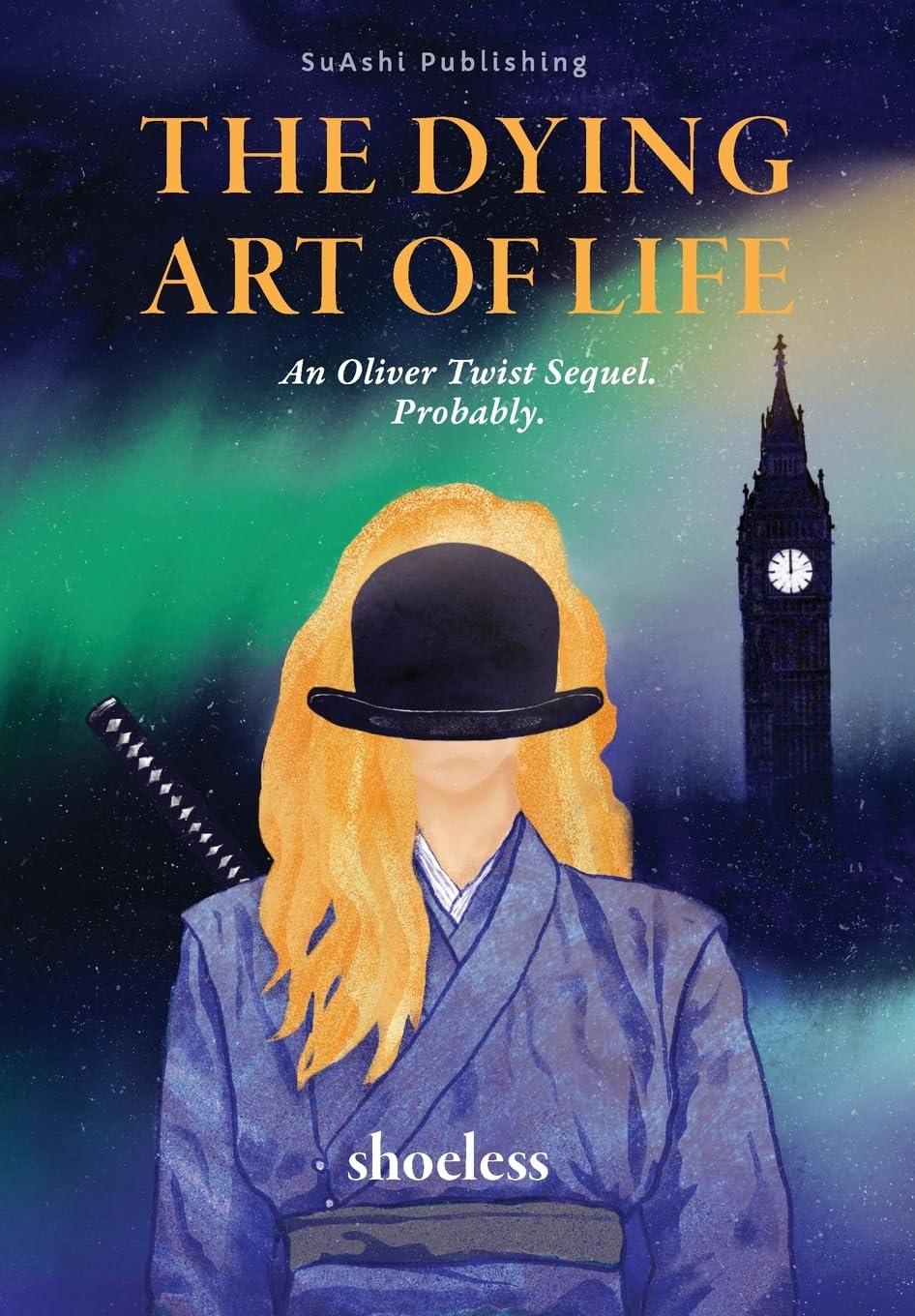
Sequels to classic novels rarely escape the shadow of their source material, but THE DYING ART OF LIFE attempts something more ambitious than a mere continuation of the plot: a postmodern follow-up to Charles Dickens’s Oliver Twist that reimagines Victorian London as a place where fictional characters can rebel against their prescribed fates.
Written by Shoeless, the novel follows Olivia Cranehill, the American-raised daughter of Nancy (the doomed prostitute from Dickens’s original), as she arrives in 1860s London to investigate her mother’s murder. Armed with a samurai sword called Kawanegi and her late father’s stories, Olivia’s investigation takes her from elegant drawing rooms to grimy back alleys. She discovers that, in this London, even the “facts” of Dickens’s novel prove unreliable—as the characters themselves have begun rewriting their own histories.
The mystery deepens when Sir Oliver Twist (now a wealthy knight) hands her his autobiography, which contradicts everything she’s been told about her mother’s death—from time discrepancies to details like Nancy’s white shawl appearing on London Bridge when it should be at the crime scene. When a fortune teller informs Olivia that “everything is written in the cards,” it becomes apparent that nothing here is set in stone—not even literary history.
One of the novel’s most engaging conceits is how Shoeless turns familiar Dickens characters into complex people who frequently defy their original roles. When Olivia innocently asks, at dinner, “Could I have some more, please?” Sir Oliver frostily retorts, “What, exactly, do you mean by asking that?”—almost as if the famous line from Oliver Twist has haunted him for decades. Even minor characters transcend stereotypes. Bet, the proprietor of the Hotel Philadelphia and Nancy’s closest friend, could have been a simple cockney caricature. Instead, Bet provides moments of unexpected wisdom on the nature of love and loyalty.
The novel’s metafictional premise prioritizes its abstract questions about character autonomy over the more conventional demands of plot and pacing. Instead of focusing on Olivia’s search for her mother’s killer, the narrative gets sidetracked by abstract questions about whether fictional characters can rewrite their own stories. As a result, the central mystery of Nancy’s murder often loses momentum, serving less as a driving force than as a framework for the author’s philosophical explorations.
THE DYING ART OF LIFE offers an intriguing “what if” for fans of both Dickens and revisionist fiction. Readers who enjoy literary puzzles and Victorian mysteries will find much to keep them engaged. Those looking for a more straightforward story or deeper emotional connections, however, may find themselves wishing Shoeless had trusted the characters more and the concept less. Overall, it’s a book that cuts at big ideas but doesn’t always draw blood.
THE DYING ART OF LIFE by Shoeless skillfully offers a meta-fictional reimagining of Oliver Twist, blending Victorian pastiche with postmodern literary theory.
By Edward Sung for IndieReader