
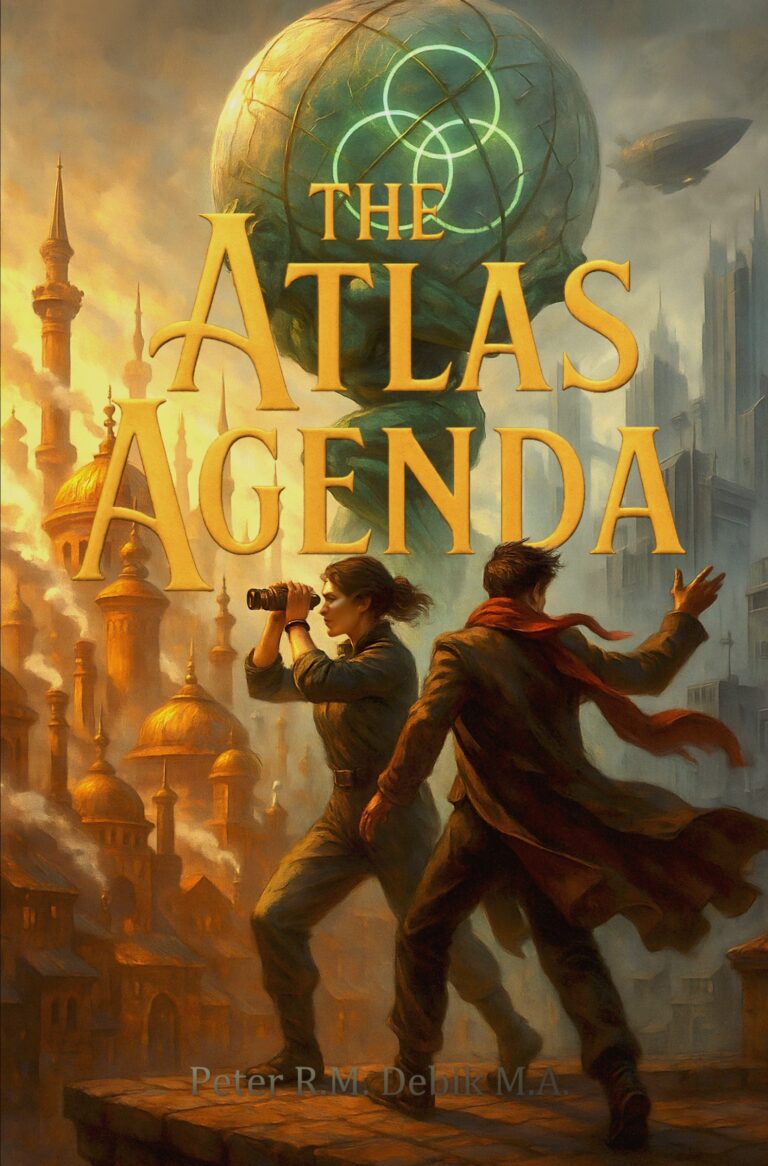


Set in a controlled future where the state routinely erases memories, THE ATLAS AGENDA follows a society built on forgetting by force. Writing in sparse, deliberate language, Peter R.M. Debik reveals a society controlled by memory clinics, government-enforced forgetting, and the quiet dread of what happens when no one remembers what was lost.
The story follows Al-Khafi, a former field operative with no clear allegiance and whose past has been scrubbed clean. As the story unfolds, we learn that he isn’t just surviving in the world the Kommission created; he is the product of it. His past comes into focus through declassified records, field notes, and conversations with those who knew him before. “It means he wasn’t part of the operation, he was the operation,” an archivist explains with unnerving calm.
As Al-Khafi seeks to confront the system, he is joined by Lira, another agent who operates differently. The ghosts she carries are evident in her clipped dialogue and how her knuckles whiten around her weapon. Al-Khafi masks pain in stillness. Their connection goes deeper than the typical romance, forming slowly and naturally through shared glances, a brief touch, or silence heavy with what’s unspoken.
Once deceptively presented as a correctional tool, the titular Atlas Agenda turns out to be something far worse. It is a protocol for “programmed forgetting.” Meaning, it isn’t meant to repair broken minds, as it’s falsely presented, but to force obedience: “The Atlas Agenda wasn’t a correction protocol. It was the last defense against truth remembered too clearly.” As the story progresses, it becomes very clear that the system doesn’t just suppress memory; it wields trauma to sustain power and rewrites injustice as a necessity: “Truth became a lie. A lie became the truth.”
As Al-Khafi and Lira edge closer to Site B-12, the Kommission’s core memory terminal, the plot moves deliberately. Debik expertly balances the high-stakes infiltration with philosophical weight, asking questions like should the world remember, and can it survive, the truth? Lira’s whispered question—“What happens when Atlas stops holding?”—is haunting, especially when what follows is reckoning instead of resolution.
Brief confrontations and tense escapes keep the action scenes purposeful, which in turn stokes tension without being distracting. The description of the settings creates a strong visual impression, from the sterile corridors of Stuttgart’s administrative hubs to the underground passageways beneath Tirana. Marrakesh stands out for its mix of ancient architecture and high-tech surveillance. Meanwhile, supporting characters enhance the story without distracting from the central arc—such as Mara (a memory survivor turned gatekeeper) and Valmir (a former courier hiding in plain sight).
While the story remains engaging and definitely worth the read, some philosophical exchanges repeat points already established in earlier scenes—slightly reducing their impact. The middle drags a bit, too, particularly when the pacing stumbles during the Tirana sequences.
Overall, though, THE ATLAS AGENDA is an immersive examination of memory as both weapon and burden. This chilling, thought-provoking read earns its weight.
Peter R.M. Debik’s THE ATLAS AGENDA is an unflinching story about weaponized memory and institutional control, delivered with quiet force and steady tension.
~ Gabriella Harrison for IndieReader