
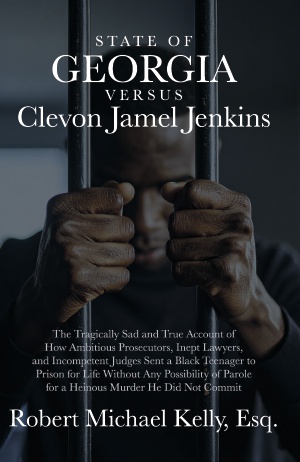

In 1993, a grocery store in Riceboro, Georgia was robbed. Its white proprietor was shot and killed by one of a group of young Black men. Two years later, Clevon Jamel Jenkins was sentenced to life imprisonment for the crimes. As author Robert Michael Kelly writes in STATE OF GEORGIA VERSUS CLEVON JAMEL JENKINS, there is no way of knowing precisely what happened during that robbery; but in his opinion, Jenkins was innocent. Kelly’s book was written to put the reader in the position of the jury and assess the question of Jenkins’s fate—as well as the shortcomings of the legal system.
Kelly began representing Jenkins on a pro bono basis in 1996 in an ultimately unsuccessful attempt to secure a new trial, as well as subsequent appeals against his conviction. Kelly notes peculiarities in the legal process—tape recorders turned off “conveniently” during interrogations; searches of property conducted seemingly unlawfully—but also points out the suboptimal performance of Jenkins’ lawyers, who advised Jenkins not to testify: a serious error, in his opinion. Space does not permit examination of every ground Kelly invoked in Jenkins’s appeal. This reviewer, however, was struck by the fact that one of Jenkins’s lawyers later testified to being “really tired” during the trial, a factor that might have impacted his effectiveness; and that the “theory of the case” the lawyers decided upon was poor, because it would fail to establish Jenkins as an innocent bystander with no involvement in the crimes (a strategy that, in Kelly’s opinion, was self-evidently the best one available).
The book weighs in at just over 550 pages. While suffusion of detail allows for a comprehensive review of a given subject, it does often tempt authors into digressions. Kelly is not immune to this: such trifling asides as a footnote about Ben Affleck being a citizen of Riceboro and a list of fictional lawyers included for rhetorical purposes could have been excised in the interests of whittling down an already lengthy text. In the same way, definitions of legal terms, so necessary for the layperson, are occasionally lacking. Phrases such as “reversible error” and “Brady material” are sometimes provided with a definition only after they have been used several times already or not defined at all.
Readers will need to judge for themselves whether Jenkins deserved his guilty verdict. To his credit, Kelly refrains from stating that Jenkins did not commit the crimes for the same reason that he alleges an unfair trial: lack of evidence. It is, rather, a question of belief. On Kelly’s meetings with Jenkins, he found him to be “very gentle.” It’s hard to disagree with Kelly’s perspective, however. What is law without fairness?
Highly detailed, forensic, and unyielding in its insistence on fairness, Robert Michael Kelly’s STATE OF GEORGIA VERSUS CLEVON JAMEL JENKINS is an exhaustive examination of a murder conviction, the appeal against it, and its consequences.
~ Craig Jones for IndieReader