
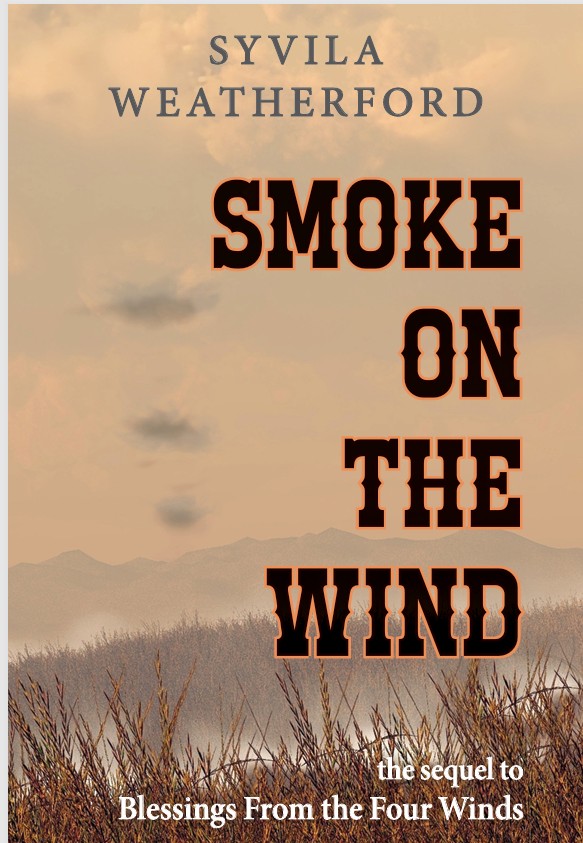

The Civil War is now twenty years past, but the memories linger. Many formerly enslaved people are still sharecropping or in domestic service on large plantations; others are struggling to find new livelihoods, as government programs favor white settlers. Amidst it all, people still cling to one another for friendship, romance, and survival.
Syvila Weatherford’s SMOKE ON THE WIND has a lot going for it. It’s up front with its historical bona fides, drawing explicitly on the history of the Boomer Movement in opening up indigenous land for white settlement. In several instances, the narrative connects to specific legislative acts and key dates in that movement. The text also knows how to mine this material for drama: for a mixed Black-indigenous couple, for instance, the need to settle their growing family competes with the moral discomfort of participating in the legalized theft of indigenous land. SMOKE ON THE WIND also has a bank of visceral detail on which to draw, from foodstuffs and fabrics to the grim and dramatic detail of a merchant company’s office being a converted trappers’ warehouse—where “a faint smell of dried blood and decayed remains” still lingers.
Unfortunately, the text’s attention is pulled in too many directions to commit to its individual stories. Any one of the plotlines could reasonably stand on its own as a novella or novel, and shifting back and forth leaves much of the action feeling perfunctory. Sometimes the problem is that a plotline doesn’t meaningfully tie into the central narrative fabric: the entire arc of “Leo” (Liao Ming Chow, a Chinese immigrant who gets a job as a cook for a wealthy ranching family) could be its own standalone piece, with an epic adventure from the Pacific coast to New York City, but the character pops up in the middle of the text instead and mostly disappears soon after. In other moments, characters are obvious, flat plot devices: two unsavory thieves show up during the start of the Boomer land grab, nearly nine-tenths of the way into the novel, and they disappear again within a few pages, doing nothing but providing some flimsy action. Perhaps these characters and their stories are intended to tie back in for a sequel, but their presence still weakens SMOKE ON THE WIND as its own reading experience.
The deeper issue, however, is that there’s surprisingly little conflict across any of the plotlines. Characters certainly struggle and face physical hardship, but that hardship is rarely tangible in the text; situations often resolve in summarily neat ways. One character throws over her rich suitor on the day of their wedding, explicitly against the wishes of her parents—but her father just shrugs it off and says it will be fine. Another character struggles with alcoholism and trauma, but the reader sees very little of the long, arduous road of self-improvement. In these moments, the exacting historicity of SMOKE ON THE WIND works against it: the characters and their arcs feel too simplistic and flat, compared to the rich complexity of the realistic setting.
There’s always room in storytelling for comforting fantasy—that’s part of the role of fiction. With that in mind, though SMOKE ON THE WIND could have been much more, some readers may still be satisfied with the novel as is.
A fascinating setting in a key historical moment buoys up Syvila Weatherford’s SMOKE ON THE WIND.
~Dan Accardi for IndieReader