


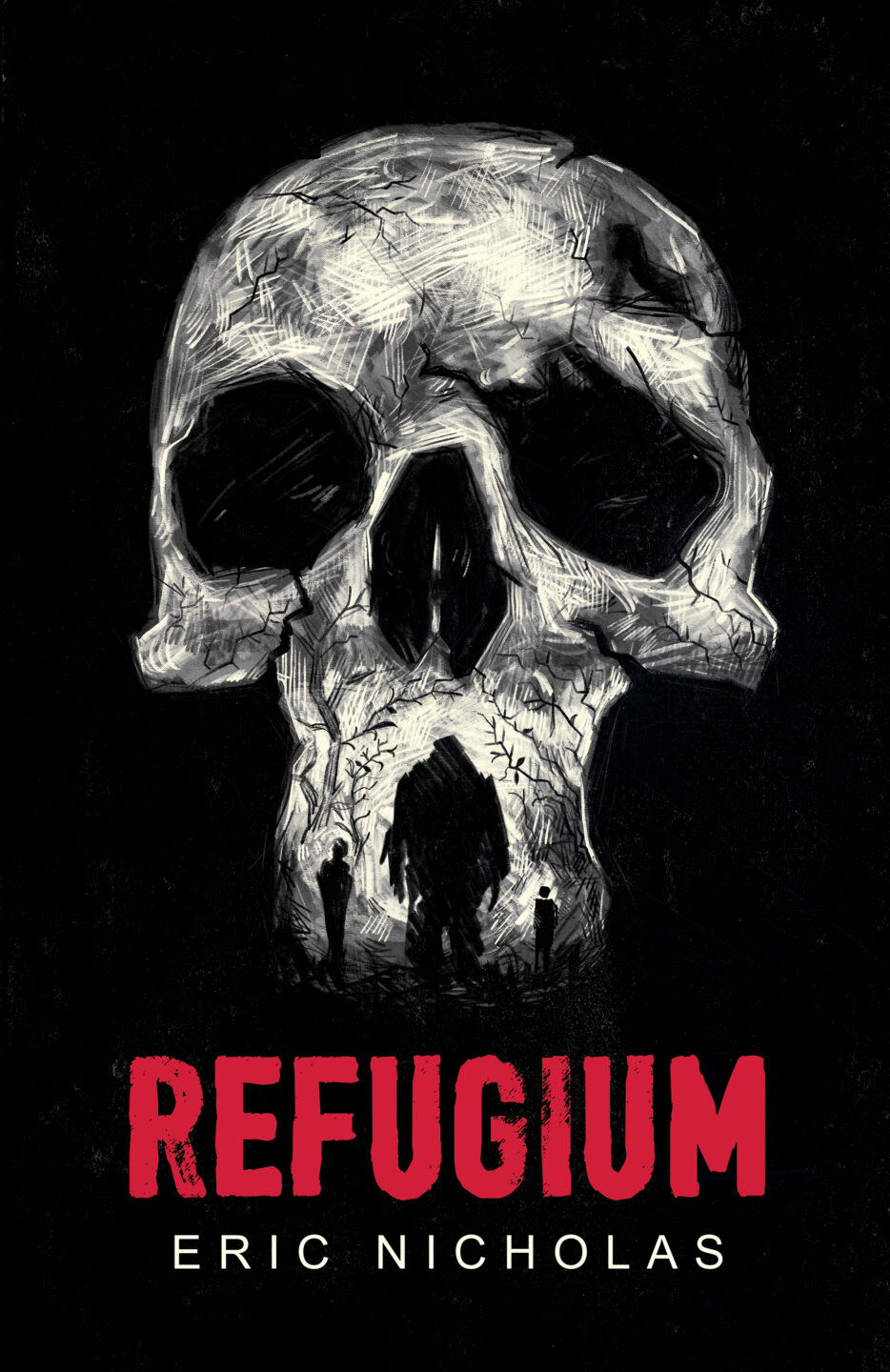
REFUGIUM, a speculative fiction epic by Eric Nicholas, anchors its narrative in the choking cindered aftermath of a super-volcanic cataclysm, as scattered remnants of various early human species (the slope-browed Homo erectus, the burly Denisovans, and fleeting intimations of the diminutive Homo floresiensis) converge within a hidden valley that serves as both sanctuary and crucible. At the center of this prehistoric microcosm stands “Last,” a physically unimposing but cognitively gifted member of Homo erectus whose marginal social status provides a lens through which to examine the nascent stirrings of symbolic thought. Through Last’s evolving consciousness, Nicholas explores the emergence of abstract thinking with remarkable subtlety, avoiding both anachronistic modernization and reductive primitivism.
The novel’s central conflict emerges with the arrival of a more advanced species, Homo denisova, led by the scarred mystic-warrior Sovran. When the Denisovans invade the hidden valley where Last’s clan has taken refuge from a global ashfall, the resulting clash illuminates questions about the nature of humanity itself—our capacity for both extraordinary violence and profound compassion. Rather than falling into the common trap of depicting prehistoric people as either brutish savages or modern minds in primitive bodies, Nicholas crafts distinct modes of consciousness appropriate to each species. Last’s growing awareness of symbolic thinking emerges organically through his desperate circumstances, while the religious authority Sovran’s more sophisticated metacognition allows him to manipulate others through abstract concepts. Both characters feel authentic to their evolutionary moment.
The author’s world-building is similarly accomplished, particularly in his construction of differentiated modes of consciousness appropriate to each species. Last’s dawning awareness of symbolic possibility emerges organically through his desperate circumstances, while Sovran’s more sophisticated metacognition enables complex manipulation of abstract concepts. Perhaps most remarkably, the deranged Homo floresiensis dubbed “Dung Fly” becomes a deeply affecting character through her fractured but recognizable yearnings for connection.
Nicholas’s conceptually ambitious prose style employs a limited third-person perspective that shifts between characters while maintaining distinct cognitive registers for each species. Perhaps most impressive is Nicholas’s ability to generate genuine emotional resonance while maintaining prehistoric plausibility. The relationship between Last and his younger brother achieves extraordinary poignancy precisely because it’s rendered through the limited but intense emotional palette available to early humans. In this passage, for instance, Nicholas observes the brothers in a moment of shared wonder without attributing to them a complex aesthetic appreciation beyond their capabilities: “Sometimes, in furtive whispers and gestures, his brother would draw attention to minor things of beauty within sight or reach. The silhouette of the canopy swaying gently against the dimming sky, the ever-shifting shapes of the ash clouds.”
If the work has limitations, they lie in occasional lapses of narrative momentum during the middle section, where the mounting tensions temporarily slacken. However, this is a minor flaw in what is otherwise a remarkable achievement in both world-building and character development. Nicholas demonstrates particular finesse in the wordless understanding that develops between Last and Dung Fly, the representatives of two distinct hominid species. In a poignant scene, a glimmer of mutual recognition passes between them: “Last could only stare. While he was familiar with the bizarre arboreal species, it was his first close look at one. Physically, it resembled a dwarf version of himself, but with unusually large feet and the complete absence of a chin. A shock of grimy black hair billowed down to its narrow shoulders. In its large glassy eyes, a trace of compassion, pity.”
REFUGIUM succeeds as both a gripping survival narrative and a profound meditation on human consciousness. Nicholas has created something rare: a prehistorical novel that feels both authentic to its period and relevant to contemporary conversations about human nature, environmental catastrophe, and the roots of social organization. The result expands the possibilities of what speculative fiction about human origins can achieve while maintaining rigorous anthropological plausibility.
A ferocious, tender novel of prehistoric survival and dawning humanity, REFUGIUM is an impressive feat of intricate worldbuilding and character-driven Paleofiction. Author Eric Nicholas brings his vanished world to startling life through evocative prose and well-drawn prehistoric personas, crafting an immersive and thought-provoking epic.
~Edward Sung for IndieReader