
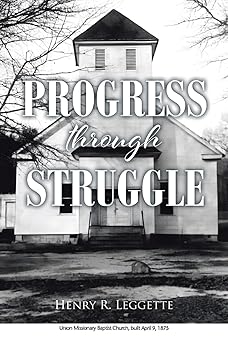

The odds were stacked against Henry R. Leggette, a Black man who grew up in Kemper County, Mississippi in the 1940s and ‘50s. At that time, most Black people in the county were poor sharecroppers, and segregation was very much the order of the day. Electricity and paved roads were still a thing of the future.
That the Leggettes owned their own farmland did not exempt them from racial prejudice. Leggette attended one of the “lowest-rated” schools in the US. He vividly recalls being told that a vending machine selling Coke was for white people only. When Leggette’s parents attempted to take out a loan to put him through school, they were denied on account of their race.
Nevertheless, Leggette has fond memories of his childhood, and it’s this defiantly positive attitude that characterizes PROGRESS THROUGH STRUGGLE. It would probably be accurate to call it a memoir, although the first third reads more like a history of Kemper County. There are chapters devoted to the local post office, mason lodge, community center, school, and churches (complete with long lists of names of pastors, Sunday school superintendents, church clerks, etc.).
We get some information about Leggette’s family and friends here and there, but not enough. As one reads, one wants to know more about his personal experiences and inner life. We learn that he took an interest in math in high school and received encouragement from his teachers, who saw in him an industrious and promising student. But it’s all very descriptive and neutral, with little emotional insight.
The book’s second half is almost exclusively about his work in electronics (he became very successful in the field). After being discharged from the Army, he found work with AT&T, and later with the Federal Aviation Administration. The content of this section is liable to bore most readers. Here are the titles of four consecutive chapters: “Entering FAA as an Electronics Technician Trainee,” “Solid-State Devices Course,” “Digital Logic Principles,” and “Communications Equipment Course.”
There is an abundance of recollection here, but very little reflection. For instance, the passage dealing with his father’s sudden death (Leggette was stationed in Germany at the time) is only a few paragraphs long. The book could also do with another round of editing: there are redundancies, such as “extremely extraordinary” and “extremely great,” as well as a number of grammatical errors.
Given Henry R. Leggette’s early difficulties and later successes, PROGRESS THROUGH STRUGGLE is inherently interesting. Unfortunately, the writing is not sufficient to sustain that interest very far beyond the first couple chapters.
~ Michael Howard for IndieReader