
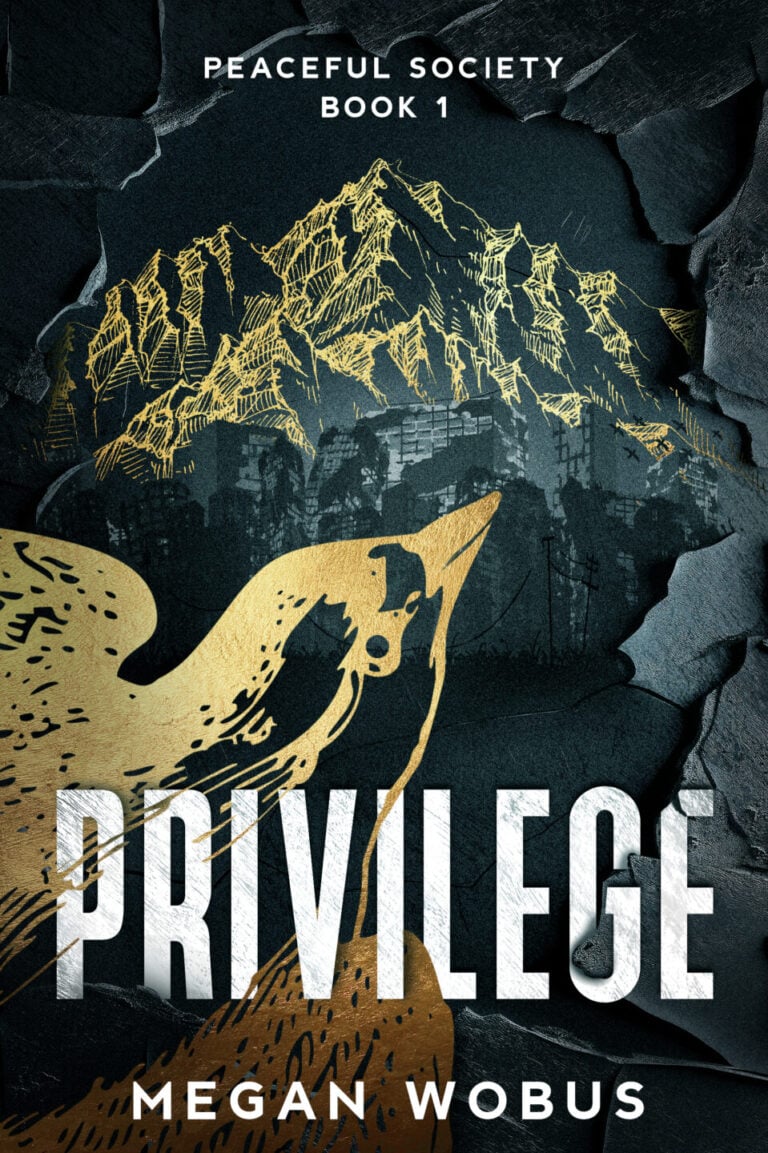


It is the first day of the rest of Amity’s life. Raised in the Peaceful Society, a matriarchal version of Greater Maryland circa 2034, she is preparing to take her Oath and become a full member of this weaponless, violence-free world. Moreover, she hopes to become an officer like her mother before her. But when she observes an undercover operation happening at the ceremony, she is plunged into her very first job: leaving the PS and venturing into the outside world.
Beyond the bounds of Greater Maryland, life is very different. While weapons are banned worldwide, every region has adapted in their own way. Notably, though, men have greater rights than they do in the PS—where they are constantly monitored and even drugged into a stupor should they become overly emotional. Countering this movement is Vale, who is recruiting men to fight for his father in Anchorage. Amity’s role will require her to go undercover into a community very unlike her own, where weapons are common and women cling to their men. As she meets the people on the outskirts of these two societies, living freely and making art, she also grows closer to Vale—both of which could compromise her mission.
PRIVILEGE bounces between its two narrators: Amity, dedicated to the PS and appreciative of the strict rules that keep her society safe; and Vale, immersed in both the freedoms and the dangers of his own world. Author Megan Wobus uses the two-narrator structure to great advantage here: both Amity and Vale are relatively assured of their cultural superiority, both have negative memories of what the other way of life has resulted in, and neither has the full picture. While it may feel natural to bristle at the idea of a matriarchal society being a bad thing, especially against the backdrop of current events, PRIVILEGE asks readers to find the truth somewhere in between these two young people’s narratives by making a point about the dangers of black-and-white thinking in any direction—denouncing the idea that a social wrong can be righted simply by doing the exact, extreme opposite. Furthermore, the presence of other, non-point-of-view characters (including Ren, a nonbinary member of an artists’ commune where Amity begins building friendships) offers early signs that neither Amity nor Vale wields the absolute truth here.
At its heart, PRIVILEGE posits that real change and real peace require constant reassessment. While the book leaves off on a cliffhanger, early signs point to the narrative continuing to be strong and insightful in later novels.
In PRIVILEGE, author Megan Wobus presents readers with a thought-provoking and worthwhile first book in the Peaceful Society series.
~Kara Dennison for IndieReader