
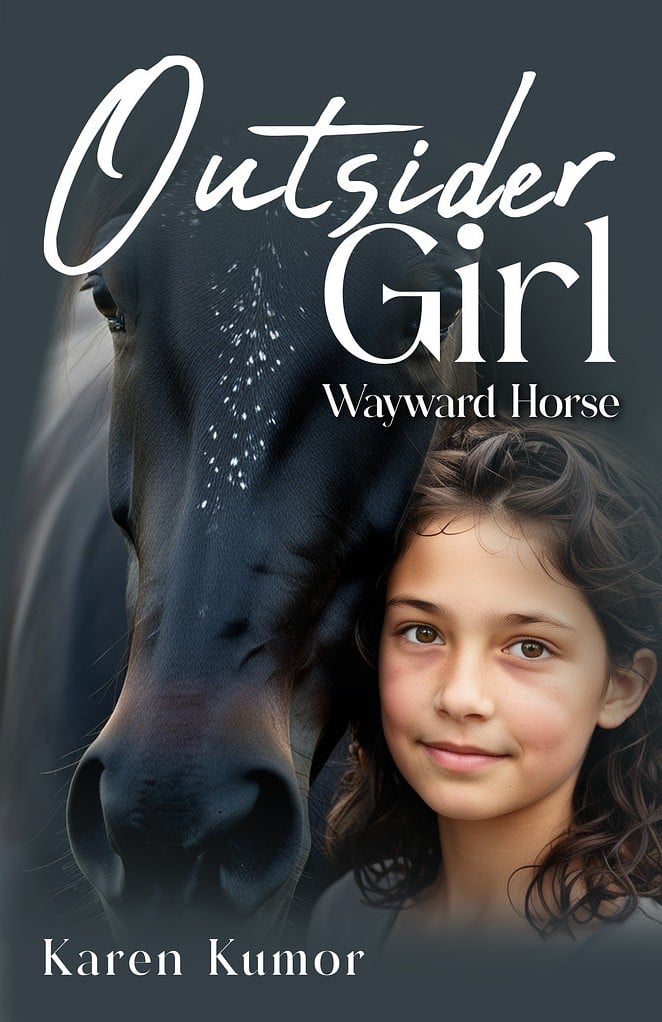

Karen M. Kumor’s OUTSIDER GIRL: Wayward Horse is an earnest and emotionally accessible middle-grade/YA novel that explores grief, belonging, and self-confidence through a familiar but effective human–animal bond. While the narrative follows a well-established coming-of-age framework, its emotional sincerity and gentle tone give it steady appeal for its intended audience.
Kumor conveys the inner life of a grieving, socially isolated twelve-year-old girl with enough clarity and compassion to make Sandy a sympathetic protagonist. Her emotional responses feel authentic and age-appropriate, particularly as she struggles with adjusting to loss, displacement, and social uncertainty. Sandy’s developing relationship with Credo, a troubled rescue horse, serves as both a narrative and emotional anchor—a clear metaphor for trust, healing, and self-acceptance. Scenes set at the stables contrast effectively with Sandy’s difficulties at home and school.
Sandy’s character arc unfolds in somewhat predictable ways, yet remains coherent and emotionally consistent. Her growth follows expected patterns common to the genre. However, while the progression rarely surprises, it's accessible and reassuring for younger readers. Rather than aiming for narrative risk, OUTSIDER GIRL: Wayward Horse favors emotional safety, reinforcing its themes through repetition and gradual confidence-building.
Although Sandy remains the clear focal point, Kumor occasionally shifts perspective to supporting characters—including Sandy’s grandfather, brother, and the stable owner Carol. These brief, character-centered chapters add texture and context to the story, offering insight into how each person grapples with responsibility, grief, or change during the same period. The added background gives them more substance than might be expected, and helps reinforce the novel’s broader emotional landscape.
Structurally, the pacing is generally steady, though the narrative can feel uneven at times. Transitions are occasionally abrupt, creating a slightly disjointed reading experience. The novel’s technical execution also presents challenges. Grammatical errors, missing quotation marks, and repeated descriptions intermittently disrupt the flow—pulling attention away from the emotional core. These editing issues detract from the book’s overall polish and suggest that stronger editorial refinement would have significantly elevated the final product.
But this straightforward book is still well-suited for its intended audience, prioritizing clarity and emotional readability over stylistic complexity. Readers drawn to gentle, reassuring stories (particularly those centered on animals, resilience, and personal healing) will find familiar and comforting ground here.
Emotionally sincere and grounded in a relatable journey of self-discovery, Karen M. Kumor’s OUTSIDER GIRL: Wayward Horse offers warmth and heart despite its predictable structure and technical shortcomings.
~ Rae O’Hara for IndieReader