
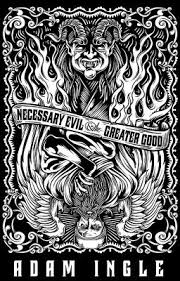

Although Adam Ingle is not the first to have fun with Christian doctrine and human conceptions of the afterlife, NECESSARY EVIL AND THE GREATER GOOD is certainly original enough to be entertaining. There are aspects of this universe that are ill-defined or puzzling (for example, why one of God’s most powerful agents can’t track purchases on a debit card like any human cop). There are also a few minor grammatical errors. However, most problematic is Ingle’s tendency to rely on vulgarity to produce humor. The comedy works well here when it’s irreverent (even blasphemous) but when an ancient god—one who has supposedly been separated from the mortal world for a millennium—starts dropping f-bombs, the result is neither plausible nor funny.
Another problem in the novel is that when innocent humans begin to die as a result of their scheme, Mestoph and Leviticus become less sympathetic characters. Ingle explains that even though both have spent time among humans, neither has ever been human; thus, neither values human life. However, Ingle then tries to convince readers that Mestoph and Leviticus suddenly develop compassion for humans through contact with humans Marcus and Stephanie. This transformation could be more believable if Marcus and Stephanie were well-developed, compelling characters, but unfortunately both are flat stereotypes.
NECESSARY EVIL AND THE GREATER GOOD has action scenes and exotic locales worthy of a spy thriller. The climax is also appropriately epic for a story about powerful supernatural forces, though the ending ties up a tad too neatly in order to pave the way for a sequel (due out in 2015). Hopefully the next novel will improve on the potential displayed in this one.
Although it lacks somewhat in characterization, NECESSARY EVIL AND THE GREATER GOOD is a comical fantasy adventure for those who don’t mind poking bit of fun at religion.
Reviewed by Tamara Agger for IndieReader.