
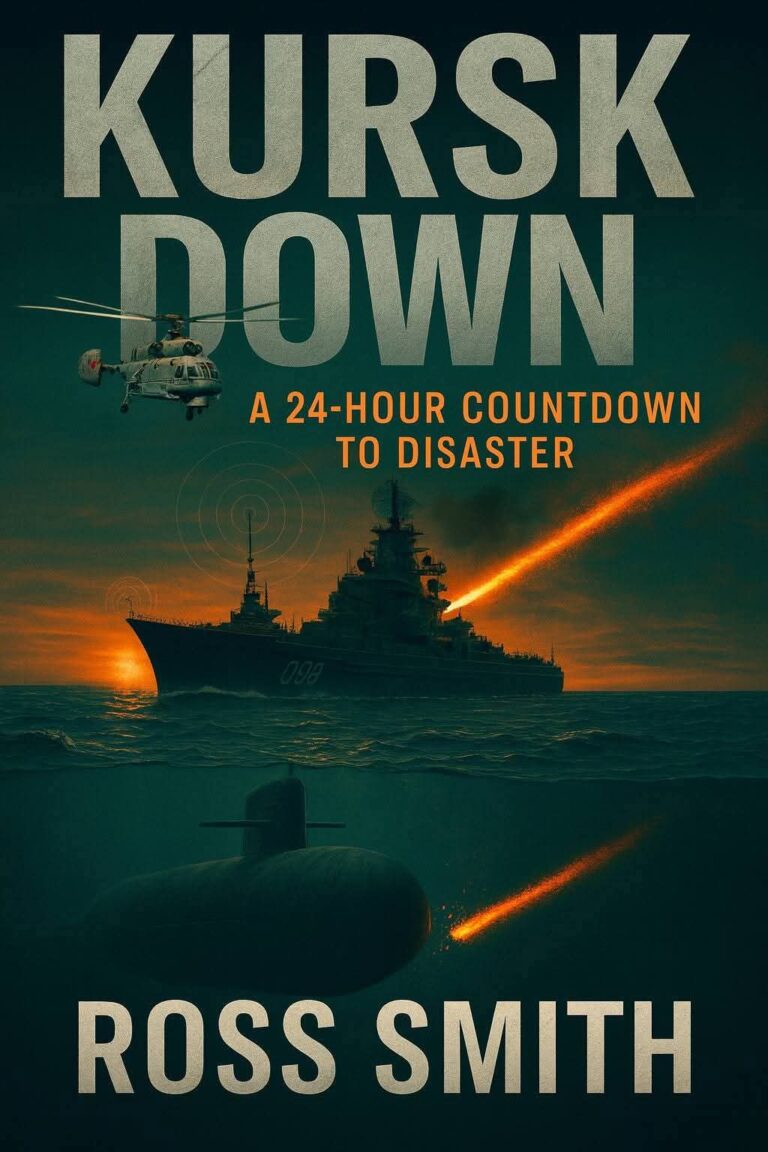

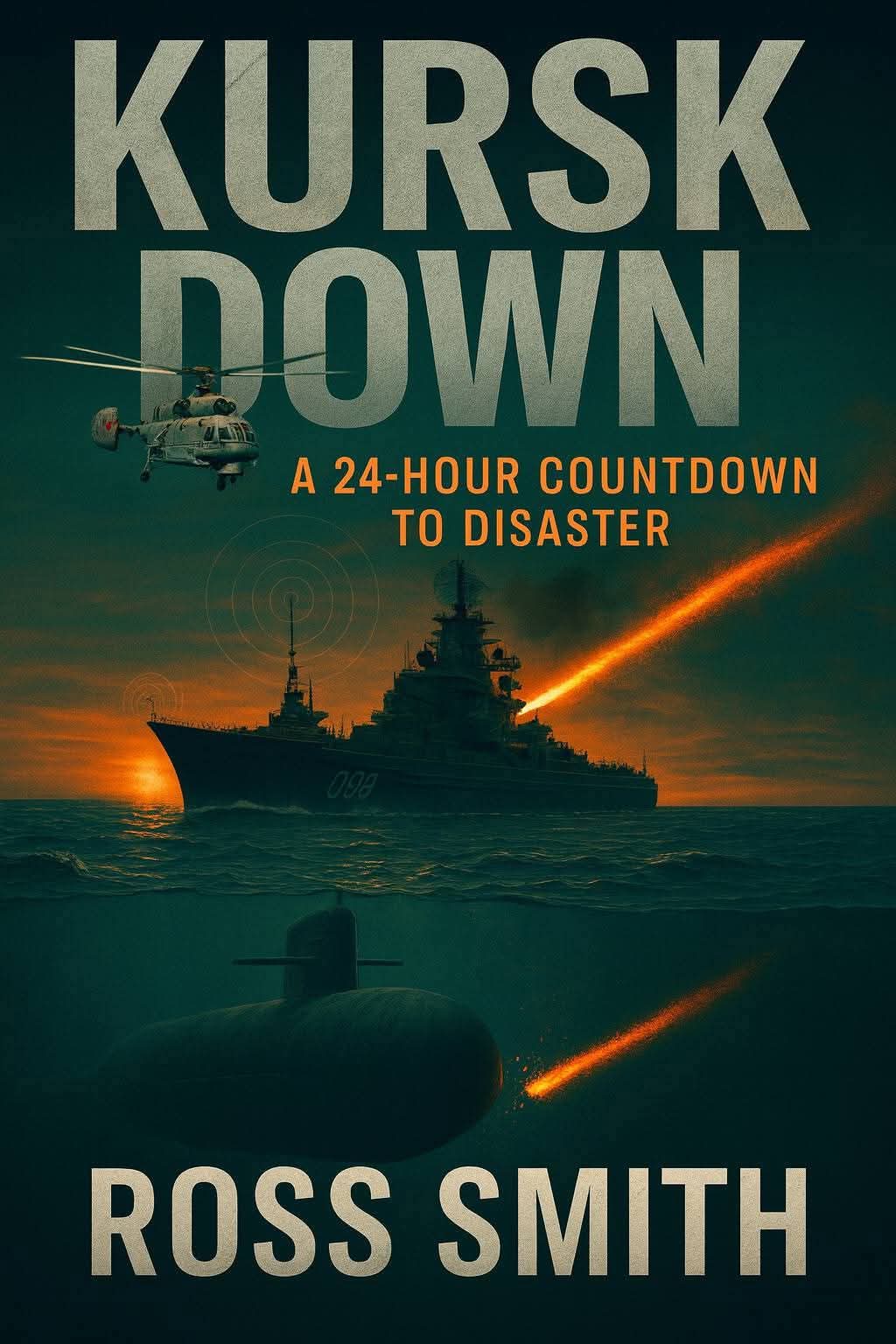
Ross Smith’s debut novel KURSK DOWN: A 24-Hour Countdown to Disaster is a post-Cold War thriller in the Tom Clancy mold. Smith takes the Kursk disaster of 2000 as his starting-point, re-imagining the event—believed to have been caused by an internal explosion—as the product of a collision between the Russian submarine and an American sub trailing it. Complicating the situation is the presence of Chinese observers in the Russian fleet, who are playing a shadowy game of their own.
The mood, then, strongly resembles that of Clancy’s The Hunt for Red October. Indeed, Smith employs a similarly game-changing piece of technology to rival Clancy’s magnetohydrodynamic drive: a “supercavitating torpedo” that was indeed pioneered by the Russians in real life, and capable of driving through the water at unprecedented speeds. The stakes are clearly drawn, the narrative urgent.
Smith’s technical research is exhaustive, and the evocation of life underwater rings true. However, instead of framing expository material in terms of a key character’s internal monologue, or as part of some omniscient narration, Smith often inserts it into conversations where it feels unnatural or unneeded. There is also one of the novel’s central plot points—an escalation—to contend with. The plausibility of a Russian sub firing on an American one following a collision between the two, and with no declaration of war in place, is extremely low. Enemy submarines and even surface ships collided during the Cold War (and indeed afterward) in circumstances not dissimilar to those in the book without further incident, and did not prompt anyone to fire torpedoes even in “self-defence” as presented here. In a book that plainly prides itself on verisimilitude, this is a strange gambit. The episode seems to occur simply to enable the plot, which subtracts credibility. In the same way, one doubts that an average submarine commander would have the authority to simply order his boat to be equipped with experimental and untested weapons without clearance (much less use them in combat). If the Sea Lance is “a wild card, a technological leap that could save them—or doom them if mishandled,” why bring it and reveal its existence to the enemy?
A few typos, grammatical errors, and the like suggest this work hasn't been properly read through. The sentence “Brennan, his mind on Rourke” on page 31 is plainly incomplete, orphaned quote marks appear on pages 45 and 75, a comma is missing on page 47, and so on. Smith also leans very heavily into technical description, and seems unwilling to trust the reader with details without repeatedly emphasizing them: for example, we're informed that the Russian flagship displaces 28,000 tons on no fewer than five occasions in the first fifty pages. Nevertheless, enough spectacle is delivered that KURSK DOWN should offer an exciting diversion for Clancy fans.
Though it's too fanciful to maintain plausibility, Ross Smith's KURSK DOWN: A 24-Hour Countdown to Disaster is full of fun thrills and spills.
~ Craig Jones for IndieReader