
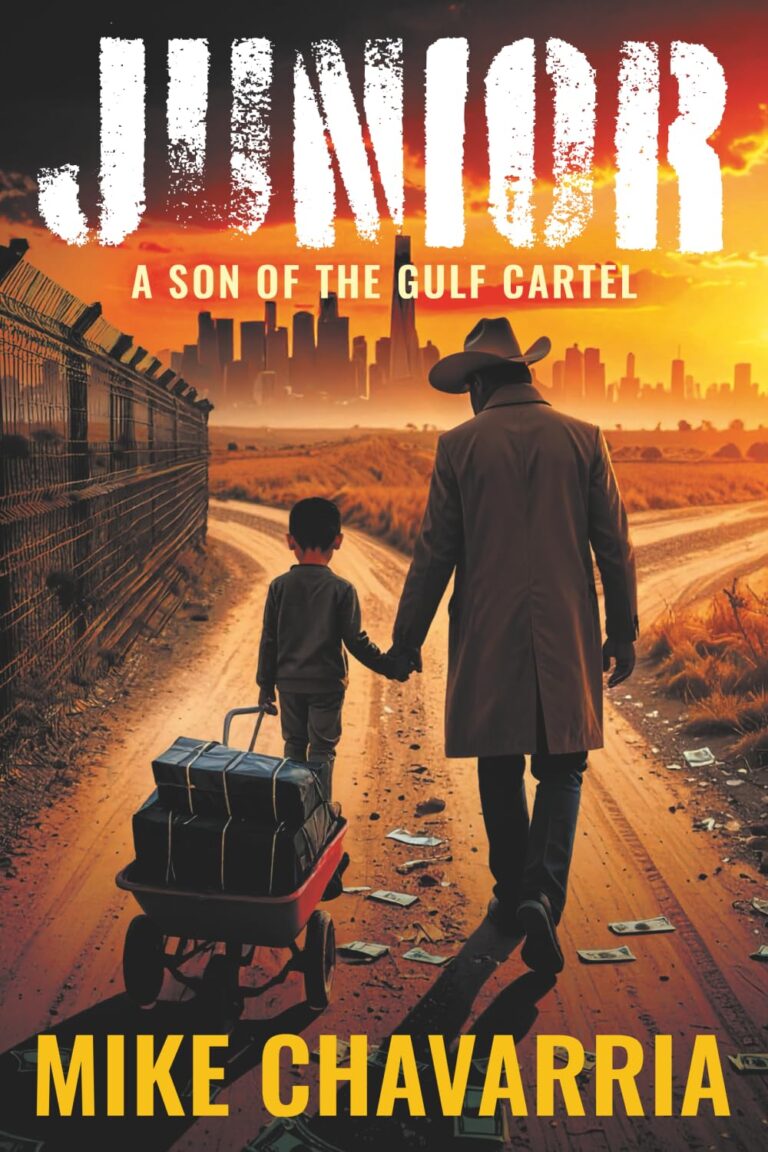

Author Mike Chavarria is a retired DEA Special Agent with three decades of frontline experience battling narco-terrorism and trafficking in Latin America. His fascinating book, JUNIOR: A Son of the Gulf Cartel, focuses on the 2005 DEA operation “Band of Brothers,” which primarily targeted the Sinaloa Federation. What set this mission apart was the inside information provided by Raul “Junior” Valladares, the charismatic son of a Gulf cartel capo who decided to work undercover for the DEA.
As a reader might expect, given his background, Chavarria has produced a polished, meticulous, and highly readable account of this particular DEA case. However, JUNIOR also exposes with rare candor the blurred lines, moral flexibility, and human costs on both sides of the investigation. Chavarria has structured his book with care and consideration. He lays out the narrative framework in a strong, concise introduction that whets the reader’s appetite and immediately marks JUNIOR as something a little different from the usual narco-memoirs. He furnishes the reader with useful, succinct information on law enforcement acronyms and Spanish naming conventions (especially Mexican, which can be confusing for non-Hispanics). He also provides photographs of key players and events.
The book opens in 1991, detailing the discovery of a cocaine shipment that Junior had been responsible for brokering into the port city of Veracruz, Mexico. It’s instantly riveting and cleverly written from Junior’s third-person perspective. Indeed, Chavarria skillfully makes it read like the opening chapter of a gripping narco-thriller (“with his body tightly confined to the rigid chair, only his mind was free to wander”) without resorting to sensationalism. Junior is clearly ruthless, but Chavarria ensures that his psychological and emotional vulnerabilities (especially regarding his wife and children) are evident early on.
Junior is an intriguing study in contrasts. Chavarria spends the opening chapters exploring the man’s background, as well as his own, immersing the reader in the twin worlds of law enforcement and cartel infrastructure (much as Junior does). Following these entertaining chapters, each reading like a separate, absorbing narrative, Chavarria shifts to his own first-person perspective as the complicated investigation gets underway—propelled by Junior’s vital knowledge and inside information.
Chavarria writes in a confident, straightforward style (“seeking an adventurous life, I began with a brief stint in the military, followed by a career in law enforcement”) that maintains constant engagement. Readers are drawn in with clear-eyed facts, including how “most of the cocaine was sourced by two influential Colombian organizations: the AUC and the North Valley Cartel." Given the almost impenetrable nature of the cartel—with its elaborate hierarchies and the intricate, far-reaching nature of its business—this is exactly how this book should be written. Overall, he maintains objectivity, though it’s clear that he and Junior form a bond of affection and respect that occasionally leads Chavarria to break his investigative detachment and slip into subjectivity. This notwithstanding, it’s an intense, thought-provoking dynamic that Chavarria shares and reflects upon with the utmost honesty.
Furthermore, the loyalties, conspiracies, and betrayals among the different law enforcement agencies are enlightening—mirroring in a basic fashion (without the extreme barbarity and cultural mores) those of the cartel. As the operation heats up, several unforeseen maneuvers unfold; but Chavarria handles these knotty developments with lucidity and sustains his driving tonal consistency to keep JUNIOR a compelling read from start to finish.
Well-written, thoughtfully crafted, and immensely involving, Mike Chavarria's JUNIOR: A Son of the Gulf Cartel is a forensic yet deeply human account of a high-stakes narcotics investigation fraught with tangled complexities, personal sacrifices, and an unexpected search for redemption.
~ Rose Auburn for IndieReader