


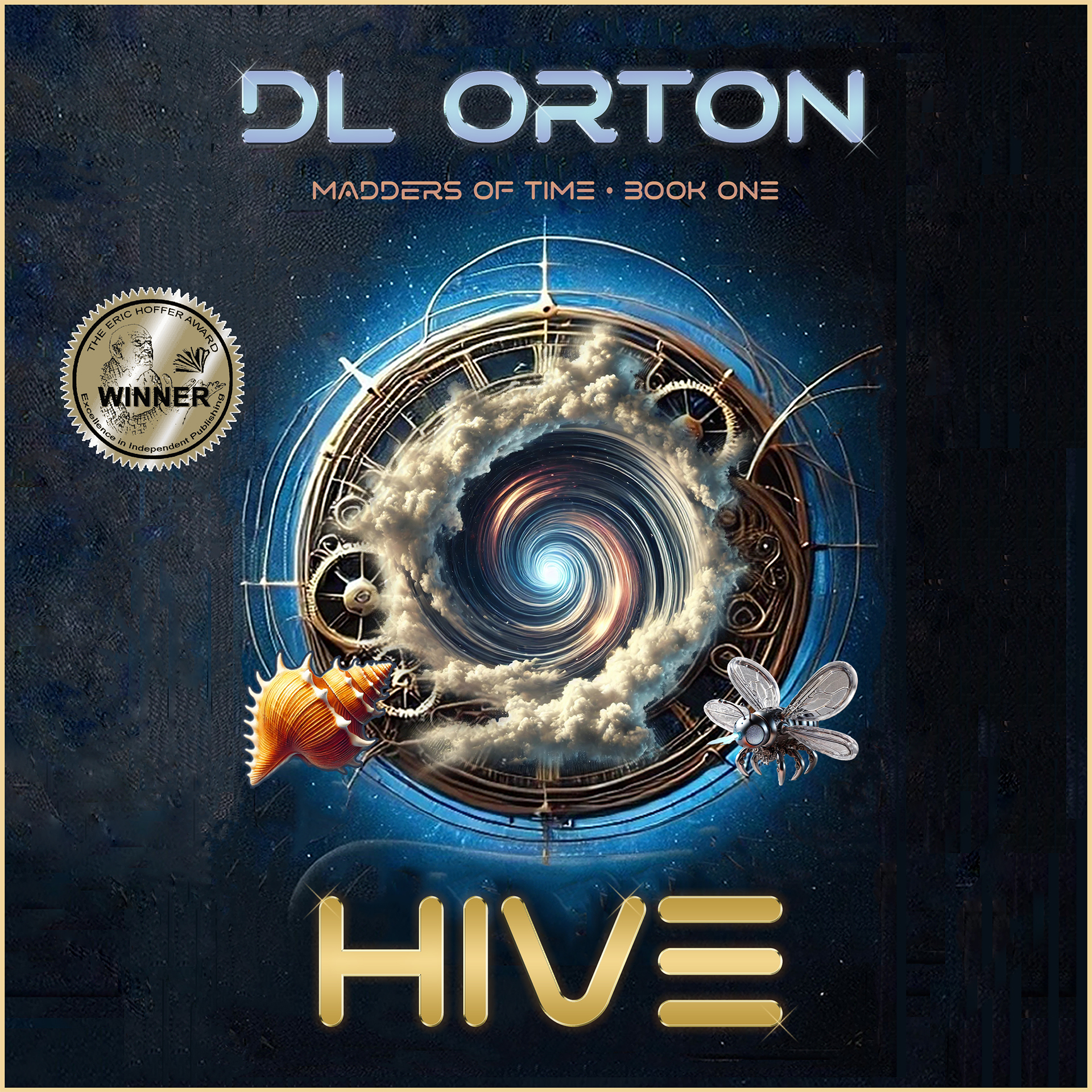
In HIVE: Madders of Time, Book 1, D.L. Orton delivers a richly layered and emotionally immersive narrative that pushes beyond the boundaries of traditional science fiction. Set in a crumbling biodome surrounded by oceans and hostile microdrones, the story places humanity’s last survivors in an environment that feels both claustrophobic and vividly realized.
The worldbuilding emerges organically through small, cumulative details, such as the understated sensory descriptions that ground the setting in everyday experience: “All around me, late afternoon shadows slink down from the tall buildings. The streetlights are just coming on, and the autumn air smells of barbecue, ripe garbage, and car exhaust.” The author’s attention to detail strengthens the worldbuilding, grounding the high-concept elements in tactile, lived-in reality while maintaining exceptional readability throughout. Online spaces are portrayed as fragile, isolating environments where human connection is mediated entirely through failing systems—illustrated when the narrator reflects, “I sit there in the dark like a ninny, until I remember the AI is gone too […] It will be decades before the batteries charge enough for him to reboot. If ever.”
Isabel and Diego anchor the novel with a relationship built on shared history, sacrifice, and unresolved longing. Their emotional depth elevates the narrative, transforming it from a tale of temporal mechanics into a meditation on love, mortality, and the ethics of second chances. Orton’s handling of character is a standout strength: both protagonists are complex, flawed, and driven by motivations that feel deeply human. Their private fears and hopes enrich the broader themes and create a throughline of tenderness amid the story’s escalating tension.
The pacing is remarkably tight for a novel with such intricate scientific and philosophical threads. Each chapter advances the stakes while allowing quieter moments to breathe, resulting in a reading experience that feels urgent without becoming overwhelming. The narrative explores profound questions—what is worth saving, who gets to decide the future, and how far should one go to rewrite the past?—while never losing sight of the characters at its center. Experienced in audio, the story’s clarity of prose and controlled structure translate smoothly to a listening format, making its complex ideas accessible without sacrificing emotional depth.
By the time the novel reaches its cliffhanger conclusion, the transition into the next installment feels both inevitable and intensely compelling. The ending not only heightens anticipation for Book 2 but also underscores the emotional cost of the characters’ choices, leaving readers with lingering questions and a powerful desire to continue the journey. With its emotional richness, thoughtful construction, and gripping execution, HIVE: Madders of Time, Book 1 proves a deeply rewarding read for fans of character-driven sci-fi.
D.L. Orton’s HIVE: Madders of Time, Book 1 delivers a gripping, emotionally resonant, and impeccably paced narrative that elevates time-travel fiction into something deeply human. With its powerful character work and thought-provoking stakes, the novel is a standout opener to the series.
~ Megan Parker for IndieReader