
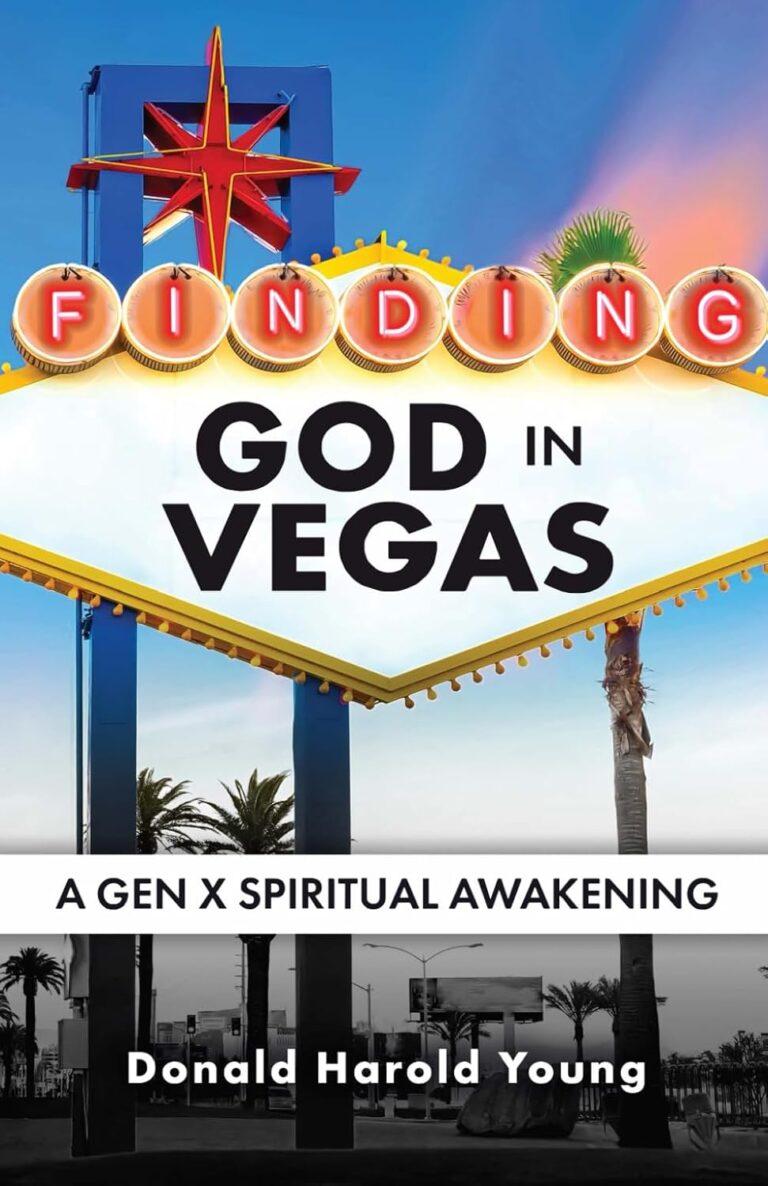

Don Young has lived a rich, complicated life. Though he was raised a Christian in the Midwest with an affinity for Republican politics, his sexuality created a secret that tore at his identity. As a successful pharmaceutical marketer, he was living a version of the American Dream, but professional challenges (and the COVID-19 pandemic) ultimately forced him to re-evaluate his life—as well as his underlying spirituality.
Young’s FINDING GOD IN VEGAS: A Gen X Spiritual Awakening tells a fairly conventional story: a successful materialist realizes that the life of the spirit is more rewarding. The core of this realization is that God is Love. The book is unusual in that it frames this conventional arc in strident, explicitly political terms. The text is not shy about saying “it is wealth and class that separates people, even if other narratives might indicate ethnicity, politics, religion, sex, or orientation are the deeper divisions.” This is a powerful moral core for the text, but also a welcome note of complexity. Although this could be either a simple moral fable about putting love over wealth, or a story about reconciling sexual identity with humanity, the text fully humanizes all of its personages as subjects of class struggle.
FINDING GOD IN VEGAS develops its ideas through rich, often beautiful descriptive prose: the narrator describes his secret double life (of his faith identity and gay identity) as “a whitewashed tomb, beautiful on the outside but on the inside full of death.” Even the natural beauty of Wisconsin is a treat, with boulders and mountains described as “earthen headstones that mark the death of an ancient silvery sheet of ice, a grave covered with a million evergreens.” The text isn’t immune to humor, either, especially in some tongue-in-cheek turns of phrase—describing the narrator (trying to conceal his sexuality and mimic his straight peers) as “an undercover gay anthropologist.”
Although it tells its story reasonably well, FINDING GOD IN VEGAS does struggle over its full length. One problem is that the book covers some five decades of life, and that makes it difficult to give everything the weight it deserves. The narrator’s experience caring for a cat, Mozzer, is illustrative. It’s clear that this relationship profoundly enriched the narrator’s emotional life, but the reader sees fairly little of it. There aren’t enough actual scenes with Mozzer to feel like he’s a character and fully appreciate his role. The text’s remarks on the COVID-19 pandemic are certainly emotionally true, and they support the class-solidarity narrative, but they also repeat some misconceptions and misapprehensions about the disease and the global response.
Most important, however, is the central, spiritual turn. The movement is easy to understand—after struggling to find meaning in the world, and losing all of the material markers of success, the narrator turns to God—but it’s poorly supported. The majority of the book is memoir, up through the 2020s when this turn finally happens, but there’s no real discussion of how or why this happens. A fuller description of the narrator’s choices and beliefs would channel its energies into a narratively and spiritually successful shape, rather than letting those energies dissipate near the end of the text.
FINDING GOD IN VEGAS is nonetheless both an emotionally legible moral fable and the compelling story of a real human life.
Although it doesn’t fully succeed in synthesizing its arguments about the world, Don Young’s FINDING GOD IN VEGAS: A Gen X Spiritual Awakening is a heartfelt invitation to a visceral, complex, and love-filled journey.
~ Dan Accardi for IndieReader