
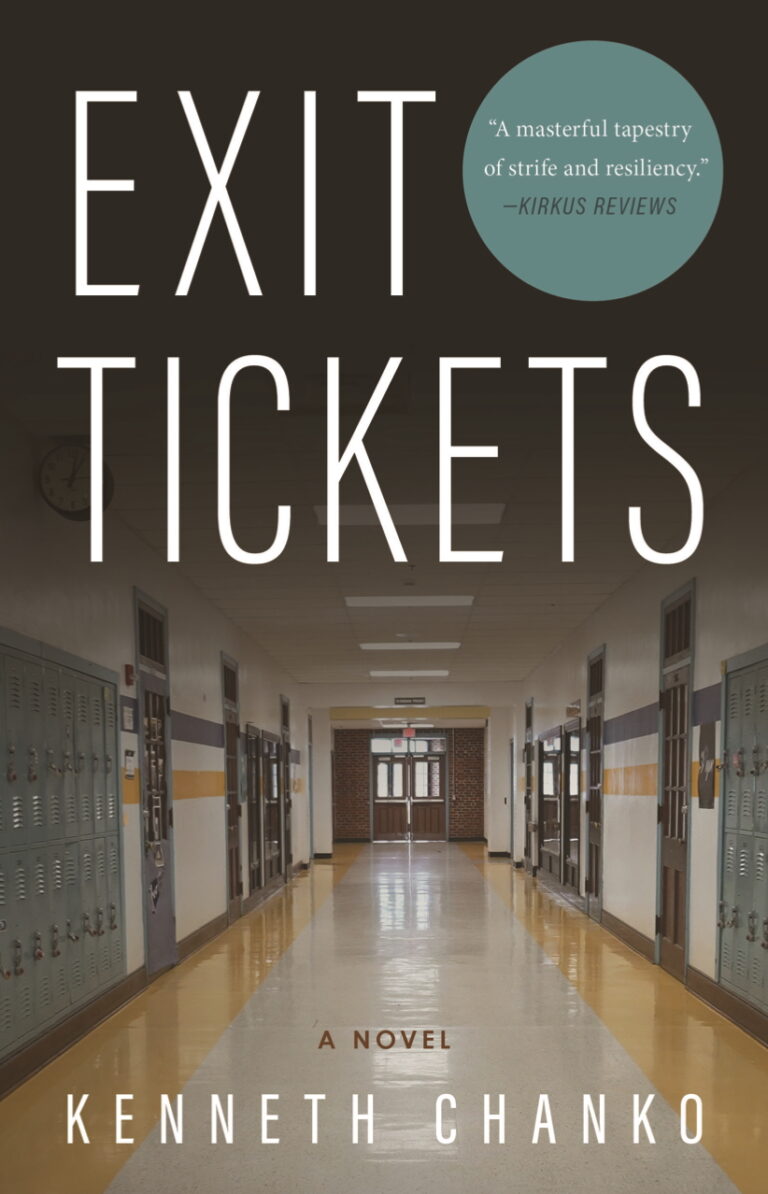

The main character of Kenneth Chanko’s EXIT TICKETS, Martin is a first-year teacher at P.S. 961: a rather rough school in New York City. From the first moment of his first class, his Black teenage students make it known that he, a white man, has his work cut out for him.
Antics at P.S. 961 include daily fist fights, indecent exposure in class, sexual harassment of teachers, physical assault of teachers, and various conspiracies plotted among students against their perceived enemies. Clearly, the students in Martin’s Writing Enrichment class have little (if any) interest in what he has to say.
There’s one exception. A girl called Kandra takes an immediate liking to both Martin and his class—a liking that, over the course of the book, evolves into an obsession with a predictable dramatic conflict. Like many of her peers, Kandra has had a troubled life: her mother died while giving birth to her stillborn sister, and her father is absent. Martin, too, has his share of problems: his older sister died recently of a drug overdose. A vague sense of guilt over her death, which he feels he could have somehow prevented, serves as Martin’s primary animating characteristic. He uses booze as a crutch, to the point of concealing a flask of liquor in his desk.
EXIT TICKETS revolves around Martin and Kandra, but there’s a range of other characters in the mix, and the rotating perspective includes nearly all of them. It’s an effective strategy if done well, and Chanko does it pretty well. The portraits of these people are layered and convincing, as is the general milieu they inhabit. It’s plain to see that Chanko is, generally speaking, writing from experience and taking the business of character development seriously.
But if the characters are thoughtfully drawn, they’re also excessively intertwined. Martin becomes involved with Coretta, the daughter of a fellow teacher, who is in turn cousin to Kandra. Meanwhile, Coretta’s ex-boyfriend (the father of her young son) also works at the school and mentors a student romantically interested in Kandra. Coretta, by the way, volunteers at the school daily. Elsewhere, Martin’s high-school crush turns out to be his ailing father’s nurse. At some point, it begins to feel as though you’re reading the script of a soap opera.
That’s not necessarily a bad thing; plenty of people like soap operas, and in that sense EXIT TICKETS can satisfy lots of people. Unfortunately, it won’t attract readers looking for greater sophistication or subtlety.
Kenneth Chanko’s EXIT TICKETS has the potential to attract a broad audience, as the writing is good enough to keep readers turning the pages. Those after a more subtle literary experience, however, may come away feeling unsatisfied.
~ Michael Howard for IndieReader