
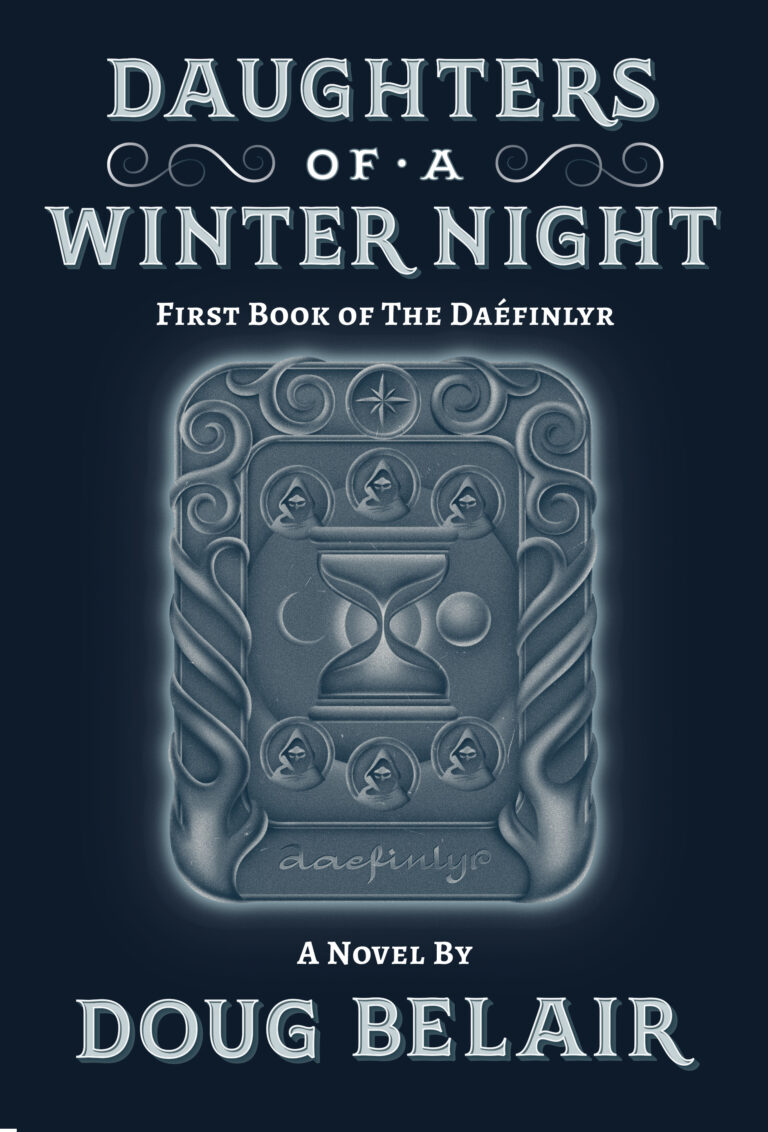

Orin d’Shardolay is a promising mage in the Order d’Shardolay, a group whose power is derived from study and control of the flow of time. More importantly, however, he’s identified by an immortal being as one of six prophesied Guardians, whose service will be necessary to preserve the very fabric of reality from unweaving.
Taking clear and unabashed inspiration from both D&D and its Tolkienian predecessors, Doug Belair’s DAUGHTERS OF A WINTER NIGHT reads like comfort food for a classic medieval fantasy audience: six middling heroes and ne’er-do-wells meet in a tavern and set out on a local mission, only to find themselves hand-picked by a demigoddess for an epic quest. The book’s greatest strength is that it nails a well-balanced tone, only occasionally leaning into the drama of high fantasy, while grounding the action in clear, lyrical description. Readers will enjoy chewing on sentences like “the seeds of dread rooted in Gaelyn’s proclamation [blossom] thick and thorny,” but they will also appreciate how the buildings in one town “[lean] into each other like drunken old men,” or how “farmhouses silvered by the moon [stand] half-hidden behind bundles of fall’s last corn.” This vivid visual imagination, with just an occasional hint of melodrama, successfully conveys the magic and the humanity of the characters and their quest.
That said, the world itself becomes less interesting over time. DAUGHTERS OF A WINTER NIGHT has enough of a well-imagined backstory to support the inevitable glossary of specialized fantasy terms, but backstory isn’t quite the same as worldbuilding. Some elements, like the doctrinal disputes between Orin’s Order and his friend Tom’s Balinian Cabal, succeed at both enriching the lore and simultaneously bearing on plot or character. Often, however, vocabulary stands in for actual storytelling. The text blunders occasionally into frustrating fantasy gobbledegook (“Orin did not need a clear mind to remember the tiny conduits Gorath used to funnel power from Ganelon to make his world of Saéthenghal—rote learning for every newly gathered. ‘My Order closed the carduyn n’ryth as part of the Narrowing,’ he said”), rather than focusing on the concrete worldbuilding. Important opportunities are missed in the scrabble to focus on magical MacGuffins. A rebellion sweeps away a forest kingdom, but the reader is left with no understanding of either the kingdom’s politics or the rebellion’s goals. Class distinctions in a port city, enforced by physical barriers and guards, are interesting but underdeveloped. As a result, the text feels like, well, exactly what it is: a very conventional story set in a very conventional Tolkienian D&D setting.
This will please readers who want a predictable, comfortable start to an epic fantasy narrative; but with its main story incomplete by the end of the book, it will be up to a sequel to provide greater interest to the plot, characters, world, or themes.
Doug Belair’s DAUGHTERS OF A WINTER NIGHT is a fun yet deeply conventional medieval fantasy, importing both the strengths and weaknesses of its genre predecessors.
~ Dan Accardi for IndieReader