
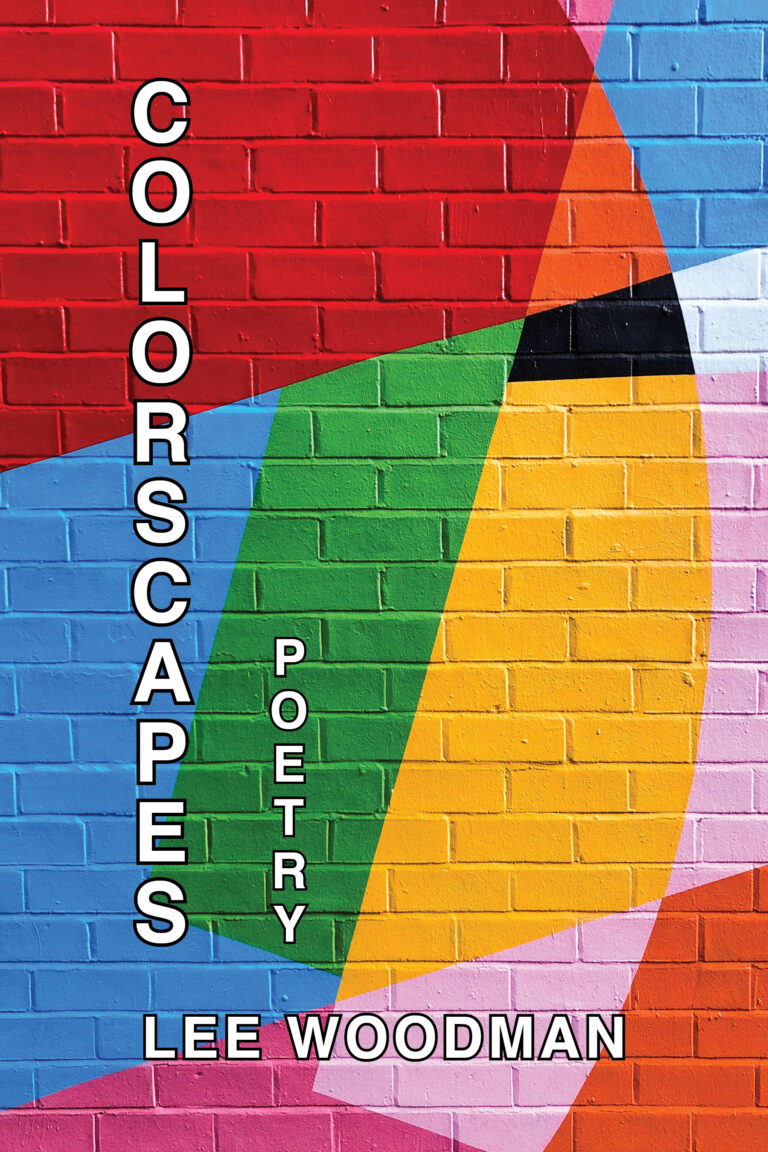

COLORSCAPES is the sixth volume in Lee Woodman’s highly acclaimed “Scapes” series. Once more the poet casts her eye on the interconnectedness between the physical and the mystical, this time focusing on color in the natural world, in the laboratory, or in the hands and minds of famous artists.
There are solid poems with on-the-nose titles such as “Black Is Not a Color,” “The Price We Pay for Yellow,” and “The Many Faces of Green,” the last of which flits from alchemists to absinthe to reveling in the wild: “Yet, picture the glory of being green / imagine three hundred shades in nature.”
Some of the very best poems in this always-captivating collection find the poet approaching the subject from more oblique angles. “Poor Brown” is a history lesson: “Mummy is a color—made from bitumen, ground bones of Egyptians / three thousand years old.” And “Shades of Anger” is a burst of tight, angular rhymes: “Broad brushstrokes of rage are red, / streaked by dark brown doomsday dread.” This poem and its companion “Tints of Anguish” were inspired by Woodman’s reading of the color theory of artist Josef Albers. As in her previous volume, Artscapes, this new collection finds Woodman often using artists and works of art as a stepping-off point as she seeks the divine amongst the earthbound.
Sometimes these poems connect with a specific painting. Vermeer’s “Girl in a Red Hat” is the focus in “The Artist and the Girl”: “She turns to look, open-mouthed, implies certain fervor / Lush blue coat, red-tipped hat, his crafty experiment.” At other times, it is the life of the artists themselves that’s uncovered, as with the close inspection of “Beheading of Saint John the Baptist” in “Caravaggio, A Story in Tenebroso.” It’s a poem of violence and shadows, including a moment of powerful alliteration hinting at the movement of a knife on skin in the stanza: “The stern enforcer’s / floodlit finger points / to command the final cut.”
Amongst all the high emotions, there are moments of levity. “PMS and CMYK, RGB and HEX” is a poem about acronyms in the world of modern color identification that ends in the poet’s exasperation: “My bandwidth is on overload / my hard drive too full.” And “Oranja Glad?” is built around a wince-inducing pun.
There are illustrations included alongside many of the poems, though (presumably for copyright reasons) the paintings that the poems reference are not included. Sometimes the imagery helps. A photograph alongside “SnowPorch” perfectly pictures the poet’s “Two wrought iron chairs / braced for the season snuggle / cloaked with puffy white armrests.” Other images are more abstract and seem unnecessary, serving only to break up the pages.
However, Woodman proves to have a true poet’s eye for uncovering new ways to look at art and rejoice in the kaleidoscope of colors that the natural world gifts anybody prepared to embrace them.
Lee Woodman’s COLORSCAPES is a vivid and vibrant collection of poems that’s easily accessible, educational, and spiritually uplifting.
~ Kent Lane for IndieReader