
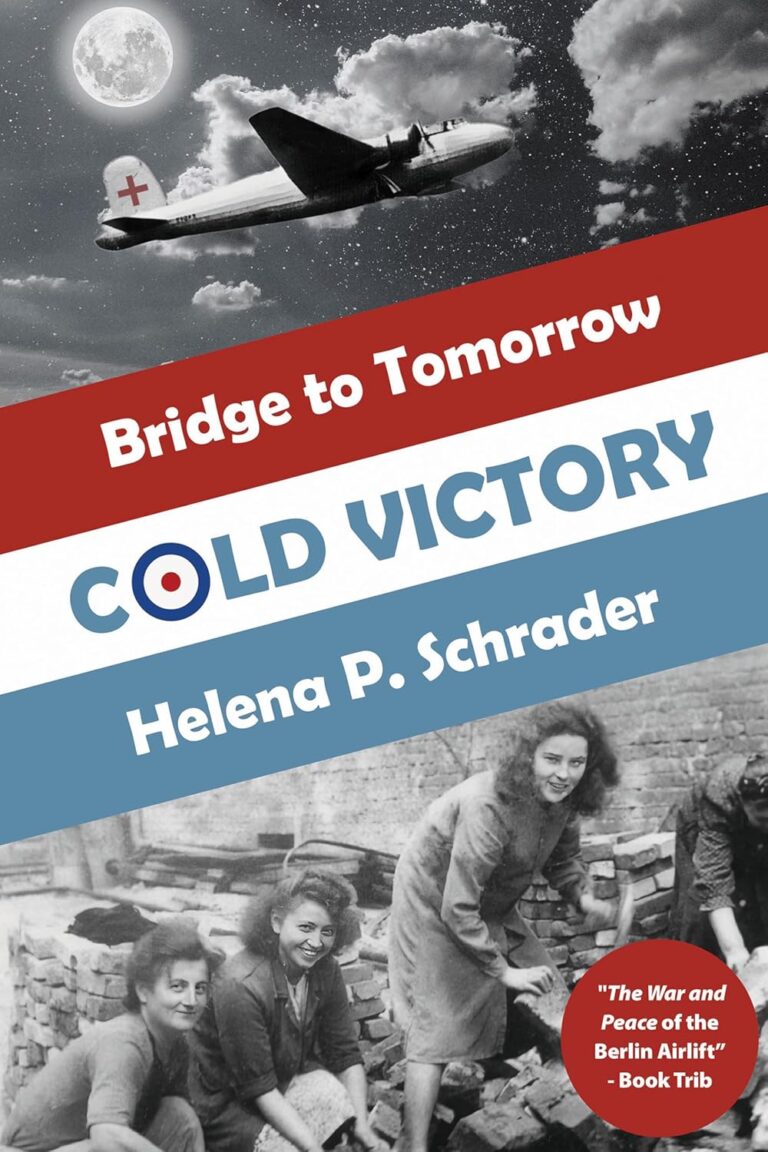

Set during the Berlin Airlift of 1948-49, Helena P. Schrader’s COLD VICTORY transports readers to a war-torn city teetering on the brink of collapse. Amid the freezing temperatures threatening some two million civilians, Wing Commander Robin Priestman is tasked with sustaining Berlin through winter while Soviet operatives do everything they can to sow distrust. Against this backdrop, Schrader weaves together multiple storylines. From a Russian spy’s dangerous double-agent work to the unexpected romance between an American pilot and a British air traffic controller, COLD VICTORY provides an intense, personal look into these pivotal pages of history.
As with the prior installments in Schrader’s Bridge of Tomorrow trilogy, COLD VICTORY is a shining example of historical fiction done right. Schrader capably balances character-driven drama with a healthy dose of political intrigue, exploring guilt, redemption, and that oh-so-fine line between justice and revenge. These are morally complex characters, each wrestling with all sorts of impossible choices that feel surprisingly resonant with our contemporary times: “‘I’ve tried to raise my concerns several times, but nobody takes responsibility for anything. It’s always somebody else’s job to fix anything. In short, it’s a shambles and,’ he paused to take a deep breath before announcing, ‘I want out.’”
Of course, the characters of COLD VICTORY exist in a very real time and place. Supported by an array of references (maps, tables, and even a brief glossary), the world-building is impeccable. Be it RAF procedures, airlift logistics, or just the day-to-day challenges of post-war occupation, the meticulous research is on constant display and always in support of the unfolding drama. Drawing on her experience as a diplomat, Schrader offers a nuanced portrait of a city caught between superpowers. In the process, she gives a voice to all sides, showing how victims can also be perpetrators, enemies can sometimes become allies, and that survival almost always requires moral compromises.
Despite its “final installment” billing, newcomers to the series will have no trouble jumping right into Schrader’s vivid, unflinching portrait of postwar Europe. A synopsis of the prior two novels certainly helps ease the way, but Cold Victory also stands firmly on its own—thanks to the character-driven narrative. While the pacing often feels more reflective than explosive, Schrader’s ability to blend personal dilemmas with geopolitical stakes makes for a consistently compelling read. As both a satisfying conclusion and an example of engaging historical fiction, COLD VICTORY is as good as it gets.
For fans of thoughtful historical fiction that values depth and insight over action-packed sensationalism, Helena P. Schrader’s COLD VICTORY stands as a poignant and satisfying conclusion to the Bridge to Tomorrow trilogy.
~James Weiskittel for IndieReader