
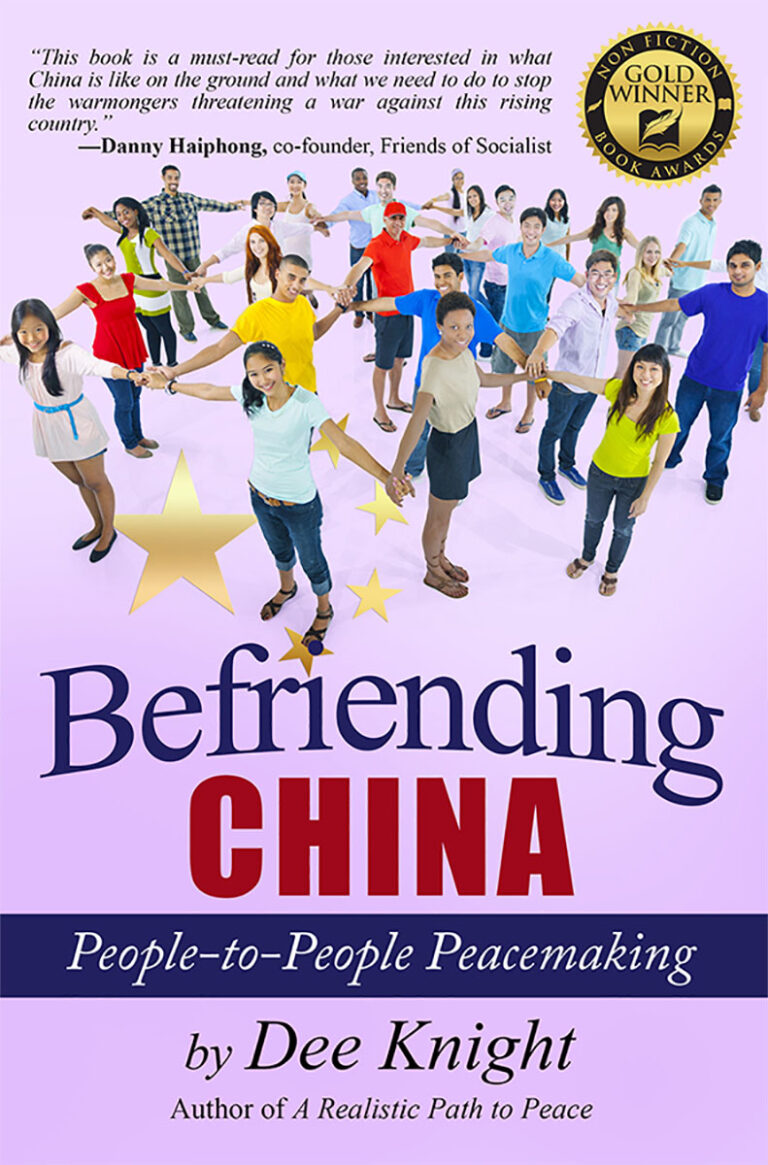

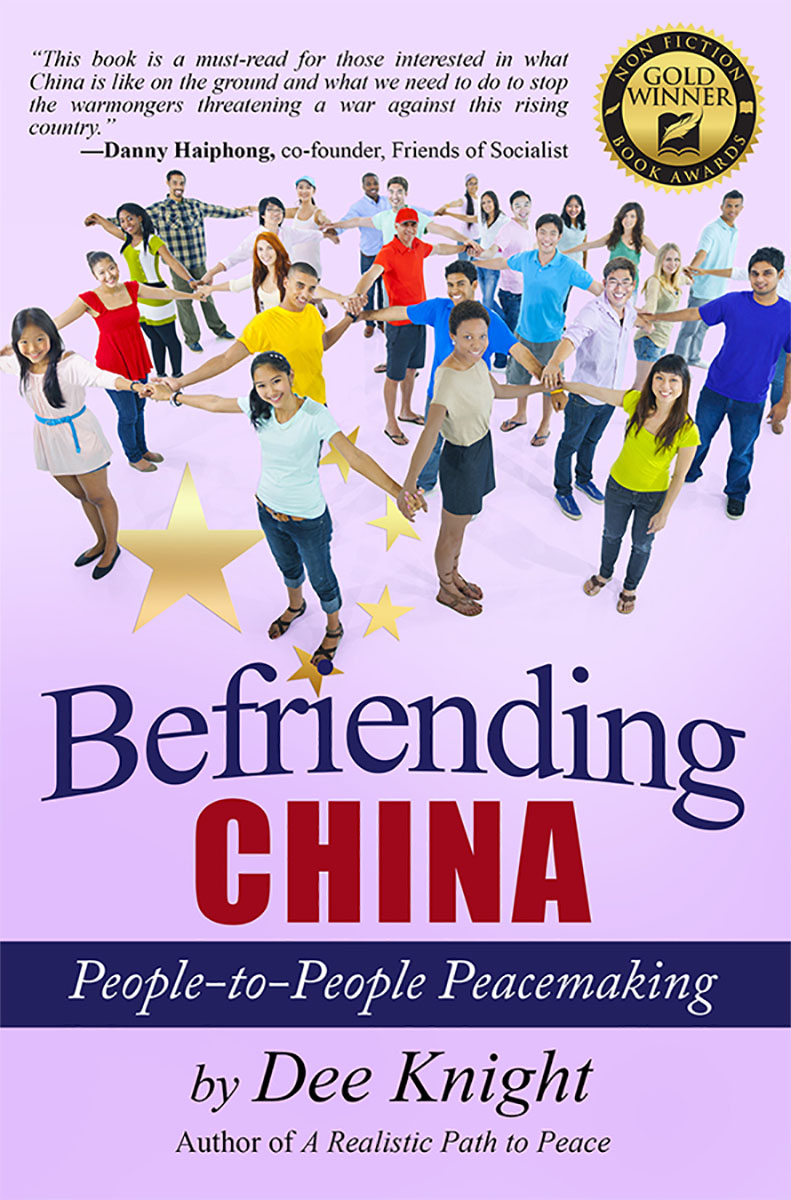
In BEFRIENDING CHINA: People-to-People Peacemaking, author Dee Knight aims to convince American readers that much of what they’ve heard about China is false, and that a strategic alliance between the two countries would benefit everyone.
Knight, an American, has taken three trips to China over the past few years. Much of the first half of BEFRIENDING CHINA reads like a travel journal, with Knight recounting his personal experiences and observations. Some of the book’s brightest passages can be found here. Knight paints an interesting picture of Chinese cities, culture, and history. One of his stated goals is to persuade readers that China is worth visiting, and he does a fairly good job of it.
As the narrative progresses, the focus shifts from travel to politics, and the book turns into a polemic. By traveling to China, Knight says, he was “able to personally debunk US anti-China propaganda, and also discover the many ways that China is not our enemy.” For instance, he dismisses claims that the Chinese government oppresses the Uyghurs, an ethnic minority in the autonomous region of Xinjiang. He also denies that the Chinese Communist Party is despotic, arguing that it ought to be viewed as democratic. Those are two of Knight’s many controversial claims, not all of which are backed up by sources. (The sources he does provide are a mixed bag, ranging from economic scholars to “YouTube analysts” and “golf instructors.”)
After a while, BEFRIENDING CHINA begins to take on an increasingly strident tone. Knight is not pleased with the way his government behaves. Long sections of the book are dedicated to denouncing US policies (domestic and foreign) and comparing them unfavorably to China’s. Granted, he makes some fair points about US military spending, the US military’s growing presence in East Asia, and the inadvisability of going to war over Taiwan.
But Knight gets carried away, becoming a little gratuitous in touting Chinese virtues. China, we’re told, has better trains, subways, and police than the US; and its response to COVID-19 was exemplary. Official statements from Chinese President Xi Jinping—a man of “charming hospitality”—are taken at face value, as is rhetoric from state media. China, Knight maintains, simply desires “common prosperity and a shared future” while the US wants war.
By relentlessly pitting the two countries against one another, Knight distracts from his book’s core idea. He would have done better to focus more on why improving relations with China would be beneficial, and less on the various ways in which China is superior to the US.
Half intriguing travelogue, half political broadside, BEFRIENDING CHINA: People-to-People Peacemaking offers a contentious take on current events. At times, Dee Knight appears to lose sight of his own thesis as he repeatedly critiques US policy and praises the Chinese government.
~ Michael Howard for IndieReader