
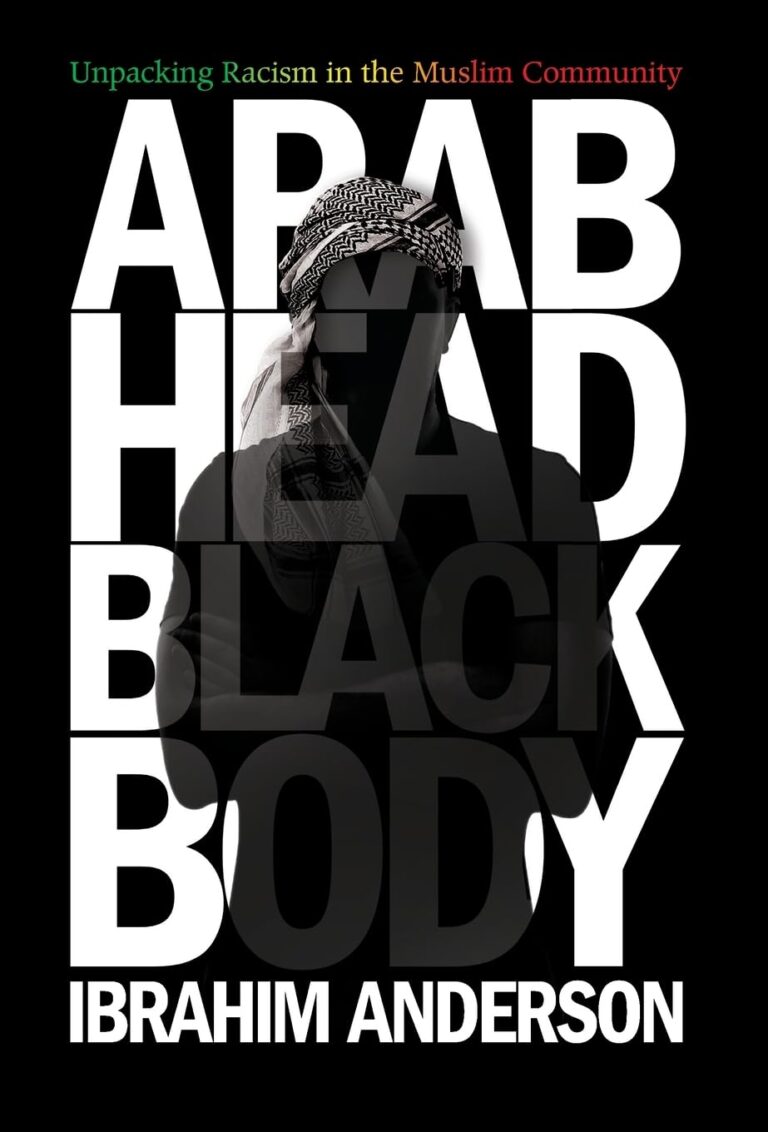

What does it mean to belong nowhere, even within the communities that claim you? Ibrahim Anderson, a Black Muslim man raised in Mississippi, found himself asking this question. Both a family member and a mosque lecturer told him he was ignoring his African American heritage. An imam admonished the lecturer's claim, assuring Anderson of his place in the community, but the damage was done. Anderson, who had identified most strongly with his Muslim faith, began to explore his African American identity.
That wound became the starting point for ARAB HEAD, BLACK BODY: Unpacking Racism in the Muslim Community, a vivid text filled with imagery that grounds the reader in both Muslim history and current-day social injustices. Anderson segues fluidly through memoir, scholarship, personal grief, and global injustice. When recalling his Mississippi childhood, he writes, "I loved riding in the back of his truck on Mississippi mornings, with the smell of the farm permeating the air," allowing the reader to see the world through his eyes. The sensory prose makes both personal memory and historical record feel lived-in and immediate.
From his childhood roots (filled with ease and self-acceptance), Anderson broadens his lens. He examines racism within Muslim communities by measuring it against the prophet's own example. The prophet was a man who adopted his servant Zaid as a son and declared that even his beloved daughter would stand equal before the law. Anderson asks why those teachings have not protected people with darker skin, and he follows that question into uncomfortable territory: family gatherings, political systems, belief structures, the trafficking networks, and Libya's active efforts to prevent African migrants from reaching Europe.
ARAB HEAD, BLACK BODY is divided into clear sections—personal history, institutional racism within Muslim spaces, and the call to action—which gives an otherwise wide-ranging argument a satisfying shape. Anderson's conclusion is to both acknowledge and challenge social injustice. He urges readers to "hear their stories and learn of the concerns they [African American people] navigate today, and let us find where we can be of service to their cause,” a call that frames anti-racism as a spiritual move towards social inclusion.
Meditative, thoughtful, reflexive, and never slow, Anderson's work is essential reading for anyone who wants to understand how racism operates across institutions, how to reclaim erased histories, or how to build a faith community that actually lives up to its founding ideals.
In ARAB HEAD, BLACK BODY: Unpacking Racism in the Muslim Community, Ibrahim Anderson has created an insightful argument on how structural racism has seeped into the Muslim community. Showing that historical racism goes unacknowledged, he argues for a new level of consciousness.
~ Nicci Attfield for Indie Reader